

Completing a GMAT practice test and checking your score is only the beginning of the process. Your score tells you where you currently stand, but a detailed score report can help you understand why you performed that way and what you should work on next.
A useful GMAT score analysis should go beyond simply counting right and wrong answers. You should review your overall and section scores, percentiles, accuracy, question difficulty, topics and sub-topics, response time, recurring mistakes, and unanswered questions. More importantly, analysing these factors across multiple mocks can help you identify patterns rather than reacting to a single bad question or test.
In this article, we will explain how to analyse a GMAT score report and use an actual GMATPoint mock score report to show how question-level data can translate into specific preparation decisions.
Download Free GMAT Sample Paper PDF
What Does Your GMAT Score Report Tell You?
Knowing your GMAT score and analysing your GMAT performance are two different things. Your Total Score tells you how you performed overall, while the detailed score report provides context around that performance.
The current GMAT has a Total Score range of 205-805. It also provides separate scores for Quantitative Reasoning, Verbal Reasoning, and Data Insights, with each section scored from 60-90. All three sections are weighted equally when calculating the Total Score.
Your Official GMAT Score Report also provides percentile rankings for the Total Score and individual sections. Beyond these headline numbers, GMAC provides detailed performance insights across areas such as section performance, question type, content domain, and time management.
During preparation, you can apply a similar analytical approach to your mock tests. A single mock gives you a snapshot of your current performance, while multiple mocks allow you to look for recurring patterns.
Score Report Metric | What It Tells You | What You Should Look For |
Total Score | Overall GMAT performance | Whether you are near your target score |
Section Scores | Performance in Quant, Verbal and Data Insights | Which sections need more attention |
Percentile | Performance relative to other test takers | How your score compares with the reference population |
Accuracy | Questions answered correctly vs incorrectly | Where errors are concentrated |
Difficulty | Difficulty level of individual mock questions | Whether errors are concentrated at a particular difficulty level |
Topic/Sub-topic | Concept tested in each question | Whether errors repeatedly occur in particular concepts |
Response Time | Time spent per question | Time sinks and pacing problems |
Unanswered Questions | Questions not completed | Whether pacing affected test completion |
The very first step to analysing a score report to build your study plan is to give a full-length GMAT mock test. It is also the first step to starting your preparation, because it can help you understand your current level, your strengths and your weaknesses.
Start today by taking a Free GMAT Mock Test by 100 Percentiler
How to Read Your GMAT Score and Percentile
Start with your Total Score, but don't stop there. Your Total Score answers the broad question: “How did I perform overall?” Your section scores then show how you performed individually in Quantitative Reasoning, Verbal Reasoning, and Data Insights.
Your percentile answers another question: “How did I perform relative to other test takers?”
A percentile should not be confused with accuracy. For example, a 75th percentile ranking means that you performed better than 75% of the reference test-taking population; it does not mean you answered 75% of the questions correctly.
When analysing a mock, you can then go deeper by looking at accuracy, question difficulty, topics, sub-topics, and response time.
Metric | Question It Answers |
Total Score | How did I perform overall? |
Section Score | How did I perform in Quant, Verbal or Data Insights? |
Percentile | How does my performance compare with other test takers? |
Accuracy | How often did I answer correctly? |
Difficulty | At what difficulty levels am I making errors? |
Response Time | How efficiently did I use my time? |
Since Quantitative Reasoning, Verbal Reasoning, and Data Insights contribute equally to the current GMAT Total Score, all three sections deserve attention during your analysis.
The more useful preparation question, however, is not simply where you lost performance but why.
Candidates can also benefit from an expert analysing their score report. GMAT Expert Mentorship offers candidates one-to-one personalised guidance from a top scorer who can help analyse your score reports in depth, share insights to improve your preparation and also help in building a structured, personalised and efficient study plan.
How to Analyse Your Performance by Section
Analyse Quantitative Reasoning, Verbal Reasoning, and Data Insights individually rather than relying only on your Total Score.
For each section, ask yourself:
- What was my sectional performance?
- What was my accuracy?
- Which topics or question types produced errors?
- Which difficulty levels caused problems?
- Did I spend disproportionately long on certain questions?
- Did my pacing deteriorate towards the end?
- Were any questions left unanswered?
The objective here is not to diagnose a weakness from every incorrect answer. Instead, you are gathering evidence that can be compared across questions and, ideally, across multiple mocks.
Response time is particularly important. Two incorrect answers may look identical in your final accuracy, but they can have very different effects on your test. Spending four or five minutes on an incorrect question can also take valuable time away from later questions.
Candidates looking to improve their scores should always use study materials that have been designed by experts and top scorers. This study materials are highly focussed and GMAT-relevant, allowing candidates to focus on the practice that actually matters.
Check out: GMAT Courses by 100 Percentiler
How to Identify Your Strengths and Weaknesses
One incorrect answer does not automatically indicate a weak topic.
Suppose you get one Percentages question wrong. That alone is not enough evidence to conclude that Percentages is a conceptual weakness. It could simply be an isolated error.
The picture becomes more meaningful when you see related errors repeatedly.
For example, if you:
- get multiple Percentages questions wrong,
- struggle with questions involving percentage-based applications,
- spend excessive time on those questions, and
- see the same pattern across multiple mocks,
then Percentages becomes an area worth investigating more closely.
This is why multiple score reports are more useful for diagnosis than one isolated mock. A single report can suggest a possible weakness; repeated evidence across mocks makes that conclusion stronger.
The same logic applies to timing. One unusually long question may not matter. Several questions taking four or five minutes, followed by an unanswered final question, tell you considerably more about your pacing.
The key principle is simple: don't diagnose a weakness from one question. Look for a pattern.
Read More: How to Fix Repeating GMAT Mistakes
How to Analyse Your GMAT Mock Test Report
Now consider an actual example from a GMATPoint mock score report.
Step 1: Look at the Question-Wise Report
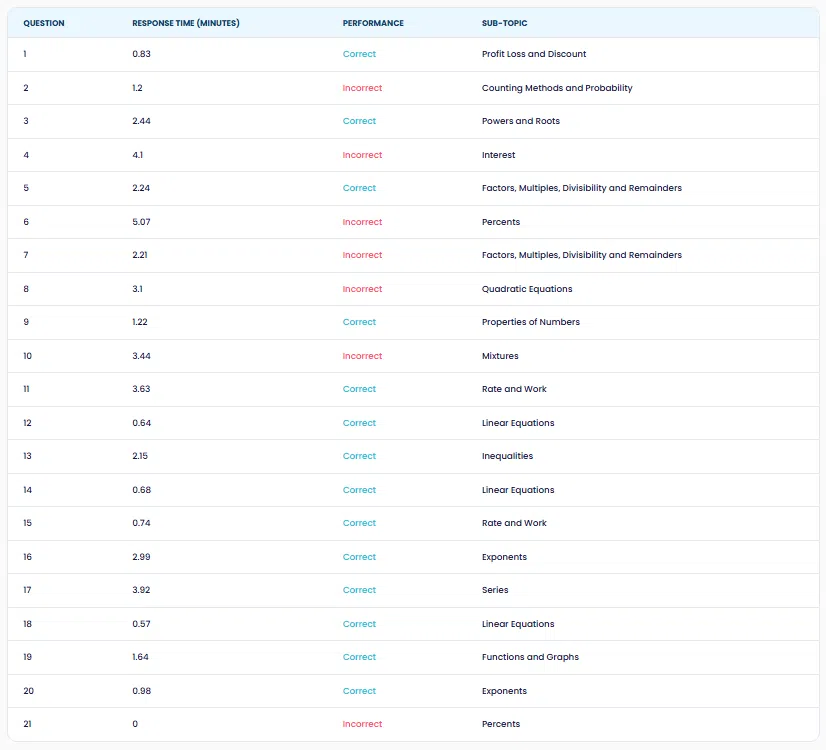
Caption: GMATPoint mock report showing question-wise response time, performance and sub-topic analysis from an anonymous student, who attempted Free GMAT Mock Test by 100 Percentiler
The report gives us several useful observations.
For Q6, the sub-topic is Percents. The student spent 5.07 minutes on the question and answered it incorrectly.
The final question, Q21, is also categorised under Percents, but it shows 0 minutes and was not successfully completed.
We should be careful with the interpretation here. Q21 does not provide the same evidence of a conceptual weakness as Q6 because the student did not have usable time to attempt it properly.
However, other questions in the report provide additional context:
Question | Sub-topic | Response Time | Result |
Q4 | Interest | 4.10 minutes | Incorrect |
Q6 | Percents | 5.07 minutes | Incorrect |
Q10 | Mixtures | 3.44 minutes | Incorrect |
Q21 | Percents | 0 minutes | Not properly attempted - Out of Time |
Interest and Mixtures can both involve percentage-based reasoning. When these results are considered alongside the incorrect Percentages question, percentage-based concepts become a possible area of weakness worth checking.
This still isn't enough to definitively conclude that the student is weak in Percentages. The next step should be to open previous mock reports and ask: Does the same pattern appear there? If Percentages and related applications repeatedly cause errors across multiple mocks, the evidence of a conceptual weakness becomes much stronger.
Start your prep today, with a Free GMAT Mock Test by 100 Percentiler
Step 2: Analyse How Much Time the Wrong Answers Cost
The same report also reveals an important timing pattern.
The student spent:
- 4.10 minutes on Q4 and got it wrong.
- 5.07 minutes on Q6 and got it wrong.
- 3.44 minutes on Q10 and got it wrong.
These are expensive mistakes. The issue is not simply that the questions were answered incorrectly; considerable test time was also spent on them.
This is where question selection becomes important.
There is no rule that says you must abandon every GMAT question in exactly three minutes. But during mock analysis, a question taking more than three minutes deserves attention.
Ask yourself:
Did I have a clear route to the answer, or was I continuing because I had already invested too much time in the question?
If you are approaching three minutes without a clear path forward, it may be better to make a decision and move on rather than allowing one question to consume time needed elsewhere.
The objective is not to automatically give up on every difficult question. It is to recognise when additional time is unlikely to produce the correct answer, or when the correct answer is no longer worth the risk.
Step 3: Check What Happened Towards the End
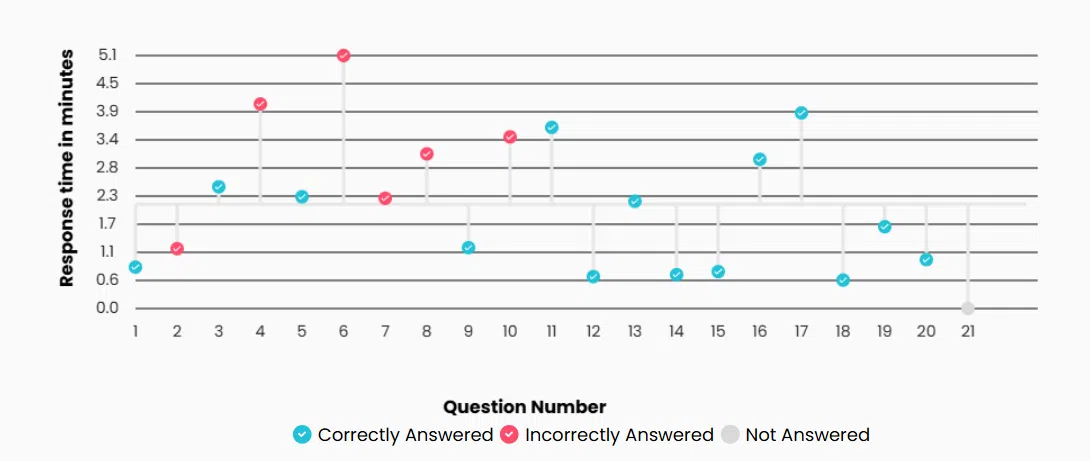
Caption: GMATPoint response-time graph showing how time spent on individual questions affected overall pacing for an anonymous student, who attempted Free GMAT Mock Test by 100 Percentiler
Now look at the broader response-time pattern.
The final question shows 0 minutes, indicating that the student did not have usable time remaining to properly attempt it.
This becomes more meaningful when combined with what happened earlier.
The student had already spent 4.10, 5.07 and 3.44 minutes on three questions that were eventually answered incorrectly. Those time sinks may have contributed to the student reaching the final question without enough time to attempt it.
This is exactly why you should not analyse each incorrect question in isolation. A mistake on Q6 can affect more than Q6. Spending excessive time there can change how much time is available for Q7, Q8 and eventually Q21.
What Does This GMAT Score Report Tell Us?
Based on this report, there are two areas the student should investigate.
Observation | What It Suggests | Next Step |
Incorrect Percentages question plus errors in Interest and Mixtures | Percentages and percentage-based applications may be a weak area | Check the same topics across multiple mocks |
4.10, 5.07 and 3.44 minutes spent on incorrect questions | Too much time may be spent on questions without a clear path to the answer | Improve the decision to disengage from time-consuming questions |
Final question received 0 minutes | Earlier time sinks may have affected section completion | Improve pacing and protect time for later questions |
The immediate action plan from this mock is therefore:
1. Practice Percentages and related applications.
Use targeted practice to strengthen the concept, but also check other mock reports to confirm that the weakness is recurring. A good resource to find these questions is GMAT Question Bank
2. Let go of questions when they become major time sinks.
If you are approaching three minutes and still don't have a clear path to the answer, consider moving on instead of investing another one or two minutes.
If you want to perform this kind of question-level analysis on your own performance, this Free GMAT Mock Test provides detailed reports that let you review areas such as performance, difficulty, response time, and topic/sub-topic.
How to Turn Your Score Analysis Into an Improvement Plan
Analysing a score report is useful only if the analysis changes what you do next. A simple process to follow is:
Diagnose → Validate → Correct → Practise → Retest
Diagnose
Use your mock report to identify a possible issue. In our example, the report suggests that percentage-based questions and time management deserve attention.
Validate
Don't immediately make major changes to your preparation based on one mock. Check previous reports. If the same problem appears repeatedly, you have stronger evidence that it needs focused work.
Correct
Once you have confirmed the problem, work directly on it. For the example above, that means revising and practising Percentages and related applications.
If your score reports indicate a clear weakness, utilising GMAT Courses by 785 Scorer can help improve your performance on those topics.
Practise
Don't immediately jump into another full-length mock. First, practise the identified area and work on the behaviour that caused the problem. In this example, that means both strengthening Percentages and becoming more disciplined about leaving questions that are consuming too much time.
Retest
Your next mock should answer a specific question:
Did the problem improve?
Check whether your accuracy on the relevant topics improves, whether you are spending less time on questions where you don't have a clear solving path, and whether you still run out of time towards the end.
Problem Identified | Action Before Next Mock | What to Check Next Time |
Possible weakness in Percentages | Revise and practise Percentages and related applications | Performance on Percentages and related questions |
Too much time spent on difficult questions | Practise pacing and time-investment decisions | Number of questions taking 3+ minutes |
Final question not attempted properly | Protect time by avoiding earlier time sinks | Whether the section is completed comfortably |
Sometimes, problems can be easy to find but hard to investigate and fix. If you aren't sure what your score reports mean for your broader preparation strategy, GMAT Expert Mentorship can help you build a preparation plan around your current performance and target score, through a one-on-one discussion with a top scorer.
Conclusion
A GMAT score report should do more than tell you whether you achieved the score you wanted. It should help you understand what happened during the test and what you need to change before the next one.
Look at your overall and section scores, but then go deeper. Examine your question-level performance, difficulty, topics, response time, and pacing. Most importantly, don't overreact to one wrong answer or one unusual mock.
Look for patterns across multiple reports.
In the example above, the report gives the student two clear next steps: practise Percentages and related applications, and become more disciplined about moving on when a question is consuming too much time.
Your next mock should then tell you whether those changes actually worked.