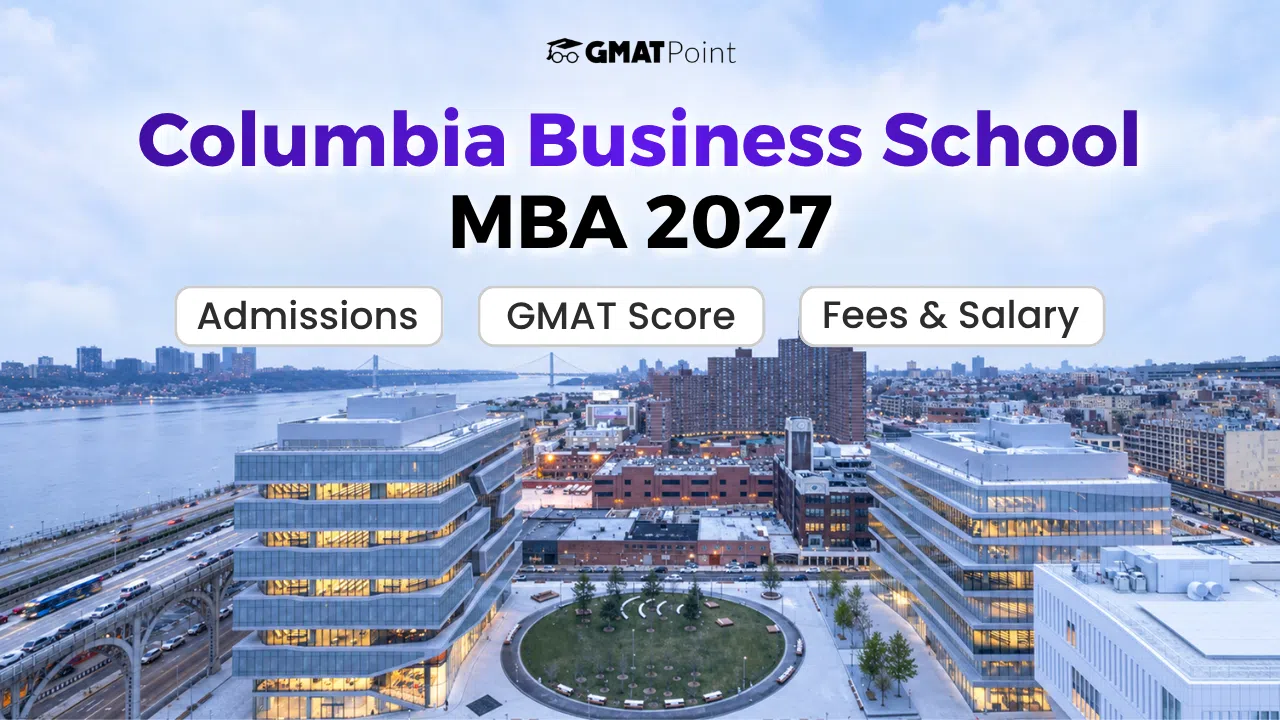

Columbia Business School (CBS), the graduate business school of Columbia University in New York City, offers a full-time MBA program with two entry options: August Entry, which takes 20 months to complete, and January Entry (J-Term), which takes 16 months.
This Columbia MBA 2027 guide covers the class profile, GMAT scores, admission requirements, application deadlines, cost of attendance, scholarships, curriculum, and employment outcomes.
Download Columbia Business School PDF
Columbia MBA GMAT Score and Admission Requirements
The Columbia MBA Class of 2026 reported an average GMAT Exam (10th Edition) score of 732, with scores ranging from 600 to 780. GMAC estimates that a score of 732 on the GMAT Exam (10th Edition) is approximately equivalent to 685 on the newer GMAT scale.
Columbia currently accepts the GMAT, GRE, and Executive Assessment (EA) for its MBA application. Test scores are considered valid for five years after the test date.
Metric | Columbia MBA Class of 2026 |
Average GMAT Exam (10th Edition) | 732 |
GMAT Exam (10th Edition) Range | 600-780 |
Approx. GMAT Equivalent of 732 on Current Scale | 685 |
Average Undergraduate GPA* | 3.6 |
*Average GPA includes students from universities using a 4.0 GPA system.
To check your current GMAT score level against the scores required for Columbia Business School and other top schools around the globe, check out: Free GMAT Mock Test by 785 Scorer
Columbia MBA Admission Requirements
Applicants to the Columbia MBA must submit:
- A bachelor's degree or equivalent from an accredited institution
- Academic transcripts
- GPA as reported on the applicant's transcript
- GMAT, GRE or Executive Assessment score
- Resume/CV
- Two short-answer questions
- Three required essays
- One recommendation for first-time applicants
- Interview, by invitation only
- A $250 non-refundable application fee
Columbia does not state a minimum work-experience requirement for the full-time MBA. Interviews are conducted by invitation only and cannot be requested by applicants.
Columbia Business School generally requires competitive GMAT scores. To improve your GMAT score, you should use study materials designed by experts and top-scorers.
Check out: GMAT Courses by 785 Scorer
Columbia MBA Essays
Columbia requires two short-answer questions and three essays. The second short-answer question differs between August Entry and January Entry. Essay 2 also differs between the two entry options.
Short Answer Question 1 — 50 characters maximum
What is your immediate post-MBA professional goal?
Short Answer Question 2 — August Entry — 50 characters maximum
How do you plan to spend the summer after the first year of the MBA? If in an internship, please include target industry(ies) and/or function(s). If you plan to work on your own venture, please indicate a focus of business.
Short Answer Question 2 — January Entry — 50 characters maximum
Why do you prefer the January-entry term?
Essay 1 — 500 words
Through your resume and recommendation, we have a clear sense of your professional path to date. What are your career goals over the next three to five years and what is your long-term dream job?
Essay 2 — 250 words
The Phillips Pathway for Inclusive Leadership (PPIL) is a co-curricular program designed to provide students with the skills and strategies necessary to become inclusive leaders. Through PPIL, students focus on five essential inclusive leadership skills: mitigating bias and prejudice, managing intercultural dialogue, addressing systemic inequity, understanding identity and perspective taking, and creating an inclusive environment.
August Entry Applicants
August Entry applicants may choose one of the following two options:
Option 1: Describe a situation in which you utilized one of the five skills emphasized by the Phillips Pathway for Inclusive Leadership. Which skill did you use, and what actions did you take? What was the outcome?
Option 2: Please share a specific example of how you made a team more collaborative, more inclusive or fostered a greater sense of community within an organization.
January Entry Applicants
Describe a situation in which you utilized one of the five skills emphasized by the Phillips Pathway for Inclusive Leadership. Which skill did you use, and what actions did you take? What was the outcome?
Essay 3 — 250 words
We believe Columbia Business School is a special place with a collaborative learning environment in which students feel a sense of belonging, agency, and partnership--academically, culturally, and professionally.
How would you co-create your optimal MBA experience at CBS? Please be specific.
Optional Essay — 500 words maximum
If you wish to provide further information or additional context around your application to the Admissions Committee, please upload a brief explanation of any areas of concern in your academic record or personal history. This does not need to be a formal essay. You may submit bullet points.
To get personalised guidance on your essays and applications from experts and top scorers, check out: GMAT Expert Mentorship
Columbia MBA Class Profile
The Columbia MBA Class of 2026 has 972 students, consisting of 734 August Entry and 238 January Entry students. Women make up 44% of the class, while international students account for 46%. The average undergraduate GPA is 3.6, and the average work experience is five years. The middle 80% of students have between three and eight years of work experience.
Metric | Columbia MBA Class of 2026 |
Applications | 7,487 |
Total Enrolled | 972 |
August Entry | 734 |
January Entry | 238 |
Women | 44% |
International Students | 46% |
Average Undergraduate GPA* | 3.6 |
Average Work Experience | 5 years |
Middle 80% Work Experience | 3-8 years |
Students with at least 1 year of work experience | 99% |
*The average GPA is based on a 4.0 scale.
Undergraduate Background
Students in the Columbia MBA Class of 2026 come from a variety of academic backgrounds. Business is the most common undergraduate major at 30%, followed by Economics at 18% and Engineering at 16%.
Undergraduate Major | Share of Columbia MBA Class of 2026 |
Business | 30% |
Economics | 18% |
Engineering | 16% |
Social Sciences | 13% |
Sciences | 10% |
Other / Not Individually Disclosed | 13% |
Pre-MBA Industries
Before enrolling at Columbia, students worked across a wide range of industries. Financial Services and Consulting were the two largest pre-MBA industries, together accounting for 55% of the Class of 2026, at 30% and 25%, respectively. Technology represented 13% of the class, while Marketing/Media accounted for another 10%.
Pre-MBA Industry | Share of Columbia MBA Class of 2026 |
Financial Services | 30% |
Consulting | 25% |
Technology | 13% |
Marketing / Media | 10% |
Other / Not Individually Disclosed | 22% |
Columbia MBA Acceptance Rate
Columbia's published Class of 2026 profile provides figures for applications and enrollment but does not provide the admissions and yield data required to calculate an official acceptance rate. The 7,487 applications and 972 enrolled students should therefore not be used to derive a Columbia MBA acceptance rate, since enrollment is not the same as the number of applicants admitted.
While the profile and background are extremely difficult to change to suit your application, a strong GMAT score is much more achievable in a short amount of time, by using study materials curated by experts and top scorers.
Check out: GMAT Courses by 785 Scorer
Columbia MBA Application Deadlines 2027
The application process at Columbia Business School varies for August Entry and January Entry applicants, so applicants should follow the dates specific to their intended entry option. Applicants seeking priority consideration for institutional funding should apply by Round 1 or Round 2 for August 2027 Entry.
August 2027 Entry
Round | Application Deadline | Interview Decision | Final Decision |
Round 1 | September 9, 2026, 12 PM ET | By November 2, 2026 | December 14, 2026 |
Round 2 | January 5, 2027, 12 PM ET | By February 17, 2027 | March 24, 2027 |
Round 3 | March 29, 2027, 12 PM ET | By April 30, 2027 | May 12, 2027 |
January 2027 Entry
Round | Application Deadline | Interview Decisions | Final Decision |
Round 1 | June 17, 2026, 12 PM ET | Rolling | Ongoing; no later than July 31, 2026 |
Round 2 | August 13, 2026, 12 PM ET | Rolling | Ongoing; no later than October 1, 2026 |
Round 2 Extended | September 1, 2026, 12 PM ET | Rolling | Ongoing |
The published application deadline for January 2027 Entry has now passed, with the extended deadline closing on September 1, 2026. The intake is no longer accepting applications, while decisions for applicable rounds may continue according to Columbia's published timeline.
Columbia MBA Fees and Cost of Attendance
The cost of attendance at Columbia Business School consists of tuition, mandatory fees, health insurance, books and supplies, housing, food, transportation, and other personal expenses. Columbia's published first-year cost of attendance for August Entry in the 2026-27 academic year is $143,030.
Expense | First-Year Cost 2026-27 | Estimated 2-Year Cost* |
Tuition | $93,908 | $187,816 |
Mandatory Fees | $6,783 | $13,461 |
Health Insurance | $5,823 | $11,646 |
Books & Supplies | $1,290 | $2,580 |
Food & Housing | $30,231 | $60,462 |
Personal Expenses | $3,636 | $7,272 |
Transportation | $1,359 | $2,718 |
Total | $143,030 | $285,955 |
*The estimated two-year cost is provided for reference based on Columbia Business School's currently published 2026-27 cost figures.
Columbia MBA Scholarships
Columbia Business School provides partial-tuition scholarships to both domestic and international MBA candidates. Scholarships are primarily need-based, although certain named scholarships include a merit component or donor-designated criteria.
Typical need-based awards range from $10,000 to $30,000, with an average award of approximately $20,000. About 50% of applicants for need-based scholarships receive an award, and these awards are generally renewed for the second year.
Applicants invited to interview for August Entry gain access to the need-based scholarship application. The scholarship application is generally due two weeks after the interview invitation.
Columbia MBA Employment Outcomes and Salary
All employment and compensation figures in this section are for the Columbia MBA Class of 2025 and come from Columbia Business School's 2025 Employment Report.
Columbia Business School MBA Salary and Employment Outcomes
For the Class of 2025, 92% received job offers within three months, while 90% had accepted offers within the same period. By the end of the year, these figures had reached 96% and 95%, respectively.
The median base salary was $175,000, while the highest reported base salary was $450,000. The median signing bonus was $30,000, and median other guaranteed compensation was $32,000.
Metric | Columbia MBA Class of 2025 |
Job Offers Within 3 Months | 92% |
Job Acceptances Within 3 Months | 90% |
End-of-Year Job Offers | 96% |
End-of-Year Job Acceptances | 95% |
Organizations Employing Graduates | 346 |
Employers Hiring CBS MBAs for the First Time | 200+ |
Median Base Salary | $175,000 |
Highest Reported Base Salary | $450,000 |
Median Signing Bonus | $30,000 |
Highest Signing Bonus | $218,000 |
Median Other Guaranteed Compensation | $32,000 |
Highest Other Guaranteed Compensation | $205,000 |
Employment by Industry
Financial Services and Consulting accounted for the largest shares of Class of 2025 offers, together representing 68.6% of offers.
Industry | Share of Offers - Class of 2025 |
Financial Services | 35.4% |
Consulting | 33.2% |
Technology | 10.2% |
Other | 4.2% |
Real Estate | 3.8% |
Consumer Products | 3.7% |
Healthcare | 2.9% |
Media, Entertainment & Sports | 1.9% |
Manufacturing | 1.8% |
Education / Government / Non-Profit | 1.2% |
Retail | 0.3% |
The breakdown within Financial Services is as follows:
Financial Services Sector | Share of Offers - Class of 2025 |
Investment Banking | 17.1% |
Investment Management | 6.8% |
Private Equity | 4.5% |
Venture Capital | 2.5% |
Consumer Finance & Analytics | 1.5% |
Fintech | 1.4% |
Other Finance | 3.0% |
Employment by Function
Consulting and Finance were also the two largest functional areas, accounting for 40.1% and 37.6% of offers, respectively.
Function | Share of Offers - Class of 2025 |
Consulting | 40.1% |
Finance | 37.6% |
Marketing | 10.3% |
Management | 5.7% |
Real Estate | 3.7% |
Other Functions | 2.7% |
Employment by Region
The United States accounted for 82% of Class of 2025 offers, making it the largest employment region. Columbia reports median and highest base salaries by region rather than average base salaries.
Region | Share of Offers - Class of 2025 | Median Base Salary | Highest Base Salary |
United States | 82% | $175,000 | $450,000 |
Asia | 7% | $95,976 | $350,000 |
Central & South America | 5% | $89,442 | $300,000 |
Europe | 4% | $112,234 | $170,000 |
Africa & Middle East | 2% | $175,000 | $340,000 |
Top Companies Hiring MBAs From Columbia Business School
Employer | New Hires | Total Hires* |
Boston Consulting Group | 51 | 62 |
McKinsey & Company | 36 | 62 |
JPMorgan Chase | 22 | 22 |
Amazon | 21 | 21 |
PwC | 18 | 24 |
Bain & Company | 17 | 33 |
Deloitte | 14 | 23 |
Goldman Sachs | 11 | 11 |
Bank of America | 10 | 11 |
*Total hires include graduates returning to sponsoring or previous employers. “New Hires” represents graduates entering a new employment relationship with the employer.
The Class of 2025 employment statistics show particularly strong representation in Consulting and Financial Services, which together accounted for more than two-thirds of offers. Columbia's New York City location also provides proximity to a major global business and financial centre and to employers across Financial Services and other industries. However, location itself does not guarantee employment outcomes.
Columbia MBA Curriculum and Student Experience
The Columbia MBA requires 60 graduate-level credits, including 18 credits of required core coursework and at least 42 elective credits. The MBA is completed over four academic terms, with students generally taking around 15 credits per term.
Transfer credits from other colleges or universities cannot be applied toward the Columbia MBA. Students with sufficient prior knowledge may be eligible for exemption from certain core courses and can replace those courses with electives.
August Entry vs January Entry
The August Entry program takes 20 months to complete, while the January Entry program takes 16 months. Approximately 70% of Columbia Full-Time MBA students enter in August and 30% enter in January. August Entry includes the traditional summer internship period after the first year, while January Entry students continue their studies through the summer.
In the fall of the second year, the two cohorts merge, after which students have access to the same elective curriculum, career-management resources, and student organizations. January Entry can therefore be particularly relevant to applicants who do not need a traditional summer internship, including candidates returning to an established industry or pursuing entrepreneurial plans.
Conclusion
Columbia Business School's full-time MBA provides flexibility through its August Entry and January Entry options. Its New York City location and the strong representation of Finance and Consulting in the Class of 2025 employment outcomes may be particularly relevant to applicants targeting these sectors.
For the Class of 2025, Columbia reported a median base salary of $175,000. Applicants should consider their GMAT profile, career objectives, overall cost, application deadlines, and whether they want or need a traditional summer internship when deciding between the August and January Entry options.






![GMAT Ratio & Proportion Formulas | Ratio & Proportion Cheat Sheet [PDF]](https://gmatpoint.com/media/73.webp "GMAT Ratio & Proportion Formulas | Ratio & Proportion Cheat Sheet [PDF]")