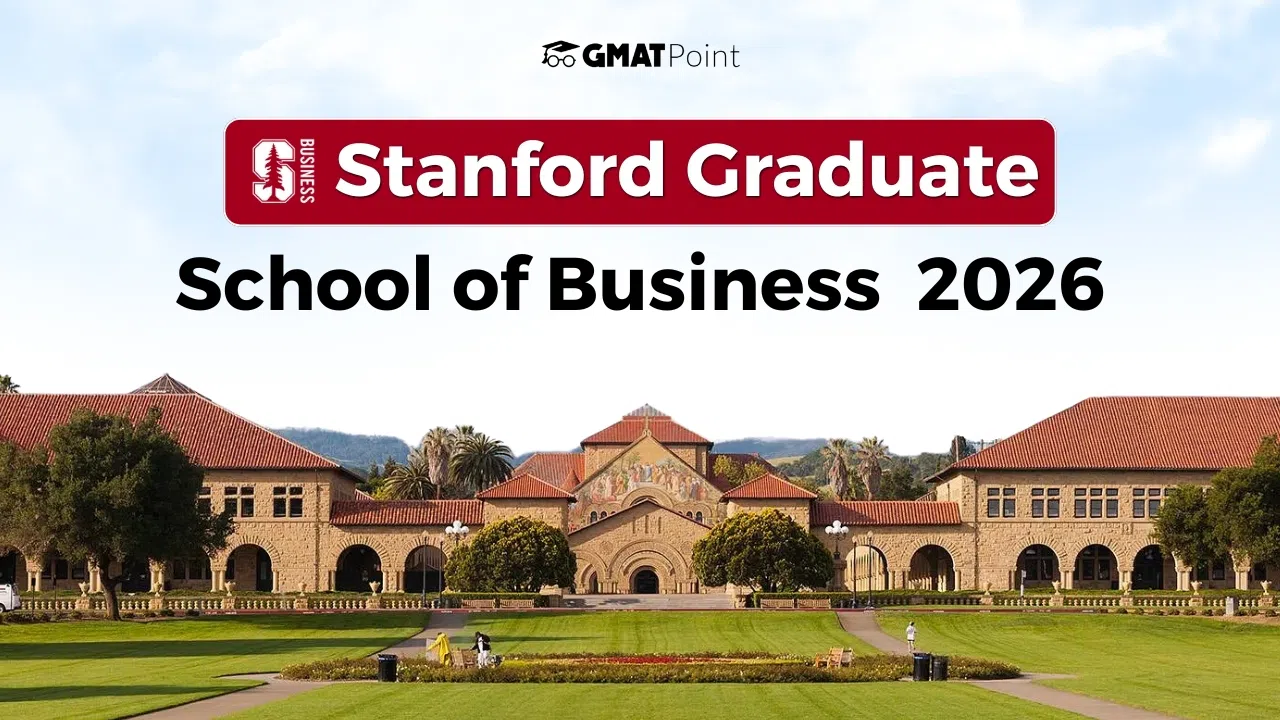
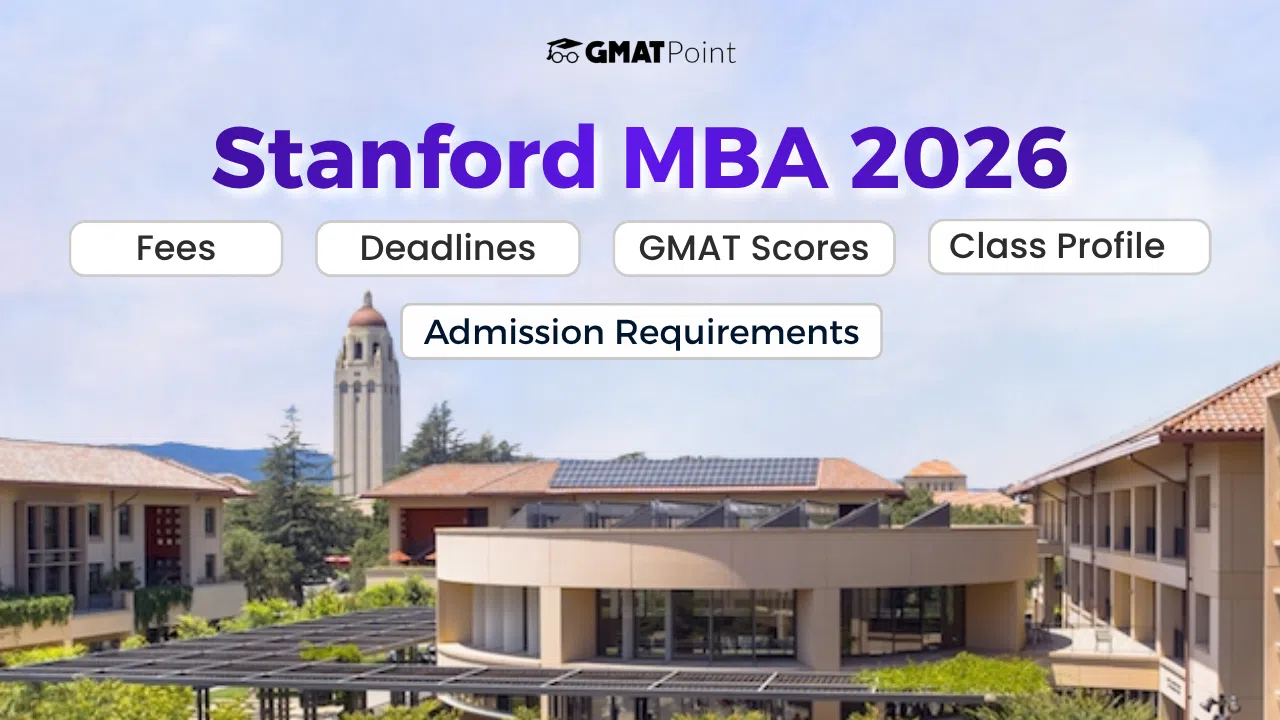

The Stanford Graduate School of Business (Stanford GSB) offers a two-year MBA program designed for students seeking to develop their leadership abilities, broaden their business knowledge, and create meaningful impact. Stanford MBA admissions consider the complete application, including academic performance, professional experience, leadership potential, personal qualities, and the impact applicants have made.
This guide covers the key information prospective applicants need to know about the Stanford MBA, including the latest class profile, GMAT and GRE scores, admission requirements, 2026-27 application deadlines, fees, scholarships, essays, and employment outcomes.
Stanford Graduate School of Business PDF
Stanford MBA Class Profile 2026
The latest available Stanford GSB class profile is for the MBA Class of 2027. The class has 434 enrolled students and represents a diverse group of candidates from different academic, professional, and international backgrounds. The class profile also provides useful context on the academic and professional experience of students entering Stanford GSB.
Parameter | Data |
Applications Received | 7,259 |
Enrolled Students | 434 |
Acceptance Rate | 6.8% |
Average Undergraduate GPA* | 3.76 |
Average Work Experience | 5.3 years |
Work Experience Range | 0-16 years |
Women | 45% |
International Students | 38% |
Countries Represented | 64 |
First-Generation College Students | 13% |
*Average GPA includes students from universities using a 4.0 GPA system.
Stanford GSB does not follow a fixed academic or professional profile for admission. The school evaluates applications holistically, with particular attention to intellectual vitality, leadership potential, personal qualities, and the impact an applicant has created.
One of the strongest profile metrics that you can use to immediately improve your application is through a strong GMAT score. To improve your GMAT score, check out: GMAT Courses by 100 Percentiler
Stanford MBA Pre-MBA Industries
The Stanford MBA Class of 2027 includes students with professional experience across a wide range of industries and organizations. Consulting is the most represented pre-MBA industry, followed by Investment Management/Private Equity/Venture Capital and Technology.
Pre-MBA Industry | Percentage of Class |
Consulting | 20% |
Investment Management / Private Equity / Venture Capital | 17% |
Technology | 15% |
Students in the Class of 2027 have worked across 294 organizations, reflecting the range of professional backgrounds represented in the incoming Stanford MBA class.
Stanford MBA GMAT/GRE Requirements and Test Scores
Stanford GSB does not have a minimum GMAT or GRE score requirement. Test scores are considered as one part of the overall application rather than as a standalone cut-off.
The following test-score figures are reported for the Stanford MBA Class of 2027:
Test | Average Score | Range |
GMAT (10th Edition) | 738 | 540-790 |
GMAT Focus Edition | 689 | 615-785 |
GRE Quantitative | 164 | 151-170 |
GRE Verbal | 164 | 150-170 |
Stanford also has a specific policy for applicants who have taken the GMAT or GRE more than once. Applicants should report the scores from one examination, with the scores coming from the same testing session. Stanford does not average scores across multiple testing sessions. Therefore, applicants should focus on submitting the test attempt that presents their strongest overall performance rather than relying on combining section scores from different attempts.
Applicants preparing for the GMAT can use realistic practice tests to assess their current preparation level. Check out: Free GMAT Mock Test by 785 scorer
Stanford MBA Application Requirements and Deadlines 2026-27
Stanford GSB follows a three-round application process for the 2026-27 admissions cycle. Applicants should submit their applications in the round that best matches their level of preparation rather than rushing to apply simply because an earlier deadline is available.
Stanford MBA Application Requirements
Applicants need to provide the following as part of their Stanford MBA application:
- Undergraduate degree and academic transcripts
- GMAT or GRE scores
- Resume
- Professional experience and employment information
- Two recommendation letters
- MBA essays
- Personal information, activities, and awards
- Application fee of $275
- English-language proficiency test scores, where applicable
- Interview, if invited
Stanford GSB uses a holistic admissions process, so there is no single component that determines an applicant's admission decision. The school considers factors including intellectual vitality, leadership potential, personal qualities, experiences, accomplishments, perspectives, values, and aspirations.
Applicants whose undergraduate education was not conducted entirely in English may also need to demonstrate English-language proficiency through an accepted test such as TOEFL, IELTS, or PTE, subject to Stanford's stated exemptions.
Stanford MBA Application Deadlines 2026-27
The Stanford MBA application deadlines for the 2026-27 admissions cycle are:
Application Round | Deadline | Decision Notification |
Round 1 | September 9, 2026 | December 9, 2026 |
Round 2 | January 6, 2027 | April 1, 2027 |
Round 3 | April 7, 2027 | May 27, 2027 |
Applications are due by 4:00 PM Pacific Time on the respective deadline date. Stanford has three application rounds, allowing candidates to choose when to apply based on their preparation and overall profile.
To get personalised guidance on which round to apply, when to attempt GMAT and overall application, check out: GMAT Mentorship
Stanford MBA Fees, Cost of Attendance and Scholarships
The cost of pursuing an MBA at Stanford GSB includes considerably more than tuition. Students should account for housing, living expenses, medical insurance, and other fees when estimating the total cost of the program.
Stanford MBA Cost of Attendance
Stanford's official 2026-27 first-year cost of attendance estimates are as follows:
Expense | Single Student | Married Student |
Tuition | $89,187 | $89,187 |
Living Expenses | $19,950 | $36,972 |
Housing | $22,152 | $33,015 |
Medical Insurance | $8,808 | $8,808 |
Health Fee | $843 | $843 |
Total Cost of Attendance | $140,940 | $168,825 |
These figures show why applicants should consider the complete Stanford MBA cost of attendance rather than looking only at the tuition fee. The cost estimates vary depending on a student's circumstances, especially whether the student is attending alone or with a spouse.
Stanford MBA Scholarships and Financial Aid
Stanford GSB primarily provides need-based fellowships rather than merit-based scholarships. Financial aid is available to MBA students who demonstrate financial need, regardless of citizenship.
For the Class of 2026, Stanford reported that the average GSB fellowship was approximately $50,000 per year, or $100,000 over two years.
Stanford also follows a need-blind admissions policy. This means an applicant's ability to pay for the MBA does not influence the admissions decision. Financial need is considered separately when determining fellowship support.
Stanford MBA Employment Report: Salary and Career Outcomes
Stanford MBA graduates pursue careers across technology, finance, consulting, healthcare, entrepreneurship, and several other sectors. The school's employment outcomes also reflect the strong entrepreneurial orientation of the Stanford GSB community.
Stanford MBA Salary and Career Outcomes
According to Stanford's employment data for the Class of 2025:
Metric | Outcome |
Median Base Salary | $185,000 |
Job Seekers Receiving Offers Within 3 Months | 90% |
Job Seekers Accepting Offers Within 3 Months | 81% |
Graduates Pursuing Their Own Ventures | 16% |
The 90% and 81% figures refer to job seekers, rather than all graduating students. Stanford also reports that 16% of the Class of 2025 pursued their own ventures, highlighting the strong culture of entrepreneurship within the Stanford MBA ecosystem.
Stanford MBA Employment by Industry
Technology, finance, and consulting are among the leading industries for Stanford MBA graduates. Healthcare and other sectors also account for a share of graduate employment.
According to Stanford GSB's 2025 MBA Employment Report, Finance offered the highest median base salary among the major employment industries at $200,000, followed by Technology at $185,000 and Consulting at $190,000. The report also provides average base salaries for each industry.
Industry | Percentage of Job Seekers | Median Base Salary | Average Base Salary |
Finance | 33% | $200,000 | $204,104 |
Technology | 35% | $185,000 | $192,394 |
Consulting | 11% | $190,000 | $187,765 |
Healthcare | 5% | $160,000 | $183,000 |
Energy | 4% | $175,000 | $169,625 |
The compensation figures are based on salary information reported by graduates who accepted full-time employment. Stanford's report notes that compensation data is student-reported and that base salary excludes bonuses, commissions, benefits, and perquisites.
Within finance, Stanford's report also breaks compensation down into areas such as Private Equity, Investment Management & Hedge Funds, Venture Capital, Investment Banking, and Other Finance. This provides a more detailed view of compensation across finance-related career paths.
Stanford MBA Employment by Location
A significant share of Stanford MBA graduates pursue careers in the United States, with the Western United States representing an important employment region. Stanford's location in the Silicon Valley ecosystem provides students with access to a major technology and entrepreneurship hub.
Stanford GSB's 2025 Employment Report also provides a geographic breakdown of where graduates accepting employment took up jobs. The West was the most popular US region, accounting for 55% of placements, followed by the Northeast at 28%. Overall, 96% of graduates who found employment took positions in the United States.
Location | Percentage of Employment Acceptances |
West | 55% |
Northeast | 28% |
Southwest | 6% |
Mid-Atlantic | 3% |
Midwest | 2% |
South | 1% |
Asia, Australia & Oceania | 2% |
Europe | <1% |
Latin America, Caribbean & South America | 1% |
Africa | <1% |
Stanford's employment report shows a strong concentration of graduates in the Western United States, which includes the region where Stanford GSB is located. The Northeast is the second-largest destination for Stanford MBA graduates, while smaller proportions of graduates take positions in other US regions and international markets.
Stanford MBA Essays and Application Process
Stanford GSB's application essays give applicants an opportunity to explain their motivations, values, experiences, and reasons for pursuing an MBA at Stanford. The essays are intended to provide insight into the applicant beyond academic scores and professional achievements.
Stanford MBA Essay Questions
For the Stanford MBA application, the two personal essay questions are:
Essay 1: "What matters most to you, and why?"
Word limit: 650 words
This essay gives applicants an opportunity to discuss the values, experiences, and motivations that have shaped them. The response should provide a genuine picture of what matters to the applicant rather than simply listing professional accomplishments.
Essay 2: "Why Stanford for you?"
Word limit: 350 words
This essay asks applicants to explain why Stanford GSB is the right fit for their goals and experiences. Candidates should connect their own aspirations and background with the opportunities and learning environment offered by Stanford.
Stanford also provides an optional short-answer question in the application, giving applicants an additional opportunity to share more about their contributions.
Preparing a Strong Stanford MBA Application
A strong Stanford MBA application should present a coherent picture of the candidate's academic preparation, professional experience, leadership, motivations, and future goals. Applicants should focus on:
- GMAT/GRE preparation: Aim for a strong test performance while maintaining a solid overall academic profile.
- Career objectives: Clearly explain how an MBA fits into your short- and long-term career plans.
- Leadership examples: Highlight situations where you led, influenced others, solved meaningful problems, or created impact.
- Personal storytelling: Ensure that the essays reflect genuine experiences, values, and motivations rather than simply repeating information from the resume.
The best way to improve your GMAT score is to do so by using courses designed by industry experts and top-scorers. Check out: GMAT Courses by 100 Percentiler
Another aspect of effective preparation is guidance building a structured study plan that is specific to your goals, current score, target score, time available for study and many other factors. To get guidance on how to improve, check out: GMAT Mentorship
Why Choose Stanford GSB MBA?
Stanford GSB combines leadership development, entrepreneurship, and a collaborative learning environment. Its location in Silicon Valley also places students close to one of the world's strongest technology and startup ecosystems.
Silicon Valley Advantage
Stanford's location provides students with proximity to technology companies, start-ups, investors, and other organisations operating within the Silicon Valley ecosystem. This can be particularly relevant for students interested in technology, entrepreneurship, and innovation.
Leadership Development
Leadership is a central part of the Stanford MBA experience. The program encourages students to reflect on their values, strengths, and leadership styles while developing the ability to lead others and create positive change.
Community and Learning Experience
The Stanford MBA Class of 2027 has 434 enrolled students, creating an MBA cohort with students from varied academic, professional, and international backgrounds. This diversity contributes to peer learning and collaboration inside and outside the classroom.
Stanford also has a strong entrepreneurial ecosystem. Stanford GSB states that its alumni launch 350+ companies each year, demonstrating the broader entrepreneurial environment associated with the school.
Overall, the Stanford MBA offers a combination of rigorous business education, leadership development, entrepreneurship exposure, and access to a global network. For applicants considering Stanford GSB, understanding the school's application requirements, deadlines, class profile, costs, and career outcomes can help them prepare a more informed application.
Stanford MBA 2026: Conclusion
The Stanford MBA is a strong option for candidates looking to combine rigorous business education with leadership development, entrepreneurship, and access to a diverse global community. The latest Class of 2027 profile highlights the academic and professional strength of the incoming cohort, while Stanford's holistic admissions process means that academic scores and work experience are considered alongside leadership, personal qualities, values, and demonstrated impact.
For prospective applicants, understanding the Stanford MBA deadlines, GMAT/GRE expectations, application requirements, fees, financial aid, essays, and career outcomes is essential before applying. Candidates should aim to submit their application when their overall profile is strongest and use the available time to build a compelling application that clearly communicates their experiences, motivations, leadership potential, and future goals.