
Join Our GMAT Preparation Group
Prep with like-minded aspirants; Get access to free daily tests and study material.
Educational materials for GMAT preparation
Join Our GMAT Preparation Group
Prep with like-minded aspirants; Get access to free daily tests and study material.
Created by GMAT FE 100%iler
Sharpen your reasoning across two of GMAT Focus Edition's most logic-intensive sections.

Exclusively made for GMAT FE Data Insights & Verbal sections - Package valid for 3 months (90 days)
Sharpen your reasoning across two of GMAT Focus Edition's most logic-intensive sections. This module pairs structured verbal instruction with expert data-reasoning content, giving you the frameworks, practice, and feedback to push both scores higher.

55+ Comprehensive Concept Videos
15 DI + 40+ VR concept videos, focused on the reasoning patterns GMAT tests repeatedly.

50+ Tests | 250+ Questions
Concept checks after every video to test and reinforce understanding in real time.

610+ DI | 900+ VR Practice Questions
Topic-wise question banks for structured, progressive practice across both sections.
Experience the most comprehensive and effective GMAT preparation with cutting-edge technology and expert guidance



Learn from the best in the industry - our instructors are top scorers with years of teaching experience.

GMAT FE 785 Scorer, 100%iler
10+ years of teaching experience
Expert in Verbal Reasoning with a proven track record of helping students achieve 700+ scores.

5 Time CAT 100%iler
10+ years of teaching experience
Specialist in Quant and Data Insights with exceptional teaching methodology.
Evaluate the problem, and the two statements - labelled (1) and (2) - that contain certain data or information. Using the given statements, decide whether the information provided is sufficient to answer the question.
An ice cream manufacturer made a two-layer ice cream consisting of vanilla and butterscotch. The percentage of vanilla(by weight) in the first layer is 20, and in the second layer is 60. What is the percentage of butterscotch(by weight) in the entire ice cream
Statement I: The weight of the ice cream is 400 gms.
Statement II: The ratio of the weight of the first layer to that of the second layer is 2:3.
Let the weight of the first layer be x and of the second layer be y.
Hence, % of butterscotch = (80% of x + 40% of y)/(x+y)
If we know the values of x and y, we can answer the question.
Statement I: This gives us the value of x+y but not the individual value of x and y. Hence, this is not sufficient to answer the question.
Statement II: According to 2, x:y = 2:3. Let x=2k and y=3k
Hence, % of butterscotch = (0.8*2k+0.4*3k)/(2k+3k) = 2.8k/5k = 56%
Evaluate the problem, and the two statements - labelled (1) and (2) - that contain certain data or information. Using the given statements, decide whether the information provided is sufficient to answer the question.
The electricity bill of any house has two components- a fixed meter charge and an extra charge per unit consumed by the user. What is the electricity bill of Anuj this month, when he consumed 75 units?
Statement I: Anuj received a bill of 2300 when he consumed 100 units of electricity.
Statement II: When the charge per unit was 20 percent less than the current value, Anuj received a bill of 2140 in one month when he consumed 100 units of electricity.
Let the fixed meter charge be X and the charge per unit be Y.
Thus, Electricity bill = X + kY, where k is the total number of units consumed.
Statement I:
Here, 2300 = X + 100Y
Since we do not have any information on the values of X and Y, this statement alone is not sufficient to answer the question.
Statement II:
Here, the charge per unit is 0.8Y.
Also, 2140 = X + 100*0.8Y
=> 2140 = X + 80Y.
Again, this statement alone is not sufficient alone to answer the question.
After combining both statements, we have,
2300 = X + 100Y....(i)
2140 = X + 80Y......(ii)
After subtraction (ii) from (i),
160 = 20Y
Thus, Y = 8
And, 2300 = X + 100*8
2300 - 800 = X
Thus, X = 1500
The electricity bill when Anuj consumed 75 units = 1500 + 75*8
=> 1500 + 600 = 2100
The correct option is C.
Evaluate the problem, and the two statements - labelled (1) and(2) - that contain certain data or information. Using the given statements, decide whether the information provided is sufficient to answer the question.
Aman accidentally dropped a tray containing two glass bowls. The probability that exactly one bowl will break is 40%. What is the probability that both bowls will break?
Statement I: The probability that both bowls will survive is 30%.
Statement II: The probability that either both bowls break or neither breaks is 60%.
In this question, there are three possible cases:
i) Both glasses will break
ii) None of the glasses will break
iii) Any one glass will break
Thus, P(both glasses) + P(exactly one glass) + P(none glasses) = 1
It is given that the probability of exactly one glass breaking = 40% = 0.4
Statement I: Given that probability of both glasses surviving = 30% - 0.3
Now, P(both glasses) + P(exactly one glass) + P(none glasses) = 1
=> P(both glasses) + 0.4 + 0.3 = 1
=> P(both glasses) = 0.3
Thus, this statement is sufficient alone to answer the question.
Statement II: Since we can conclude this information even without using this statement, this statement alone is not sufficient to answer the question.
The correct option is A.
Evaluate the problem and the two statements - labelled (1) and (2) - that contain certain data or information. Using the given statements, decide whether the information provided is sufficient to answer the question.
If a and b are natural numbers and $$2^ab=48$$, then what is the value of a?
Statement 1: b is even
Statement 2: a>=2
$$2^ab=48$$
or, $$2^ab=2^4\times3$$
So possible solutions are a
a=0, b=48
a=2, b=24
a=4, b=12
a=8, b=6
a=16, b=3
So we can see that even after using both the statements we cannot get a unique answer.
Despite its growth, Canada still falls significantly short of meeting the estimated total annual funds needed to achieve its commitments to the United Nations Sustainable Development Goals (UN SDGs), according to the US government's analysis. The current deficit amounts to $58 billion for the fiscal year 2019. However, even with a projected increase of $20 billion in social sector funding, the deficit is expected to balloon to a daunting $110 billion in the following year (FY 2020).
The deficit, defined as the gap between the funding available and the demand for resources, highlights the immense financial challenges Canada faces in fulfilling its social sector funding requirements. For instance, in 2019, the social sector funding demand was estimated at $298 billion, but the actual funding (from varied philanthropy segments) fell short at $240 billion. Consequently, the deficit amounted to $58 billion, emphasizing the considerable shortfall in meeting the nation's social sector obligations.
The increasing deficit in social sector funding underscores the urgent need for the government to address this financial gap and allocate additional resources to meet its commitments. Failure to bridge this deficit could undermine progress in critical areas such as healthcare, education, and social welfare, hindering the overall advancement of the nation.
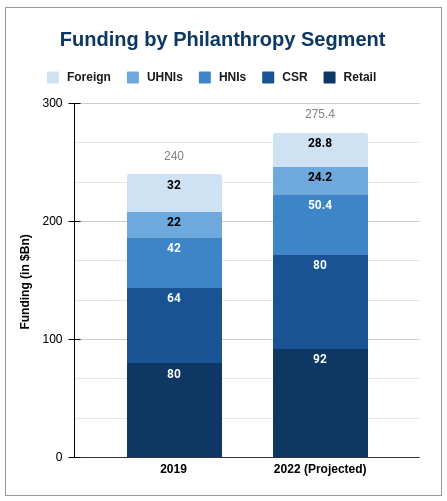
Most social sector funding comes from two major sources: foreign and domestic philanthropists. Domestic philanthropists include corporations (CSR and corporate trusts) and individuals. Domestic individuals are further classified as family philanthropists (HNIs and UHNIs) and retail givers. The following figure showcases a breakdown of social sector funding by philanthropy segments for FY 2019 and the growth projections (for each segment) for FY 2022:
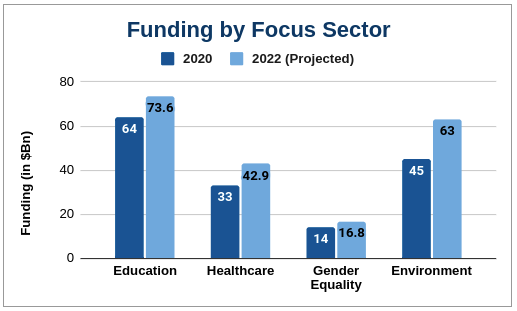
In terms of the allocation of funds across sectors, environment and education remain at the forefront. However, due to the impact of the pandemic, a significant portion of funds that were originally designated for other causes were redirected towards healthcare. As a result, the healthcare sector witnessed a notable increase, reaching $33 billion in the fiscal year 2020. Looking ahead, projections from industry analysts indicate a further growth of 30% in healthcare funding for the fiscal year 2022 (see figure below).
Consider each of the following statements. Does the information from the two reports support the inference as stated?
[Yes] According to the figure in NGO Report #1, the retail philanthropy segment constituted $80 billion [~33.33%] of the total funding in 2019, while the projected contribution for 2022 was $92 billion [~33.4%]. This shows an increase in the contribution from the retail segment.
[No] The combined social sector funding from retail [$80 Bn] and foreign philanthropists [$32 Bn] in Canada for the fiscal year 2019 was less than $120 billion [$112 Bn].
[No] The environment sector is projected to have a 40% (not 30%) growth in funding from 2020 to 2022.
Despite its growth, Canada still falls significantly short of meeting the estimated total annual funds needed to achieve its commitments to the United Nations Sustainable Development Goals (UN SDGs), according to the US government's analysis. The current deficit amounts to $58 billion for the fiscal year 2019. However, even with a projected increase of $20 billion in social sector funding, the deficit is expected to balloon to a daunting $110 billion in the following year (FY 2020).
The deficit, defined as the gap between the funding available and the demand for resources, highlights the immense financial challenges Canada faces in fulfilling its social sector funding requirements. For instance, in 2019, the social sector funding demand was estimated at $298 billion, but the actual funding (from varied philanthropy segments) fell short at $240 billion. Consequently, the deficit amounted to $58 billion, emphasizing the considerable shortfall in meeting the nation's social sector obligations.
The increasing deficit in social sector funding underscores the urgent need for the government to address this financial gap and allocate additional resources to meet its commitments. Failure to bridge this deficit could undermine progress in critical areas such as healthcare, education, and social welfare, hindering the overall advancement of the nation.
Most social sector funding comes from two major sources: foreign and domestic philanthropists. Domestic philanthropists include corporations (CSR and corporate trusts) and individuals. Domestic individuals are further classified as family philanthropists (HNIs and UHNIs) and retail givers. The following figure showcases a breakdown of social sector funding by philanthropy segments for FY 2019 and the growth projections (for each segment) for FY 2022:
In terms of the allocation of funds across sectors, environment and education remain at the forefront. However, due to the impact of the pandemic, a significant portion of funds that were originally designated for other causes were redirected towards healthcare. As a result, the healthcare sector witnessed a notable increase, reaching $33 billion in the fiscal year 2020. Looking ahead, projections from industry analysts indicate a further growth of 30% in healthcare funding for the fiscal year 2022 (see figure below).
Consider each of the following statements. Does the information from the two reports support the inference as stated?
[No] According to the figure in NGO Report #1, the social sector funding from foreign philanthropists in 2019 was $32 Bn, and the projected funding for 2022 was $28.8, indicating a decrease in funding.
[No] According to the figure in NGO Report #1, the projected growth in social sector funding for retail philanthropists is 15%, while for CSR funding, the projected growth is 25%.
[Yes] According to the figure in NGO Report #1, the social sector funding for HNIs in 2019 was $42 Bn, and the projected funding for 2022 is $50.4 Bn, indicating a growth of $8.4 Bn. On the other hand, the social sector funding for UHNIs in 2019 was $22 Bn, and the projected funding for 2022 is $24.2 Bn, indicating a growth of $2.2 Bn. Therefore, the growth in social sector funding for HNIs is higher than the growth for UHNIs.
Despite its growth, Canada still falls significantly short of meeting the estimated total annual funds needed to achieve its commitments to the United Nations Sustainable Development Goals (UN SDGs), according to the US government's analysis. The current deficit amounts to $58 billion for the fiscal year 2019. However, even with a projected increase of $20 billion in social sector funding, the deficit is expected to balloon to a daunting $110 billion in the following year (FY 2020).
The deficit, defined as the gap between the funding available and the demand for resources, highlights the immense financial challenges Canada faces in fulfilling its social sector funding requirements. For instance, in 2019, the social sector funding demand was estimated at $298 billion, but the actual funding (from varied philanthropy segments) fell short at $240 billion. Consequently, the deficit amounted to $58 billion, emphasizing the considerable shortfall in meeting the nation's social sector obligations.
The increasing deficit in social sector funding underscores the urgent need for the government to address this financial gap and allocate additional resources to meet its commitments. Failure to bridge this deficit could undermine progress in critical areas such as healthcare, education, and social welfare, hindering the overall advancement of the nation.
Most social sector funding comes from two major sources: foreign and domestic philanthropists. Domestic philanthropists include corporations (CSR and corporate trusts) and individuals. Domestic individuals are further classified as family philanthropists (HNIs and UHNIs) and retail givers. The following figure showcases a breakdown of social sector funding by philanthropy segments for FY 2019 and the growth projections (for each segment) for FY 2022:
In terms of the allocation of funds across sectors, environment and education remain at the forefront. However, due to the impact of the pandemic, a significant portion of funds that were originally designated for other causes were redirected towards healthcare. As a result, the healthcare sector witnessed a notable increase, reaching $33 billion in the fiscal year 2020. Looking ahead, projections from industry analysts indicate a further growth of 30% in healthcare funding for the fiscal year 2022 (see figure below).
Based on the information provided, the social sector funding demand estimate for FY 2020 must be
2019:
social sector funding demand = $298 billion
actual funding = $240 billion.
deficit =$58 billion
2020:
a projected increase of $20 billion in social sector funding
actual funding = $240 billion + $20 billion = $260 billion
deficit = $110 billion
Estimated funding demand = deficit + actual funding = $260 billion + $110 billion = $370 billion
1. The revenue generated from region A = $26 million; the total revenue generated from all four regions = $100 million. Therefore, the % contribution of the revenue generated from region A in total revenue generated by all four regions together is 26%.
2. The revenue generated from the sale of product Y = $20 million; the total revenue generated from all four regions = $100 million. Therefore, the % contribution of the revenue generated from the sale of product Y in the total revenue generated by all four regions together is 20%.
The Ministry of Urban Affairs, Government of India, conducted an extensive study focusing on India's top 10 cities to gather essential data for analysis. The purpose was to compare and evaluate various parameters across these cities, including population size, average salary, age demographics, average monthly expenses, average life expectancy, literacy rate, and unemployment rate.
This data-driven analysis is crucial for informed policy-making, as these 10 cities play a significant role in shaping the country's economy. It is noteworthy that these cities collectively contribute approximately 65% of India's GDP, highlighting their economic significance.
Recognizing the importance of addressing key socioeconomic challenges, the government aims to identify effective measures to improve the unemployment rate, life expectancy, and average income in these cities. These aspects are vital for fostering sustainable development, promoting job opportunities, enhancing the quality of life, and ensuring overall progress.
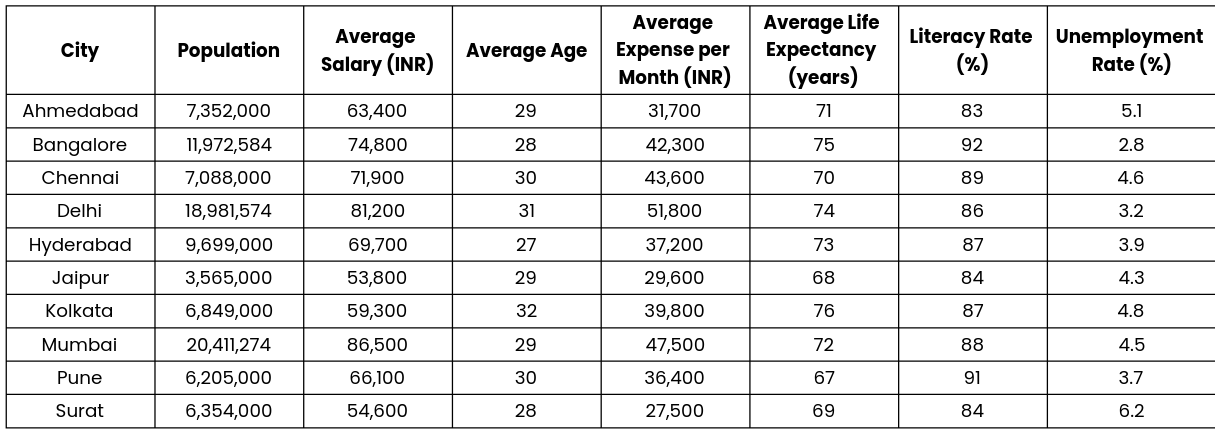
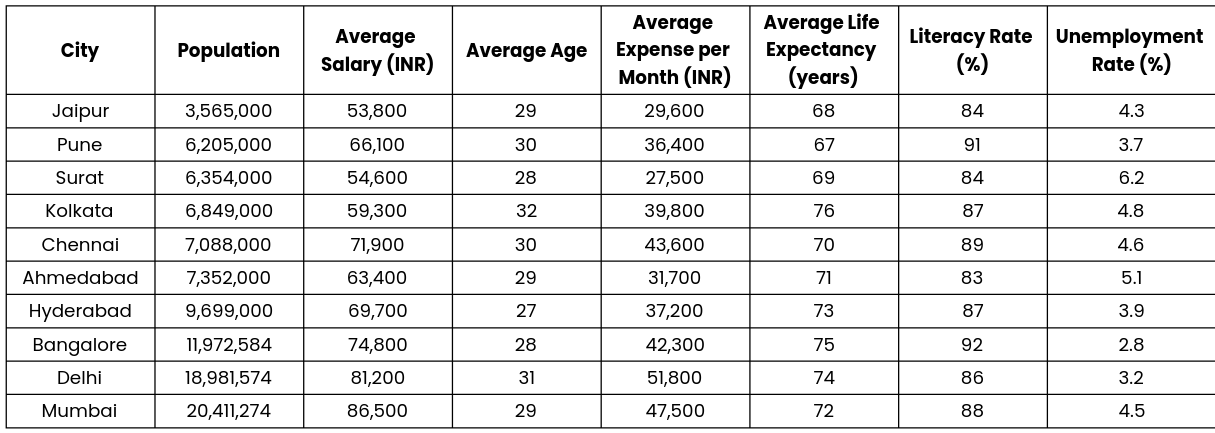
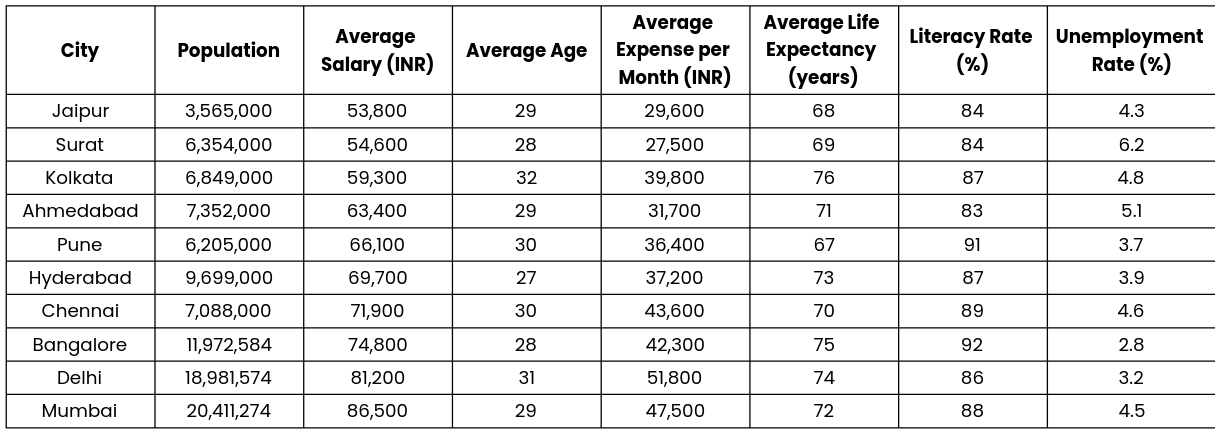
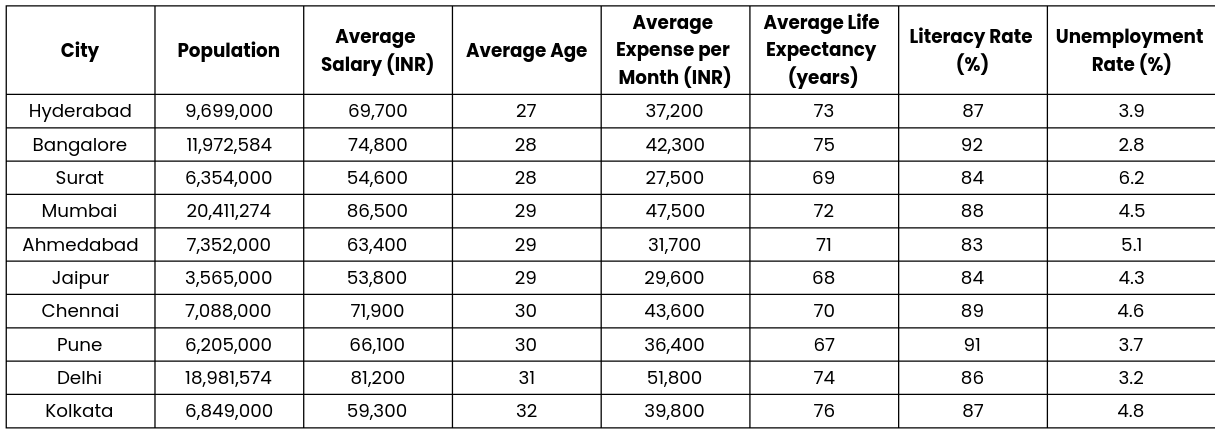
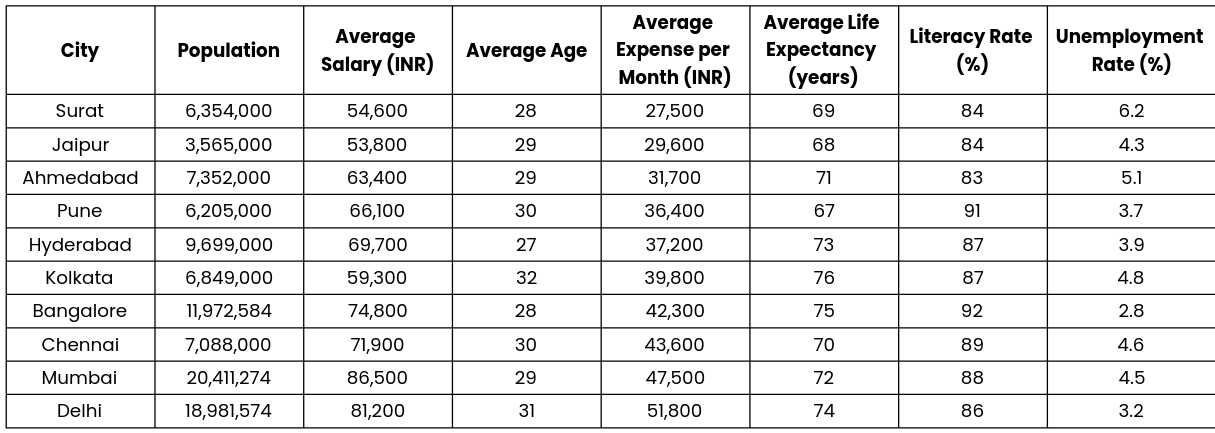
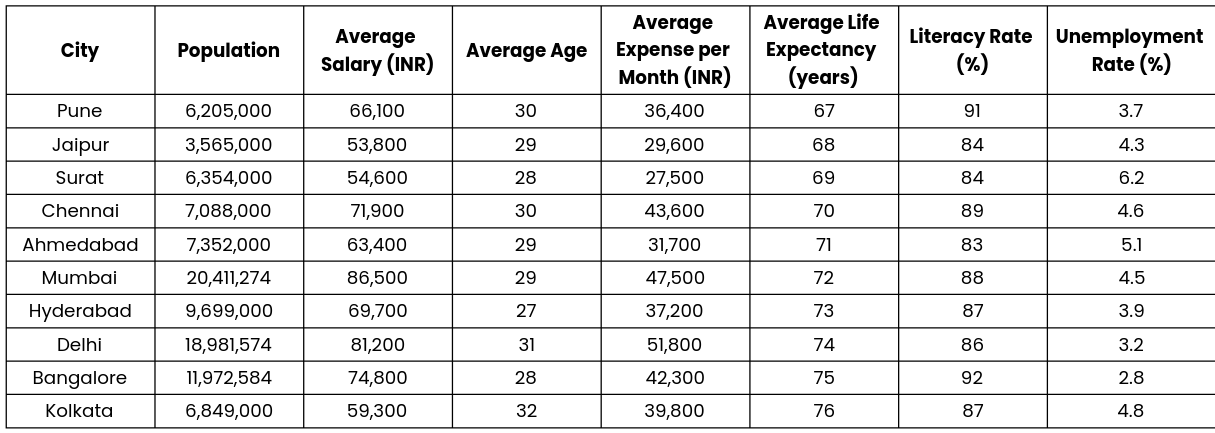
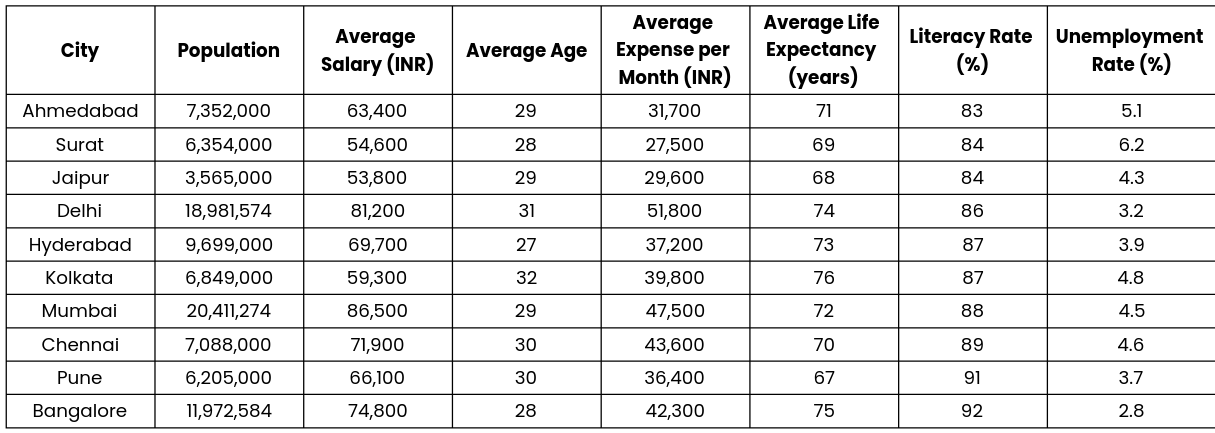
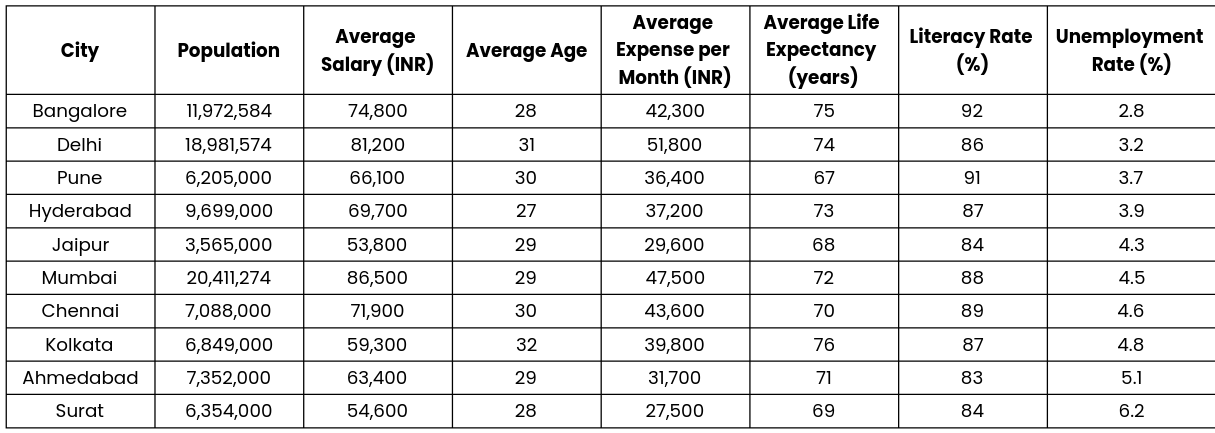
In light of the provided data and its implications, a set of statements has been presented for evaluation. Determine whether it is true or false based on the information provided.
1. The city with the 4th highest average salary is Chennai, and the city with the 4th highest unemployment rate is also Chennai (True)
2. The life expectancy of Kolkata is 76 years
The average life expectancy of the other nine cities combined = 72+74+75+73+71+70+69+67+68 = 639
=> 639/9 = 71
It is 5 years more than the average of other 9 countries. (False)
3. The city with the lowest average age is Hyderabad,
The city with the 4th highest average expense per month among the top 10 cities in India is Bangalore (False)
At a nursery, two unique species of plants, Species X and Species Y, were grown over a period of several years. Initially, Species X had a population of 520 plants, while Species Y had a population of 800 plants. Every year, the gardeners would additionally plant a fixed number of Species X plants; the same was true for Species Y. However, the number of plants added was different for each species. The nursery owner predicted that if each species maintained this respective annual increase in population, they would reach a point of intersection in population size after seven years, with Species X eventually surpassing Species Y in population size.
In the table below, choose the increase in population, in plants per year, for Species X and the increase in population, in plants per year, for Species Y that aligns with the nursery owners' projection. Select only one option from each column.
Let the number of new plants added to the Species X plant population annually be ‘x’
The increase in the population of plant Species X after 7 years = 7x
Species X plant population after 7 years = 520 + 7x
Let the number of new plants added to the Species Y plant population annually be ‘y’
The increase in the population of plant Species Y after 7 years = 7y
Species Y plant population after 7 years = 800 + 7y
We know:
520 + 7x = 800 + 7y
7x - 7y = (800 - 520)
7(x - y) = 280 or (x - y) = 40
The only values of (x,y) from the given that satisfy the above condition are x = 110 and y = 70
Read the passage and answer the questions that follow:
Scientists think that déjà vu actually provides a peek into how the memory system works when it goes a little off-kilter. The feeling may arise when parts of your brain that recognize familiar situations get activated inappropriately. When this happens, another region of the brain then checks this feeling of familiarity against your recall of past experiences. When no actual matches are found, the result is a discomfiting sense of having seen it all before, accompanied by the knowledge that you haven’t.
There is now some laboratory evidence that vague similarities between one scene and another can indeed lead to déjà vu. In a 2009 study, researchers found that viewing sneakily similar scenes was more likely to cause feelings of déjà vu than viewing dissimilar scenes—suggesting that perhaps there is some environmental trigger for the brain to call out, “Hey, I recognize that!” even when it’s never seen the scene before.
While research shows that a slight familiarity can result in déjà vu, it’s not clear that true familiarity is necessary to kick off the sensation. In spontaneous déjà vu cases, it’s quite possible that the familiarity feeling is random. At times, the part of the brain responsible for detecting familiarity—the medial temporal lobe, which is located just behind your temple and plays a large role in encoding and retrieving memories—may fire off overenthusiastically for no particular reason. Supporting this random-misfire hypothesis is the fact that young people actually experience more déjà vu than older people.
The primary purpose of the passage it to
The passage aims to explain the phenomenon of déjà vu and discuss some of the theories and research surrounding it. The passage presents various ideas about what déjà vu is, how it works, and what might trigger it. It also notes that there is still much that is not understood about this experience, and that different theories exist to explain it. The main focus of the passage is to provide information and insight into this intriguing and often mysterious phenomenon. Option B correctly captures this idea.
Option A: The passage does not offer a critique of the scientific study of déjà vu, but rather presents current theories and research about the phenomenon.
Option C: The author does not argue that déjà vu is not a real experience, but rather provides scientific evidence and theories about how it may occur.
Option D: It is not suggested that déjà vu should be studied primarily from a psychoanalytic perspective.
Option E: While the passage does describe the experience of déjà vu and notes that it is a common occurrence, it simply presents theories and research regarding the phenomenon without calling these explanations “well-accepted.”
Hence, Option B is the correct choice.
Read the passage and answer the questions that follow:
Scientists think that déjà vu actually provides a peek into how the memory system works when it goes a little off-kilter. The feeling may arise when parts of your brain that recognize familiar situations get activated inappropriately. When this happens, another region of the brain then checks this feeling of familiarity against your recall of past experiences. When no actual matches are found, the result is a discomfiting sense of having seen it all before, accompanied by the knowledge that you haven’t.
There is now some laboratory evidence that vague similarities between one scene and another can indeed lead to déjà vu. In a 2009 study, researchers found that viewing sneakily similar scenes was more likely to cause feelings of déjà vu than viewing dissimilar scenes—suggesting that perhaps there is some environmental trigger for the brain to call out, “Hey, I recognize that!” even when it’s never seen the scene before.
While research shows that a slight familiarity can result in déjà vu, it’s not clear that true familiarity is necessary to kick off the sensation. In spontaneous déjà vu cases, it’s quite possible that the familiarity feeling is random. At times, the part of the brain responsible for detecting familiarity—the medial temporal lobe, which is located just behind your temple and plays a large role in encoding and retrieving memories—may fire off overenthusiastically for no particular reason. Supporting this random-misfire hypothesis is the fact that young people actually experience more déjà vu than older people.
It can be understood that the author mentions the medial temporal lobe to
The discussion on the medial temporal lobe is an important part of the author's explanation of the possible mechanisms behind déjà vu. The medial temporal lobe is a region of the brain that is involved in the formation and retrieval of memories. The author suggests that when the brain recognizes a familiar situation, such as a scene that is similar to one that has been previously encountered, the medial temporal lobe may be activated inappropriately, which leads to a feeling of familiarity even if there is no actual memory to support it. The author is using the example of the medial temporal lobe to illustrate one of the ways that the memory system can go slightly “off-kilter,” which is thought to be one of the underlying causes of déjà vu. By discussing the role of the medial temporal lobe in detecting familiarity, the author is highlighting the idea that the sensation of déjà vu may be related to the brain's attempts to make sense of ambiguous or conflicting information from different sources. Option C best captures the elements discussed above.
Option A: While it's true that the processing of temporal information has been proposed as a possible mechanism behind déjà vu, the mention of the medial temporal lobe in the passage is not intended to provide a “detailed” explanation of this idea. Instead, it is used to support the broader notion that déjà vu is related to memory processes.
Option B: Although the passage mentions how similar scenes can trigger déjà vu, it doesn't imply that this is due to different brain segments misinterpreting visual information. The passage suggests that the feeling of familiarity that characterizes déjà vu may arise when parts of the brain that recognize familiar situations get activated inappropriately, and the mention of the medial temporal lobe is used to support this idea.
Option D: While visual information may play a role in the occurrence of déjà vu, the passage doesn't emphasize it as the primary factor. Furthermore, there is no discussion on the recognition of “complex” situations.
Option E: The passage suggests that déjà vu may arise when the brain is unable to distinguish between a present experience and a similar past experience that was not fully encoded into long-term memory. In other words, the feeling of familiarity that characterizes déjà vu can arise even in the absence of actual memories, which is different from the ability to distinguish between present and past experiences that were fully encoded into long-term memory.
Hence, Option C is the correct choice.
Read the passage and answer the questions that follow:
Scientists think that déjà vu actually provides a peek into how the memory system works when it goes a little off-kilter. The feeling may arise when parts of your brain that recognize familiar situations get activated inappropriately. When this happens, another region of the brain then checks this feeling of familiarity against your recall of past experiences. When no actual matches are found, the result is a discomfiting sense of having seen it all before, accompanied by the knowledge that you haven’t.
There is now some laboratory evidence that vague similarities between one scene and another can indeed lead to déjà vu. In a 2009 study, researchers found that viewing sneakily similar scenes was more likely to cause feelings of déjà vu than viewing dissimilar scenes—suggesting that perhaps there is some environmental trigger for the brain to call out, “Hey, I recognize that!” even when it’s never seen the scene before.
While research shows that a slight familiarity can result in déjà vu, it’s not clear that true familiarity is necessary to kick off the sensation. In spontaneous déjà vu cases, it’s quite possible that the familiarity feeling is random. At times, the part of the brain responsible for detecting familiarity—the medial temporal lobe, which is located just behind your temple and plays a large role in encoding and retrieving memories—may fire off overenthusiastically for no particular reason. Supporting this random-misfire hypothesis is the fact that young people actually experience more déjà vu than older people.
Which of the following best describes the function of the boldfaced line?
[While research shows that a slight familiarity can result in déjà vu, it’s not clear that true familiarity is necessary to kick off the sensation.]
The function of the boldfaced line is to convey the idea that true familiarity may not be required for someone to experience déjà vu. The line suggests that even a slight sense of familiarity or similarity can trigger the feeling of déjà vu, and that the sensation may not necessarily correspond to a genuine memory. This idea is then discussed at length in the final paragraph. Option D comes closest to describing the function of the line.
The line does not necessarily provide an explanation or present a limitation of any kind; therefore, Options A, B and E are invalid. The line also does not emphasise the distinction between two “triggers” [unclear about the reference].
Hence, Option D is the correct choice.
Read the passage and answer the questions that follow:
Scientists think that déjà vu actually provides a peek into how the memory system works when it goes a little off-kilter. The feeling may arise when parts of your brain that recognize familiar situations get activated inappropriately. When this happens, another region of the brain then checks this feeling of familiarity against your recall of past experiences. When no actual matches are found, the result is a discomfiting sense of having seen it all before, accompanied by the knowledge that you haven’t.
There is now some laboratory evidence that vague similarities between one scene and another can indeed lead to déjà vu. In a 2009 study, researchers found that viewing sneakily similar scenes was more likely to cause feelings of déjà vu than viewing dissimilar scenes—suggesting that perhaps there is some environmental trigger for the brain to call out, “Hey, I recognize that!” even when it’s never seen the scene before.
While research shows that a slight familiarity can result in déjà vu, it’s not clear that true familiarity is necessary to kick off the sensation. In spontaneous déjà vu cases, it’s quite possible that the familiarity feeling is random. At times, the part of the brain responsible for detecting familiarity—the medial temporal lobe, which is located just behind your temple and plays a large role in encoding and retrieving memories—may fire off overenthusiastically for no particular reason. Supporting this random-misfire hypothesis is the fact that young people actually experience more déjà vu than older people.
If true, which of the following would serve as the best criticism of the 2009 study cited in the passage?
[In a 2009 study, researchers found that viewing sneakily similar scenes was more likely to cause feelings of déjà vu than viewing dissimilar scenes—suggesting that perhaps there is some environmental trigger for the brain to call out, “Hey, I recognize that!” even when it’s never seen the scene before.]
Let us examine the choices individually:
Option A: The assertion here is not directly related to the study's findings on the relationship between viewing similar scenes and experiencing déjà vu. It focuses on a potential limitation in the study's scope, which is that it only measured the immediate effects of viewing similar scenes and did not investigate the long-term impacts of such exposure. While this limitation may be relevant to some research questions, it is not a criticism of the study's main finding.
Option B: This criticism suggests that individual variability may impact the results of the study, as what one person considers to be “sneakily similar” may not be the same as what another person considers to be similar. Therefore, it is possible that some participants in the study may have experienced déjà vu in response to scenes that other participants did not find similar enough to trigger that sensation. This potential variability in perception could undermine the validity of the study's conclusions.
Option C: This criticism is invalid because while prior research may have suggested that environmental triggers are associated with déjà vu, the specific finding of this study could be new and might add to the existing understanding of the phenomenon. The claim that subsequent research on “similar lines” is fruitless does not hold water.
Option D: While it is true that investigating brain chemistry and neural activity may be a valuable approach to understanding the causes of déjà vu, it is not a direct criticism of the 2009 study (the study aimed to investigate a specific hypothesis about the relationship between scene similarity and déjà vu, and it is not necessary for all studies on the topic to explore brain chemistry or neural activity).
Option E: The passage does not provide any information about the study sample's representativeness, so this criticism is not supported by the passage (nor is it relevant since the purpose was to explore a specific hypothesis and not map the occurrence of déjà vu in the general population).
Hence, Option B is the correct choice.
Read the given excerpt and answer the question that follows:
In the early 20th century, a manuscript was discovered that appeared to be a lost work of Shakespeare. The manuscript was found in a trunk belonging to a distant relative of Shakespeare who had recently died. However, there is no evidence that Shakespeare ever wrote this particular play. Scholars who believe that Shakespeare wrote the play argue that it is stylistically similar to his other works and that it contains themes common to his writing.
Which of the following is an assumption on which the scholar's argument depends?
The scholars argue in the passage that the recently discovered manuscript is a lost work of Shakespeare. However, there is no direct evidence that Shakespeare wrote this particular play. To support this argument, the passage points out two pieces of evidence that some scholars use to argue for Shakespeare’s authorship: the manuscript’s stylistic similarities to Shakespeare’s other works and the presence of common themes in the manuscript.
We need to identify an assumption that is necessary for the argument to be valid. If the assumption were false, then the argument would be weakened or even invalid. In this regard, let us examine the given choices:
Option A: This assumption is not necessary for the argument. Even if the manuscript was a fake, scholars could still argue that it resembles Shakespeare’s style and themes.
Options B and D: Even if Shakespeare had destroyed all copies of the play or written many more plays than we know of, scholars could still argue that the newly discovered manuscript was a lost work.
Option C: This assumption is necessary for the argument. If the manuscript’s similarity to Shakespeare’s other works is not strong evidence that he wrote it, then the argument for the manuscript being a lost work of Shakespeare is weakened or invalid.
Option E: Even if the themes were common to other writers of Shakespeare’s era, scholars could still argue that the newly discovered manuscript was a lost work of Shakespeare based on its stylistic similarities to his other works.
Hence, Option C is the correct choice.
Read the given excerpt and answer the question that follows:
Recently, there have been several incidents of automobile accidents caused by distracted driving. This has led to a corresponding increase in auto insurance claims and payouts, causing insurance premiums paid by car owners to rise. As a result, car manufacturers are under pressure to produce newer versions of cars that are safer and less prone to accidents.
Which of the following, if true, taken together with the information above best supports the conclusion that the cost of owning a car will continue to increase?
According to the given excerpt, the cost of owning a car is becoming more expensive due to several incidents of automobile accidents caused by distracted driving. This has led to an increase in auto insurance claims and payouts, which in turn, is causing insurance premiums paid by car owners to rise. [When insurance premiums rise, car owners have to pay more money to maintain their insurance coverage, which adds to the overall cost of owning a car]. In addition to this, the excerpt suggests that car manufacturers are under pressure to produce newer versions of cars that are safer and less prone to accidents. [This could potentially increase the cost of cars as well since car manufacturers may need to invest in new technology and safety features to make their cars safer.] We are expected to assess the given choices and identify the one that helps us support the conclusion that the “cost of owning a car will continue to increase.”
We note that Option C best supports this conclusion because it suggests that the cost of repairing newer cars is significantly higher than repairing older cars. This could impact the car maintenance cost, making car ownership relatively costly. Furthermore, insurance companies may have to pay higher amounts for repairs of newer cars, leading to a further increase in insurance premiums. This increase in insurance premiums could be passed onto car owners, resulting in higher ownership costs.
Option A is irrelevant to the given information as it talks about the cost of manufacturing cars over the past years, which need not be indicative of future price trends. Option B suggests that the demand for car ownership is decreasing, which may result in decreased ownership costs instead of increased costs - this is tangential to the question.
Option D is also irrelevant since it suggests that the demand for luxury cars is decreasing, which may or may not have an impact on the cost of owning a car. Option E mentions that stricter government regulations are being implemented to reduce emissions from cars, which may increase the cost of manufacturing cars. However, it does not directly support the conclusion that the cost of owning a car will continue to increase.
Hence, Option C is the correct choice.
Read the given excerpt and answer the question that follows:
Studies have shown that eating a diet high in fruits and vegetables can have numerous health benefits, including reducing the risk of chronic diseases. However, many people still do not consume the recommended daily servings of fruits and vegetables. One reason for this is the perception that these foods are expensive, and that it is cheaper to eat processed foods. While it is true that some fruits and vegetables can be expensive, there are also many affordable options that can be incorporated into a healthy diet.
The argument is most vulnerable to the objection that it fails to
The argument presented in the passage states that many people perceive fruits and vegetables to be expensive, and that this perception may be a barrier to consuming the recommended daily servings of these foods. However, the argument also notes that there are many affordable options for fruits and vegetables that can be incorporated into a healthy diet. Option E correctly identifies a vulnerability in the argument - namely, that the argument does not provide a direct comparison between the cost of fresh fruits and vegetables and the cost of processed foods on a per-serving basis. This comparison is important because it directly addresses the perception that healthy foods are more expensive than processed foods. Without this comparison, the argument may be seen as incomplete.
Option A: This is not relevant to the passage’s central claim. While it is true that some processed foods can have health benefits, this does not directly address the argument.
Option B: The argument does provide evidence for the claim that eating fruits and vegetables reduces the risk of chronic diseases - it mentions ‘studies’ that have shown this relationship, so the claim is adequately supported. Nevertheless, this option fails to address the core argument around perception and, thus, can be discarded.
Option C: While it is true that the availability and cost of healthy foods may vary across different regions and countries, this is not the primary concern of the argument.
Option D: This choice is not directly relevant to the argument. The passage does cite perception as one of the ‘factors’ [it implicitly acknowledges the presence of other factors]
Hence, Option E is the correct choice.
Read the given excerpt and answer the question that follows:
Athlete: I think this new training program is not effective in improving my performance. I've been doing it for two months now, but I haven't seen any improvements.
Coach: Actually, our data shows that athletes who follow this program for at least three months see a significant improvement in their performance. Your perception may be influenced by the fact that you haven't set a new personal record yet.
The underlying strategy of the coach's response to the athlete is most analogous to the underlying strategy of which of the following?
The coach is essentially saying that the athlete’s perception of the effectiveness of the training program may be flawed because it’s based on their individual experience, rather than an objective assessment of the program's effectiveness. This is most analogous to Option A, in which the teacher is saying that the student’s perception of the test’s difficulty may be flawed because it’s based on their individual experience, rather than an objective assessment of the test’s difficulty. In both cases, the coach and the teacher use objective evidence to challenge the subjective perception of the athlete and the student, respectively. The coach presents data that shows the effectiveness of the program, while the teacher cites the average grade of the class to demonstrate that the test was not too difficult.
Option B is not analogous to the coach’s response - the coach uses objective data to counter the athlete’s subjective perception, while the chef is using subjective data (i.e. other customers’ opinions) to counter the specific customer’s subjective perception. Similar reasoning can be used to reject Options C, D and E because they either involve rejecting a complaint based on qualifications (no perception involved), refuting a claim using the methodology, or challenging a belief using advice (subjective), which are not the same strategies employed by the coach in this scenario.
Hence, Option A is the correct choice.
For this question, select the best of the answer choices given.
Many social scientists have endeavoured to define the concept of "culture," but this elusive term resists a concise definition. Culture encompasses elements such as language, customs, beliefs, and artistic expressions. However, some argue that even non-human animals exhibit elements of culture in their behaviours, blurring the lines between what is uniquely human and what is universal. We must remain receptive to the possibility that cultures on other planets, if they exist, could be vastly different from our own. Consequently, attempting to pinpoint a singular definition of culture solely through the examination of human societies is analogous to trying to specify _______.
Which of the following most logically completes the argument?
The passage discusses the challenge of defining the concept of "culture," which encompasses various elements found in human societies. It also mentions the possibility that non-human animals may exhibit cultural behaviours, suggesting that the concept might be broader than previously thought. Additionally, the passage emphasizes the importance of considering the potential existence of different cultures on other planets. In this context, only Option B logically completes the passage. The analogy here in B implies that just as attempting to define all of music by studying a single melody would be inadequate, trying to define the entire concept of culture based solely on human societies would also be insufficient. Both culture and music are complex and diverse phenomena, requiring a broader perspective and consideration of various examples to gain a comprehensive understanding.
Read the given excerpt and answer the question that follows:
A group of researchers have discovered a new species of plant in a remote part of the rainforest. They want to study it to understand its ecology and potential medicinal properties better. However, they are concerned that their activities could harm the species and the surrounding ecosystem. To maximize the long-term potential for gaining knowledge about the plant and its habitat, they are considering delaying their investigation by a few years.
Which of the following questions would be most useful to ask in order to evaluate the researchers’ plan's prospects of achieving its goal?
Situation: The passage states that the researchers have discovered a new species of plant in a remote part of the rainforest and want to study it to understand its ecology and potential medicinal properties better.
Complication: However, they are concerned that their activities could harm the species and the surrounding ecosystem.
Decision: Therefore, they are considering delaying their investigation to maximize the long-term potential for gaining knowledge about the plant and its habitat.
The line of investigation that would most help assess the validity of this conclusion is presented in Option C - because the discovery of a new species implies that the species is not well-known, its conservation status may be unknown. If the species is endangered or threatened, delaying the investigation may be a high-risk strategy, as the species could become extinct before the researchers can study it. Additionally, if the species is rare or has a small population, delaying the investigation may also be risky, as the species could be at risk of being wiped out by natural or human-induced events. Therefore, Option C affects the conclusion by pointing out the need to consider the risk of extinction of the new species before delaying the investigation. If the species is at risk of extinction, then the researchers may need to prioritize studying it before it becomes extinct to understand how to protect it and its habitat. By doing so, the researchers may be able to maximize the long-term potential for gaining knowledge about the plant and its habitat while minimizing the risk of causing harm to the species and its ecosystem.
Option A: Although it is important to consider competition or crossbreeding with other plant species, it is not as urgent a concern as the risk of extinction. Furthermore, this question would be more relevant if the researchers were planning to introduce the new species into a different environment, rather than studying it in its natural habitat.
Option B: This question is also not as relevant to the researchers’ plan as option C. Collaborating with local indigenous communities who have traditional knowledge about the area could be important for promoting cultural understanding and respect, but it does not address the immediate concern of the risk of extinction.
Option D: While this question is important to consider in the long-term study of the new species, it is not as relevant to the immediate concern of the risk of extinction. Predators or diseases that could pose a threat to the new species can be studied and managed after the species has been studied and understood more thoroughly.
Option E: Although new technologies may improve the researchers’ ability to study the new species, it is not relevant to the stated plan. Additionally, relying on future technologies to study the species may result in the species becoming extinct before any useful information can be gathered.
Hence, Option C is the correct choice.

Deconstruct CR arguments - identify premises, conclusions, assumptions, and logical gaps with precision

Read RC passages strategically - extract what matters fast, without re-reading or losing context

Navigate every DI format - DS, MSR, Graphs & Tables, Two-Part - with a consistent, reliable framework

GMAT FE Score: 635
"GMATPoint totally transformed my GMAT prep—it supercharged my quant skills with those killer practice modules that made tough problems a breeze, even with my crazy PwC consulting schedule! The daily practice tests and mocks were a game-changer, especially the verbal sections and Sayali Ma’am’s spot-on analysis that helped me crush my weak spots. Honestly, it took my engineering background and turned it into GMAT success—couldn’t recommend it more!"

GMAT FE Score: 675
"I tried the GMAT official mock 1 and scored terribly in the data insights section (50th percentile). My performance in the other two sections were at a decent 80th percentile. I went through the DI course and it was particularly useful in helping me understand that GMAT is as much an exam of nerves as it is of concepts and helped me land at the 90th percentile for the section."
GMAT FE Score: 685
"I started prep late in January and was worried whether I’ll be able to get up to speed for the exam in March. I bought the mock + question bank course and practiced daily. I went through all 10 mocks over the course of 2 months and the practice helped immensely in improving my score. I went from 555 in the first mock to 685 in the actual exam."
GMAT Classic Score: 710
"What set this course apart was how it trained me to think. The concept videos introduced a proper framework for problem-solving, and the massive question bank was where it all clicked into place during practice. When I took the actual GMAT, I was not just answering questions; I was able to recognise patterns quickly and apply the processes I had internalised. That made the biggest difference on exam day; it helped me greatly with my time management."

Sale ends in

Sale ends in

Sale ends in
Almost Done – Let's Get You Started
Available Offers
Congratulations! You saved
Coupon code applied
Terms of Service