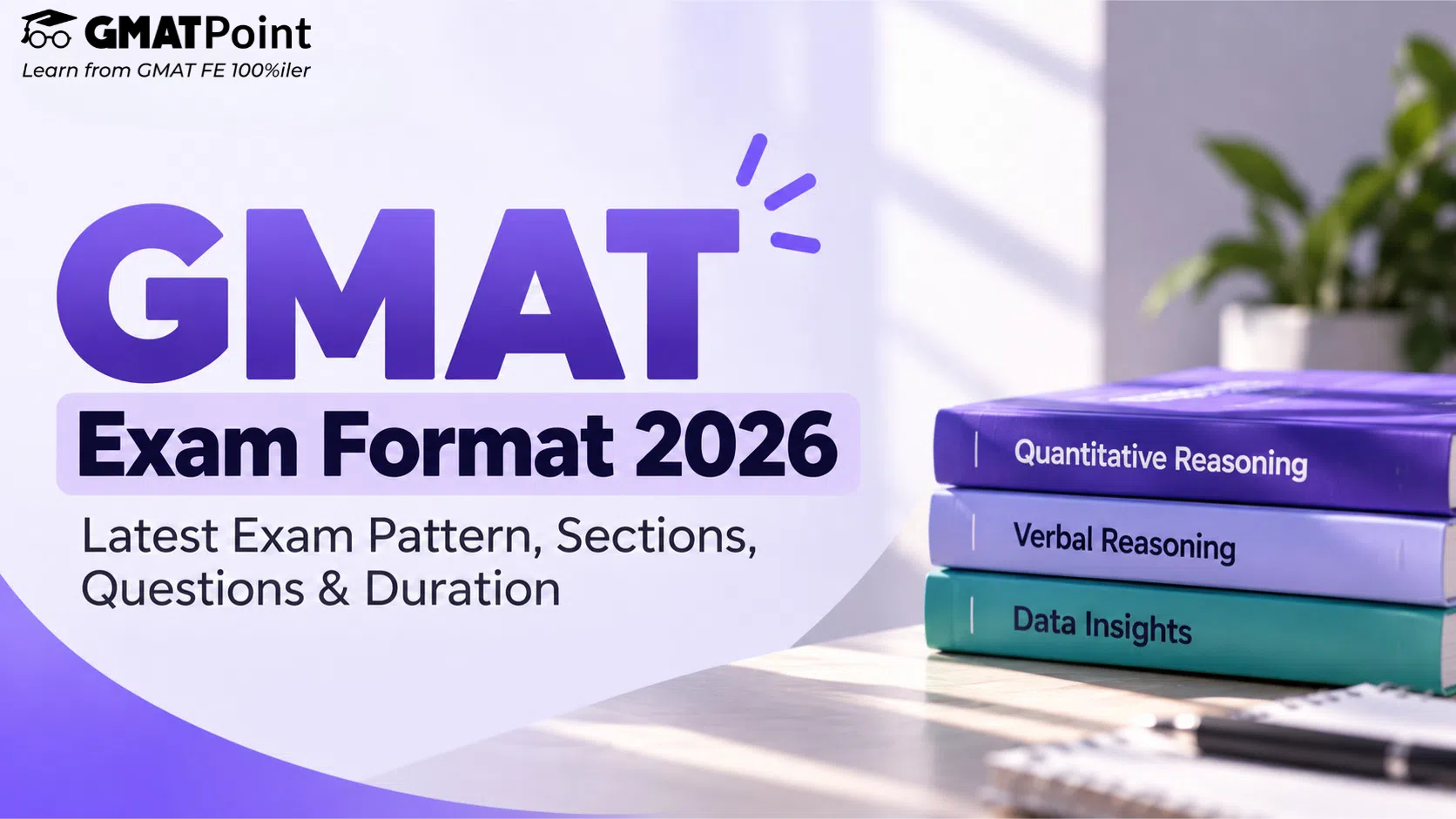

The GMAT Exam Format 2026 consists of three sections: Quantitative Reasoning, Verbal Reasoning, and Data Insights. The exam has a total of 64 questions that candidates need to complete within 2 hours and 15 minutes of testing time. Each of the three sections has a time limit of 45 minutes.
Candidates can also take one optional 10-minute break after either the first or second section. Understanding the GMAT exam format, question distribution, section timings, and scoring system can help candidates plan their preparation and manage their time effectively on test day.
GMAT Exam Format 2026: Quick Overview
The GMAT is a computer-adaptive exam with three equally timed sections. Candidates can choose the order in which they attempt Quantitative Reasoning, Verbal Reasoning, and Data Insights, allowing them to select a section sequence that suits their strengths and test-taking strategy.
GMAT Section | Number of Questions | Time Limit |
Quantitative Reasoning | 21 | 45 minutes |
Verbal Reasoning | 23 | 45 minutes |
Data Insights | 20 | 45 minutes |
Total | 64 | 2 hours 15 minutes |
Here are the key points about the GMAT exam pattern 2026:
- Three sections: Quantitative Reasoning, Verbal Reasoning, and Data Insights.
- 64 questions: The exam includes 21 Quantitative Reasoning, 23 Verbal Reasoning, and 20 Data Insights questions.
- 45 minutes per section: Each section has the same time limit.
- Total testing time: The exam lasts 2 hours and 15 minutes, excluding the optional break.
- Optional break: Candidates can take one 10-minute break after either the first or second section.
- Flexible section order: Candidates can choose the order in which they attempt the three sections.
- Computer-adaptive format: The GMAT uses computer-adaptive testing.
One of the best ways to familiarize yourself with the GMAT Exam Format is to take a Free GMAT Mock Test. This test has been curated by experts and top scorers, and follows the exact same format as the real GMAT exam.
GMAT 2026 Section-Wise Exam Pattern
Each GMAT section has a different focus, even though all three have the same 45-minute time limit. Quantitative Reasoning tests mathematical problem-solving skills, Verbal Reasoning evaluates reading and argument analysis, while Data Insights measures the ability to interpret and work with data.
Understanding what each section tests is important before starting section-wise GMAT preparation.
Quantitative Reasoning
The GMAT Quantitative Reasoning section consists of 21 questions to be completed in 45 minutes. It tests foundational arithmetic and algebra skills and, more importantly, the ability to apply mathematical concepts to solve problems.
- Number of questions: 21
- Time limit: 45 minutes
- Question type: Problem Solving
- Key skills tested: Arithmetic, algebra, logic, and analytical reasoning
- Calculator policy: Calculators are not permitted in this section
The focus is on applying mathematical concepts and reasoning to solve problems rather than testing advanced mathematical knowledge.
Verbal Reasoning
The GMAT Verbal Reasoning section consists of 23 questions to be completed in 45 minutes. It evaluates a candidate's ability to understand written material, evaluate arguments, identify assumptions, and draw logical conclusions.
The section contains two major question categories:
- Reading Comprehension: Tests the ability to understand passages, identify main and supporting ideas, make inferences, and analyse the logical structure of a passage.
- Critical Reasoning: Tests the ability to evaluate arguments, identify assumptions, draw conclusions, and analyse plans of action.
Candidates do not need specialised knowledge of a particular subject to answer these questions. The focus is on reading comprehension, reasoning, and argument analysis.
Data Insights
The GMAT Data Insights section consists of 20 questions to be completed in 45 minutes. It assesses how effectively candidates can analyse, interpret, and use data to solve problems and make decisions.
An on-screen calculator is available in the Data Insights section. Questions can involve tables, graphs, written information, quantitative information, and multiple data sources.
The GMAT Data Insights section includes five major question types:
Data Insights Question Type | What It Tests |
Data Sufficiency | Determines whether the information provided is sufficient to solve a quantitative problem |
Multi-Source Reasoning | Requires candidates to analyse and combine information from multiple sources such as text, tables, and graphics |
Table Analysis | Requires candidates to sort and analyse tabular data and identify relevant information |
Graphics Interpretation | Tests the ability to interpret graphs and visual data, identify relationships, and draw conclusions |
Two-Part Analysis | Tests multi-step problem-solving involving quantitative, verbal, or combined reasoning |
Together, these question types assess data literacy, analytical reasoning, and decision-making skills.
Candidates are advised to use study materials curated by experts and top scorers, since they can help them significantly improve their GMAT scores.
Check out: GMAT Courses by 785 Scorer
Watch this video by a GMAT 725 Scorer to understand the GMAT Exam Syllabus and the concepts that are tested in the exam:
How Many Questions Are There in the GMAT 2026?
The GMAT 2026 has 64 questions across its three sections. Candidates get 45 minutes for each section, which makes effective pacing an important part of the exam.
The section-wise question distribution is:
- Quantitative Reasoning: 21 questions
- Verbal Reasoning: 23 questions
- Data Insights: 20 questions
- Total: 64 questions
During a section, candidates must answer the current question before moving to the next one; they cannot skip a question and return to it immediately.
However, the Question Review & Edit feature allows candidates to review questions at the end of a section and change up to three answers per section, provided there is time remaining.
This makes time management particularly important. Candidates should aim to complete the section with enough time remaining to review flagged questions instead of spending too much time on a single difficult question.
GMAT Expert Mentorship can help candidates improve their GMAT scores by building personalised and structured study plans, conceptual practice and exam strategies.
What Is the GMAT Exam Duration in 2026?
The GMAT exam duration in 2026 is 2 hours and 15 minutes of testing time, excluding the optional 10-minute break. Each of the three sections has a fixed time limit of 45 minutes.
Component | Duration |
Quantitative Reasoning | 45 minutes |
Verbal Reasoning | 45 minutes |
Data Insights | 45 minutes |
Total Testing Time | 2 hours 15 minutes |
Optional Break | 10 minutes |
Key Points About GMAT Exam Duration
- Equal section timing: Each section has a fixed time limit of 45 minutes.
- Optional break: Candidates can take one 10-minute break after either the first or second section.
- Flexible section order: Candidates can choose their preferred order for the three sections.
- Time management matters: Candidates need to balance accuracy with pacing so they do not run out of time toward the end of a section.
- Test section order beforehand: Candidates should experiment with different section orders during practice instead of deciding their sequence for the first time on exam day.
Practicing with GMAT Free Mock Tests can help candidates build familiarity with the exam format, and also practice various sectional orders to find out which one works the best for them.
How Does the GMAT Scoring System Work?
The GMAT scoring system includes a Total Score along with individual scores for Quantitative Reasoning, Verbal Reasoning, and Data Insights. The GMAT Total Score ranges from 205 to 805, while each individual section is scored from 60 to 90.
Score | Range | Interval |
GMAT Total Score | 205-805 | 10 points |
Quantitative Reasoning | 60-90 | 1 point |
Verbal Reasoning | 60-90 | 1 point |
Data Insights | 60-90 | 1 point |
Key Points About GMAT Scoring
- Total Score: The GMAT Total Score ranges from 205 to 805 in 10-point intervals. Therefore, Total Scores end in 5.
- Section Scores: Quantitative Reasoning, Verbal Reasoning, and Data Insights are each scored on a scale of 60-90 in one-point increments.
- Equal Weighting: All three sections are equally weighted when calculating the GMAT Total Score.
- Percentile Rankings: Candidates receive percentile rankings along with their Total Score and individual section scores.
- Unanswered questions: Candidates should aim to complete every section, as leaving questions unanswered can negatively affect the score.
A percentile rank indicates the percentage of test takers a candidate performed better than. For example, an 80th percentile ranking means that the candidate performed better than approximately 80% of test takers in the comparison group.
Candidates should also avoid directly comparing the current 205-805 GMAT score scale with the previous 200-800 GMAT scale. The scoring scales are different, so percentile rankings provide better context when comparing performance across the two versions.
Read More: GMAT Scoring System Explained
What Has Changed in the New GMAT Format?
The current GMAT format differs significantly from the previous GMAT 10th Edition. Major changes include a shorter exam duration, fewer questions, the introduction of Data Insights as a measured section, greater flexibility in choosing section order, and the Question Review & Edit feature.
The redesigned exam was previously introduced as the GMAT Focus Edition and is now referred to simply as the GMAT Exam.
Feature | Current GMAT | Previous GMAT (10th Edition) |
Number of Sections | 3 | 4 |
Sections | Quantitative Reasoning, Verbal Reasoning, Data Insights | Quantitative Reasoning, Verbal Reasoning, Integrated Reasoning, Analytical Writing Assessment |
Number of Questions | 64 | 80 |
Exam Duration | 2 hours 15 minutes | 3 hours 7 minutes |
Total Score Range | 205-805 | 200-800 |
Section Order | Candidate can choose any order | Candidate chose from three predefined orders |
Question Review & Edit | Yes; review questions and edit up to 3 answers per section | No |
Key Changes in the Current GMAT Format
- Analytical Writing Assessment removed: The current GMAT no longer includes a separate essay-writing section.
- Integrated Reasoning removed as a standalone section: Data Insights now assesses data analysis and interpretation as one of the three sections contributing to the Total Score.
- Shorter exam duration: Testing time has decreased by 52 minutes, from 3 hours and 7 minutes to 2 hours and 15 minutes.
- Fewer questions: The current exam contains 64 questions compared with 80 questions in the previous format.
- Flexible section order: Candidates can choose the order in which they attempt Quantitative Reasoning, Verbal Reasoning, and Data Insights.
- Question Review & Edit: Candidates can review questions at the end of each section and change up to three responses, provided time remains.
These changes make the current GMAT shorter and give candidates greater flexibility over their test-taking experience. However, a shorter exam should not be interpreted as an easier exam, as candidates still need strong reasoning, time-management, and decision-making skills across all three sections.
































![ISB Programmes Full Breakdown 2026: Compare PGP, PGP YL, Fees & Placements [Free PDF]](https://gmatpoint.com/media/ISB_PDF_Banner.webp "ISB Programmes Full Breakdown 2026: Compare PGP, PGP YL, Fees & Placements [Free PDF]")