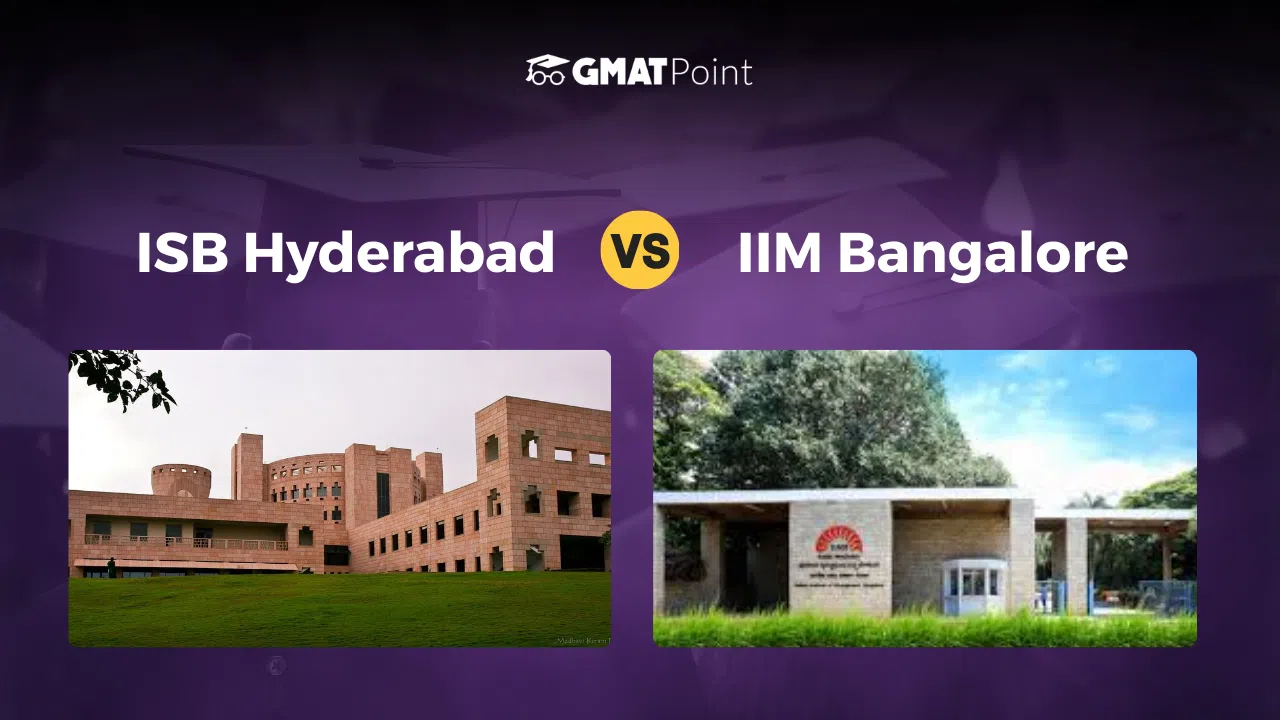


Indian Institute of Management Bangalore (IIM B) and the Indian School of Business (ISB) are among India's most prestigious management institutions, with strong academic reputations, alumni networks and career outcomes. However, deciding whether IIM Bangalore or ISB is better is not straightforward because the two institutions offer programmes designed for candidates at different stages of their careers.
The choice depends on factors such as work experience, career goals, entrance exams, programme duration, fees and preferred learning environment. For fresh graduates and early-career candidates, the most relevant comparison is usually between IIMB PGP and ISB PGP YL. For experienced professionals, IIMB EPGP and ISB PGP become more relevant options.
This IIM Bangalore vs ISB MBA comparison covers the key differences in entrance exams, eligibility, work experience requirements, programme duration, fees, placements, ROI and programme strengths. It also separately considers IIM Bangalore EPGP vs ISB PGP and IIM Bangalore PGP vs ISB PGP YL to help applicants identify the programme that best fits their profile.
IIM Bangalore vs ISB: Key Differences
IIM Bangalore and ISB are both top-tier management institutions in India, but their programmes cater to different candidate profiles. While IIMB PGP and ISB PGP YL are primarily relevant to fresh graduates and early-career professionals, IIMB EPGP and ISB PGP are designed for candidates with professional experience.
Therefore, headline figures alone cannot determine which institution is better. Admission requirements, programme duration, fees, candidate profile, career opportunities and long-term goals should all be considered when comparing IIM Bangalore and ISB.
Parameter | IIMB PGP | ISB PGP YL | IIMB EPGP | ISB PGP |
Duration | 2 years | 20 months | 1 year | 1 year |
Entrance route | CAT* | CAT/GMAT/GRE | GMAT/GRE | GMAT/GRE |
Work Experience Requirements | None | Maximum 2 Years | Minimum 5 years | Minimum 2 years |
Approx. fees | ₹26 lacs | ₹29.5 lacs | ₹33.7 lacs | ₹39-50 lacs |
Placement figure | ₹35.35 LPA | Final placement data unavailable** | ₹36.5 LPA | ₹37.29 LPA |
Key strength | Legacy + established PGP | Flexible admissions + ISB ecosystem | IIMB brand for experienced professionals | Global exposure + career acceleration |
*For IIMB PGP, CAT is the standard route for regular domestic applicants. Eligible Overseas/International applicants can apply using GMAT/GRE under IIMB's separate Overseas/International admissions process.
**For ISB PGP YL, the inaugural batch is yet to graduate in 2027.
IIM Bangalore has a long-established presence in Indian management education. Its PGP is a two-year programme for candidates pursuing the traditional MBA route, while its EPGP is a one-year programme designed for experienced professionals.
ISB offers a different proposition. Its PGP YL gives early-career candidates multiple entrance options through CAT, GMAT or GRE, while its flagship PGP targets professionals with at least two years of work experience.
Placement and fee figures for IIM Bangalore and ISB should also be viewed in the context of differences in programme duration, candidate profiles and admission requirements. Ultimately, the better option depends on the applicant's career stage, eligibility, preferred programme structure, budget and post-MBA career goals.
If you’re confused as to which program is the better fit for your profile or just want a profile evaluation from an expert, check out: GMAT Expert Mentorship
IIM Bangalore vs ISB: Admission and Entrance Exams
Entrance exam requirements vary across the four programmes depending on the programme and candidate profile. While IIM Bangalore's PGP primarily follows the CAT route for domestic candidates, ISB offers greater entrance-exam flexibility through its PGP YL.
IIMB PGP
CAT is the standard entrance route for regular domestic applicants to the IIMB PGP. Eligible Overseas/International applicants can apply using GMAT or GRE under IIM Bangalore's separate Overseas/International admissions process. Regular domestic applicants should not assume that they can freely choose between CAT, GMAT and GRE for admission to the PGP.
ISB PGP YL
The ISB PGP YL accepts CAT, GMAT or GRE, giving applicants greater flexibility when choosing an entrance exam. This is one of the key differences between ISB PGP YL and IIMB PGP in terms of their admission routes.
IIMB EPGP vs ISB PGP
Both IIMB EPGP and ISB PGP accept GMAT or GRE. Candidates considering these programmes therefore have broadly similar entrance-exam options.
Overall, ISB PGP YL stands out for its admission flexibility because candidates can apply using CAT, GMAT or GRE. For experienced professionals comparing IIMB EPGP and ISB PGP, entrance-exam choices are broadly similar.
While CAT and GMAT are two different exams, one factor stays the same across both of them; that effective and smart preparation is best achieved when done by utilising study materials created by experts and top-scorers.
Check out: GMAT Courses by 100 Percentiler and CAT Courses by 5-time 100 Percentiler
IIM Bangalore vs ISB: Work Experience Requirements
Work experience is one of the major differentiators between the four programmes. IIMB PGP and ISB PGP YL are relevant to fresh graduates and early-career candidates, while IIMB EPGP and ISB PGP cater to candidates with professional experience.
Programme | Work Experience Requirement |
IIMB PGP | No mandatory requirement |
ISB PGP YL | 0-2 years (Maximum 24 months) |
IIMB EPGP | Minimum 5 years |
ISB PGP | Minimum 2 years |
IIMB PGP and ISB PGP YL
Neither IIMB PGP nor ISB PGP YL requires applicants to have prior work experience. Both fresh graduates and experienced professionals can therefore apply to both programmes. However, ISB PGP YL is specifically intended for candidates with a maximum of 24 months of work experience. Relevant internships, full-time professional experience and significant achievements after graduation can potentially strengthen an applicant's overall profile.
IIMB EPGP Work Experience
IIMB EPGP requires a minimum of five years of work experience, making it more relevant to experienced professionals looking to accelerate their careers or transition into new roles and functions.
ISB PGP Work Experience
ISB PGP requires applicants to have at least two years of work experience. However, ISB's latest PGP cohort had approximately four years of average work experience. Candidates applying with only two years of experience may therefore be eligible but would be at the younger end of the cohort in terms of professional experience.
The important distinction here is between minimum eligibility and the typical experience of the cohort. Meeting the minimum work-experience requirement makes a candidate eligible on that criterion, but does not by itself make the applicant competitive for admission.
To know whether your current exam scores are competitive for admissions to either of these schools, the best way to start is to gauge this through a Free GMAT Mock Test or a Free CAT Mock Test.
IIM Bangalore vs ISB Placements and Average Package
Placements are an important factor when comparing IIM Bangalore and ISB, but the figures need to be evaluated on a programme-by-programme basis. Candidate backgrounds, work experience, programme duration and career stage can significantly affect placement outcomes.
Programme | Latest Placement Figure |
IIMB PGP | ₹35.35 LPA Average Package |
ISB PGP YL | ₹3.2 lacs Average Summer Internship Stipend |
IIMB EPGP | ₹36.5 LPA |
ISB PGP | ₹37.29 LPA Average Package |
IIMB PGP vs ISB PGP YL Placements
IIMB PGP reported an average package of ₹35.35 LPA, whereas final placement data is not yet available for ISB PGP YL. PGP YL is a newer programme at ISB, with its inaugural cohort expected to graduate in 2027.
ISB has, however, released summer internship data for the PGP YL cohort. The average stipend was ₹3.2 lacs, while the highest stipend was ₹7.3 lacs. These summer internship figures can provide an early indication of recruiter interest, but they should not be directly compared with final MBA placement packages.
It would also be incorrect to substitute ISB PGP placement figures for PGP YL placement figures, as they are separate programmes designed for different candidate profiles.
Metric | ISB PGP YL |
Average stipend | ₹3.2 lacs |
Highest stipend | ₹7.3 lacs |
Important EPGP vs PGP Nuance
IIMB EPGP reported a placement figure of ₹36.5 LPA, while ISB PGP reported an average package of ₹37.29 LPA. However, these figures should not be compared in isolation to determine which programme is better.
Compensation for experienced cohorts can depend on several factors, including previous work experience, industry, seniority, pre-MBA compensation, functional background and the roles secured after completing the programme. Therefore, the slightly higher quoted figure for ISB PGP does not automatically make it superior to IIMB EPGP.
Overall, placement figures are useful for comparison, but they should be evaluated alongside programme fit, candidate profile, career goals and ROI rather than viewed in isolation.
IIM Bangalore vs ISB Fees and ROI
Fees are another important consideration in the IIM Bangalore vs ISB comparison, particularly because the four programmes differ in duration, structure and target candidate profile.
Programme | Approximate Fees |
IIMB PGP | ₹26 lacs |
ISB PGP YL | ₹29.5 lacs |
IIMB EPGP | ₹33.7 lacs |
ISB PGP | ₹40-50 lacs |
IIMB PGP vs ISB PGP YL Fees
IIMB PGP costs approximately ₹26 lacs, while ISB PGP YL costs around ₹29.5 lacs. The difference is relatively small when considered against the overall investment involved in pursuing an MBA.
IIMB EPGP vs ISB PGP Fees
The fee difference is more significant when comparing IIMB EPGP and ISB PGP. IIMB EPGP costs approximately ₹33.7 lacs, whereas ISB PGP costs around ₹40-50 lacs. Fees can therefore become an important consideration for experienced professionals deciding between these programmes.
IIM Bangalore vs ISB ROI
MBA ROI cannot be calculated simply by dividing the average placement package by the programme fee. It also depends on factors such as opportunity cost, programme duration, pre-MBA compensation, post-MBA role, career progression, alumni and network benefits, and long-term earning potential.
These factors are particularly significant for experienced professionals because leaving the workforce to pursue an MBA involves an opportunity cost in addition to the programme fee. Candidates should therefore consider both short-term costs and potential long-term career gains when comparing the ROI of IIM Bangalore and ISB.
IIM Bangalore vs ISB: Which One Is Better for You?
Both IIM Bangalore and ISB offer strong career opportunities, but their programmes cater to different candidate profiles. The better choice depends on your career stage, work experience, programme preferences, budget and long-term goals.
Why Choose IIM Bangalore?
IIM Bangalore is one of India's most established management institutions, with a long-standing legacy and a strong alumni network. Its emphasis on case-based learning and its alumni presence across corporate and public leadership are among the factors candidates may consider when evaluating the institution.
IIMB PGP can be particularly attractive to candidates looking for the established, traditional IIM MBA experience. IIMB EPGP, meanwhile, gives experienced professionals access to the IIMB ecosystem through a one-year programme instead of committing to a two-year programme.
Why Choose ISB?
ISB has a strong global orientation, internationally diverse faculty exposure and an alumni network spread across different countries and industries. Its cohorts also bring substantial professional experience, creating a learning environment shaped by diverse career backgrounds.
ISB PGP can be particularly attractive to experienced professionals seeking accelerated career progression through a one-year programme. PGP YL, on the other hand, gives early-career candidates greater entrance-exam flexibility by accepting CAT, GMAT or GRE.
Recommendations by Profile
Fresh graduates / candidates with limited experience:
The most relevant comparison is IIMB PGP vs ISB PGP YL. IIMB offers its established PGP and legacy, while ISB PGP YL offers greater test flexibility and access to the ISB ecosystem.
Candidates with 2-4 years of experience:
ISB PGP becomes a relevant option once candidates meet its minimum work-experience requirement, while PGP YL is limited to candidates with a maximum of 24 months of experience. However, applicants should remember that the average work experience of the ISB PGP cohort is approximately four years.
Candidates with 5+ years of experience:
IIMB EPGP vs ISB PGP becomes the more relevant comparison. At this stage, candidates should evaluate programme cost, career goals, peer group, desired exposure and the respective institutional ecosystems rather than comparing salary figures alone.
Conclusion
The IIM Bangalore vs ISB comparison ultimately comes down to programme fit rather than identifying one institution as the overall winner. IIM Bangalore can be particularly compelling for candidates who value its long-standing legacy, established IIM ecosystem and emphasis on case-based learning.
ISB may be more appealing to candidates looking for international exposure, greater admission flexibility in the case of PGP YL, and accelerated career progression through its PGP. Experienced professionals choosing between IIMB EPGP and ISB PGP should carefully consider programme duration, cost, peer group and desired career outcomes. Ultimately, the choice between IIM Bangalore and ISB depends on your experience, priorities and long-term career goals.