
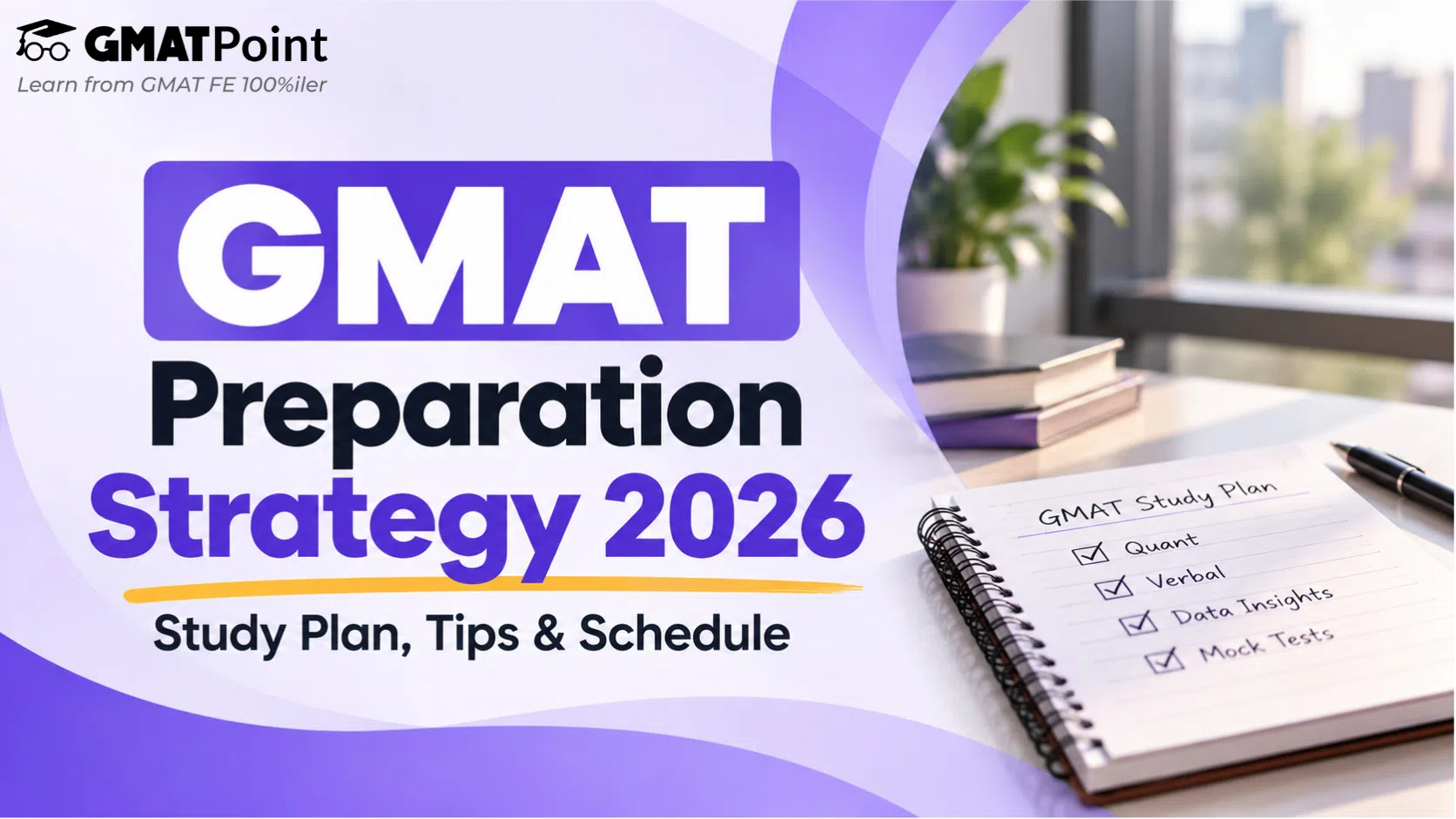
GMAT Preparation Strategy 2026
Preparing for the GMAT might be tough if started without any plan. Preparing for the GMAT 2026 can be a daunting task, but following an appropriate strategy, it will become a piece of cake. Beginning early, getting a feel for what the GMAT exam pattern is, and developing strong basics in Quant, Verbal, and Data Insights are key. Going out of their style-wise group work and preparation for the exam will also need to achieve targets in a planned way, like daily practice and GMAT mock tests on a regular basis, with time management. It is better to be consistent than to study for long hours. Read till the end and know the best GMAT preparation strategy for 2026.
What’s the Best GMAT Preparation 2026 Strategy?
Preparing for the GMAT in 2026 is not about studying harder, but studying smart. A clear plan, consistent practice, and regular analysis can help you improve faster and avoid burnout.
- Learn the basics: Start the GMAT preparation by learning the basic concepts, and have clarity of the topics after analyzing which topics have more weightage.
- Can give mock test: Candidates can start attempting topic-wise and subject-wise mock tests to understand the preparation level.
- Focus on weak points: Analyze the mock test and focus on weak points. Get a clear understanding of the topics or chapters you want to clarify more.
- Make small notes: Students studying for the GMAT exam can jot down important formulas, statistics, and facts on small notes for last-minute revision.
- Have a definite goal and time frame: Fix your target score, and accordingly, schedule to attempt all the questions.
- Build strong fundamentals: Focus on core concepts first, for example:
- Quant: Arithmetic, Algebra, Word Problems
- Verbal: Grammar rules, Reading skills, Critical reasoning
- Avoid jumping to hard questions too early
- Follow a daily routine: Make sure to plan a study routine as per your bandwidth and convenience, but you need to follow it religiously and consistently.
Read More: GMAT 3 Months Study Plan, Section -Wise Preparation Tips
Section-wise GMAT Preparation 2026 Strategy
Trying preparation but without any proper plan is, anyway, not a good plan to start with. But on top of that, aspiring candidates need to focus on all the subjects or sections equally, as all have an equal role. Hence, the preparation strategy needs to be different for each section. Candidates can follow the section-wise GMAT preparation strategy as mentioned in the table below:
Preparation Area | Quantitative Reasoning | Verbal Reasoning | Data Insights |
What to Focus | Arithmetic, Algebra, Word Problems | Grammar, Reading Comprehension, Critical Reasoning | Charts, Graphs, Data Interpretation |
Important Topics | Percentages, Ratios, Equations, Profit/Loss | Sentence Correction, RC passages, CR logic | Tables, Multi-source reasoning, Two-part analysis |
How to Prepare | Clear basics, then practice mixed questions | Read daily, understand logic, practice regularly | Practice case-based sets, focus on accuracy |
Common Mistakes | Ignoring basics, rushing calculations | Guessing without understanding, skipping RC | Ignoring data carefully, rushing answers |
Time Strategy | Don’t spend too long on one question | Manage time as per the passage/question | Balance speed + accuracy while reading data |
Mock Test Approach | Practice timed quant sections regularly | Attempt full verbal sections with timer | Include DI in mocks, don’t skip it |
GMAT Preparation 2026: Tips for Beginners
Beginners often get confused about where and how to start their preparation when they decide to start their GMAT preparation. So, here are a few tips for beginners that can be followed to start GMAT preparation 2026 and score well.
- Understand the exam pattern: Know the sections, question types, and time duration to attempt the exam so you’re not going in blindly.
- Set a clear goal: Analyze the previous year's cut-off list, and decide your target score. This helps you plan your preparation better.
- Start with basics: Focus on understanding concepts and get clarity of all the topics of all sections, instead of rushing into solving difficult questions.
- Study consistently: Follow a daily routine that you can actually maintain. Being consistent is more important than studying long hours in one day and nothing in the next few days.
- Practice topic-wise first: Gain confidence by focusing on only one topic at a time, and then, after getting enough practice, move to the mixed sets.
- Take mock tests regularly: First, you should get familiar with tests from one section only, and later, do full-length mocks to evaluate your performance before moving on to other sections.
- Review mistakes: Don't simply score yourself. Know the errors or mistakes and correct them so that you do not make the same mistakes again.
- Concentrate on weak areas: Determine the topics where your score is lower and dedicate yourself to studying them deeply.
- Create concise notes for revision: For quick revision, keep formulas, rules, and main points easily accessible.
- Improve time management: Learn to skip difficult questions and manage time during the exam.
Read More: GMAT Preparation Strategy for Beginners 2026, Study Plan PDF
GMAT Exam Preparation Tips for Working Professionals
Working professionals are already working in something or another field, and it might get difficult to take out time and prepare for further scaling up the talent. With time constraints, working professionals need to have a different approach than others. Here’s a step-by-step guide to start preparation that working professionals can start with.
- Plan around your schedule: Choose study hours that fit your work routine, like early morning or late evening.
- Use small time slots: Make use of short breaks during the day for quick revision or practice questions.
- Set weekly goals: Instead of daily pressure, plan realistic weekly targets to stay consistent.
- Focus on high-impact topics: Prioritize topics that are frequently tested and scoring.
- Keep study sessions focused: Even 1-2 hours of distraction-free study is enough if done properly.
- Use online resources: Go for flexible learning options like apps, videos, or online question banks.
- Practice under timed conditions: Train yourself to solve questions within a time limit to match exam pressure.
- Revise regularly: Keep weekends or one day in the week for revision instead of learning new topics.
- Avoid burnout: Don’t try to study for long hours after work. Take breaks and keep your schedule balanced.
- Stay consistent over perfection: Missing a day is okay, but don’t break your routine completely.
Read More: GMAT Previous Year Question Papers, Section-Wise PDFs
Mistakes to Avoid in GMAT Preparation 2026
Candidates often make a few mistakes, which ultimately leads to failure or scoring less marks. Below are the points that candidates often do, you can avoid.
- Starting without a plan: Studying randomly without a clear schedule can waste time and effort.
- Ignoring the exam pattern: Not understanding the format and question types can lead to confusion during the test.
- Focusing only on strong areas: Concentrating solely on your favorite topics might end up damaging your total score.
- Skipping basic concepts: Lack of proper knowledge of the basics will result in difficulty in solving even moderate questions.
- Using too many resources: Frequent changes from one book or course to another may lead to confusion.
- Not practicing regularly: Irregular practice breaks your flow and slows down progress.
- Avoiding mock tests: Not taking mocks means you won’t understand your real exam readiness.
- Overlooking errors: Merely verifying answers won't help if you don't make an effort to figure out your errors, because mistakes will be repeated.
- Misallocation of time: Besides that, if you are stuck on one question for too long, you might not be able to complete the rest of your section.
- Leaving revision for the end: Not revising regularly makes it harder to retain what you studied.
How Much Time is Required for GMAT Preparation 2026?
Depends on your starting level, like if your basics are strong, you may need less time. If not, you’ll need more time to build concepts first.
- Average preparation time: Around 2 to 4 months of regular studying is the length of time.
- For beginners: It is better to allocate 3-6 months for preparation to be on the safe side.
- For working professionals: Preparation may take longer, approximately 3-5 months, if you can only allocate a few minutes per day for studying. However, this also depends on how consistent you are.
- Quality first: Working on your studies with no concentration during long stretches is pointless. On the other hand, a couple of short, really concentrated study sessions will give you better results.
- Allocating a period for tests: Save the very last few weeks for doing full-length mock tests and also for revision of materials.
- Consistency is key: Sticking to a schedule is very important; studying regularly matters more than finishing the syllabus quickly.
Read More: GMAT 1 Month Study Plan 2026, Section -Wise Preparation Tips
GMAT Preparation Strategy 2026: Conclusion
GMAT Preparation Strategy 2026 is about studying smart, not just studying more. First, focus on building strong basics in Quant, Verbal, and Data Insights. Then, practice regularly and take mock tests to check your progress. A clear study plan and daily practice will help you stay focused. Also, work on your weak areas to improve your overall score.
In the end, consistency and proper planning are very important for success in the GMAT exam. Whether you are a beginner or a working professional, following a simple study plan, managing your time well, and revising regularly will help you score better in GMAT 2026.












![GMAT Accepting Colleges in India 2026: MBA Programmes List [Free PDF]](https://gmatpoint.com/media/Colleges_accepting_GMAT_PDF_Banner.webp "GMAT Accepting Colleges in India 2026: MBA Programmes List [Free PDF]")