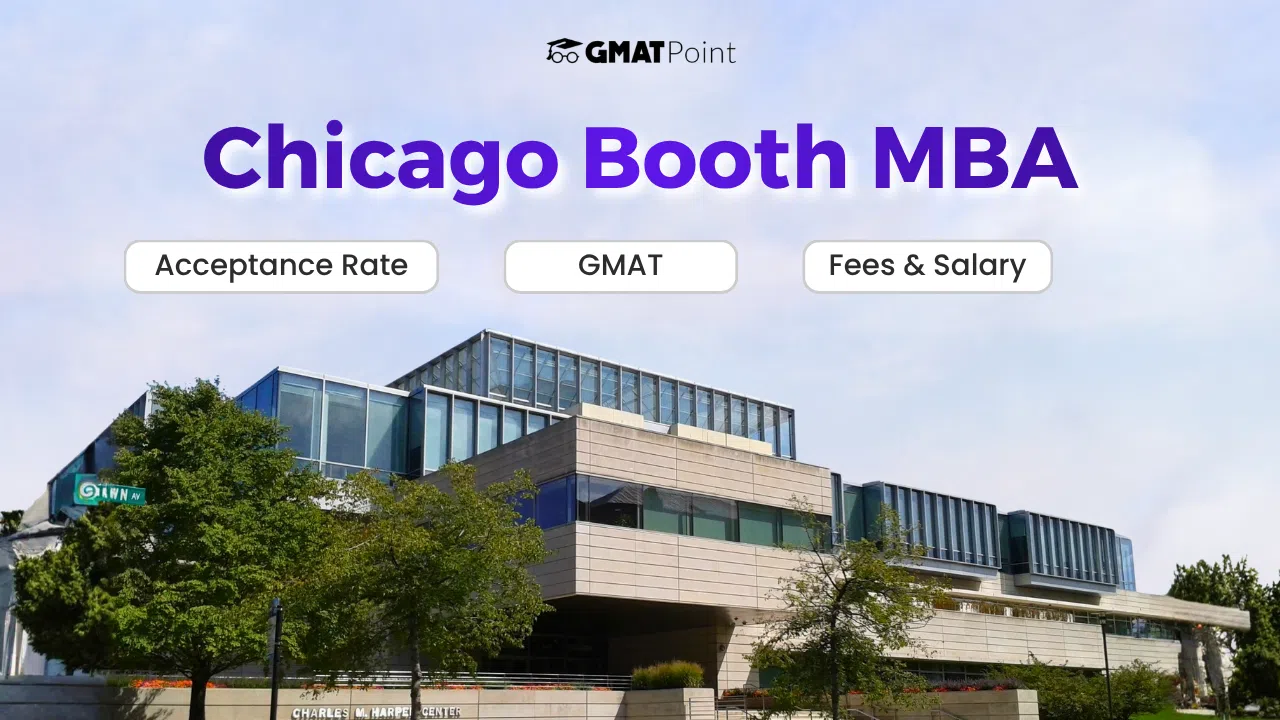

The Chicago Booth School of Business is the business school of the University of Chicago. Its Full-Time MBA is a 21-month program known for its highly flexible curriculum, which allows students considerable freedom in shaping their academic experience.
The Booth curriculum has one required course, LEAD, along with a qualified work-experience requirement, such as a summer internship or other qualifying professional experience. Students can also choose from 16 optional concentrations based on their academic interests and career goals. This article covers the latest Chicago Booth MBA class profile, GMAT and GRE scores, admission requirements, application deadlines, fees, scholarships, and employment outcomes.
Download Chicago Booth School of Business PDF
Chicago Booth MBA Class Profile
The Chicago Booth MBA Class of 2027 has 635 Full-Time MBA students from a wide range of academic, professional, and personal backgrounds. The class represents 63 countries, with international students making up 37% of the cohort. Women account for 41% of the class, while 12% are first-generation students and 11% are veterans.
Students in the class represent 286 undergraduate institutions and have an average of five years of work experience. The average GPA is 3.6, while the reported GPA range is 2.5-4.0 for applicable US institutions using a 4.0 scale.
Metric | Class of 2027 |
Full-Time MBA Students | 635 |
Applications Submitted | 5,876 |
Joint Degree Students | 60 |
Countries Represented | 63 |
International Students | 37% |
Women | 41% |
First-Generation Students | 12% |
Veterans | 11% |
Average Work Experience | 5 years |
Undergraduate Institutions Represented | 286 |
Average GPA* | 3.6 |
GPA Range* | 2.5-4.0 |
Students Holding Graduate-Level Degrees | 15% |
*The average GPA is based on a 4.0 scale for domestic applicants. The GPA range is based on a 4.0 scale for US-based institutions.
Undergraduate Academic Background
Chicago Booth attracts students from a variety of undergraduate academic backgrounds. Business and economics together account for half of the Class of 2027, while engineering, liberal arts, physical sciences, law, and other disciplines are also represented.
Undergraduate Field | Share |
Business | 26% |
Economics | 24% |
Engineering | 21% |
Liberal Arts | 13% |
Physical Sciences | 9% |
Other | 5% |
Law | 2% |
Curriculum at a Glance
Chicago Booth’s Full-Time MBA is a 21-month program with a highly flexible curriculum. LEAD, or Leadership Exploration and Development, is the program’s one required course. Students can also choose from 16 optional concentrations to develop deeper expertise in areas relevant to their interests and career goals. The program additionally requires qualified work experience, such as a summer internship or another qualifying professional experience.
One of the ways to increase your chances of getting into Chicago Booth, irrespective of your background, is to secure a strong GMAT score. And the best way to do so is by utilizing study materials and resources curated by experts and top scorers.
Check out: GMAT Courses by 785 Scorer
Chicago Booth MBA Acceptance Rate and GMAT Score
Chicago Booth does not currently publish an official acceptance rate for its latest MBA class. The Class of 2027 received 5,876 applications and enrolled 635 Full-Time MBA students. However, these figures cannot be used to calculate the acceptance rate because the number of students enrolled is not the same as the total number of admission offers made.
Chicago Booth MBA GMAT and GRE Scores
The Chicago Booth Class of 2027 includes students who submitted scores from the previous GMAT 10th Edition, the current GMAT exam, and the GRE. These figures describe the academic profile of enrolled students and should not be interpreted as admission cutoffs.
Test | Representation | Average | Median | Middle 80% Range |
GMAT (10th Edition) | 14% | 736 | 740 | 690-770 |
GMAT (Current Exam) | 39% | 670 | 675 | 615-725 |
GRE Quantitative Reasoning | 42% | 163 | Not publicly disclosed | 156-169 |
GRE Verbal Reasoning | 42% | 161 | Not publicly disclosed | 155-167 |
Note: The test percentages do not total 100% because alternate testing requirements apply to certain University of Chicago-affiliated and joint-degree applicants.
Booth also reports an overall GMAT average of 729 and a median of 730 for the Class of 2027. The school does not have an established minimum GMAT or GRE score for admission. The middle 80% ranges represent the scores achieved by the middle 80% of the relevant students and should not be treated as required score ranges for applicants.
To gauge your current score level against Chicago Booth MBA’s class profile, along with the class profiles from multiple top b-schools in the world take a Free GMAT Mock Test by 100 Percentiler.
Chicago Booth MBA Admission Requirements
Applicants to the Chicago Booth Full-Time MBA must meet the school’s academic and application requirements. Booth follows a holistic admissions process that considers an applicant’s academic background, professional experience, career goals, personal qualities, recommendations, and other components of their application.
Requirement | Details |
Undergraduate Degree | Bachelor’s degree from an accredited US institution or equivalent international degree |
GMAT/GRE | Required; no established minimum score. Optional for current University of Chicago undergraduate students and graduates of a UChicago program |
English Proficiency | TOEFL, IELTS Academic, PTE, or Duolingo English Test may be required depending on the applicant’s background |
Work Experience | No stated minimum (Class of 2027 average: 5 years) |
Application Materials | Resume, transcripts, one recommendation, and responses to application questions |
Application Fee | $250 |
Interview | By invitation only; required for admission |
Chicago Booth MBA Application Questions
For the 2026-27 admissions cycle, Booth requires applicants to answer four short-answer questions. Each response has a 300-character limit:
- “What is your immediate post-MBA career goal?”
- “What is your long-term post-MBA career goal?”
- “Upload an image and explain its significance to you.”
- “Share a fun fact or something unique about yourself.”
Applicants can also respond to an optional question:
“Is there any unclear information in your application that needs further explanation or additional details you would like to share with the Admissions Committee?”
The optional response has a maximum limit of 300 words.
Recommendation
Chicago Booth requires one letter of recommendation. The school prefers a recommendation from the applicant’s current supervisor. If this is not possible, the applicant should explain why.
Applicants who own a business or work in a family-run business may use a client or another business contact who can provide an objective assessment of their professional performance.
Interview
Chicago Booth MBA interviews are by invitation only and are required for admission for candidates who are invited to interview. Interviews are conducted virtually, and invited applicants must also complete a brief virtual interactive exercise.
To get into the Chicago Booth MBA, candidates are suggested to prepare exceptionally well thought-out applications. To do so, one should seek the Expert Guidance.
Check out: GMAT Expert Mentorship
Chicago Booth MBA Application Deadlines
Applicants to the Chicago Booth Full-Time MBA can apply through one of three standard admission rounds. Applications and all required materials must be submitted by 11:59 p.m. Central Time on the respective deadline.
Round | Submission Deadline | Decision Notification Date |
Round 1 | September 15, 2026, 11:59 p.m. CT | December 3, 2026 |
Round 2 | January 7, 2027, 11:59 p.m. CT | March 25, 2027 |
Round 3 | April 1, 2027, 11:59 p.m. CT | May 20, 2027 |
Chicago Booth Scholars | April 1, 2027, 11:59 p.m. CT | June 24, 2027 |
Chicago Booth Scholars is Booth’s deferred-admission program for undergraduate students. Its submission deadline is the same as the Round 3 deadline—April 1, 2027—but it has a separate decision notification date of June 24, 2027.
Applicants targeting a particular application round should work backwards from their deadline and leave sufficient time for test preparation. To build a structured study plan, that is personalised to your timelines, target scores, and other factors, check outGMAT Expert Mentorship
Chicago Booth MBA Fees and Cost of Attendance
Chicago Booth’s official estimated cost of attendance for 2026-27 is $132,449. However, this does not represent the cost of the entire MBA. The official estimate covers three quarters, or nine months, of the academic year.
Since the Full-Time MBA runs for 21 months, students will incur additional costs beyond the nine months covered by the current estimate. Chicago Booth has not yet published its 2027-28 tuition and cost-of-attendance figures.
Expense | Official 2026-27 Cost | Extrapolated Two-Year Cost* |
Tuition | $89,976 | $179,952 |
Student Services Fee | $1,560 | $3,120 |
Administrative Service Fee | $3,100 | N/A |
Lifetime Transcript Fee | $84 | N/A |
Books & Course Materials | $549 | $1,098 |
Housing & Food | $26,010 | $52,020 |
Miscellaneous Personal Expenses | $7,770 | $15,540 |
Transportation | $1,800 | $3,600 |
Computer Allowance | $1,600 | N/A |
Official/Extrapolated Total | $132,449 | $255,340* |
*Recurring costs have been projected across two years. Actual 2027-28 tuition, fees, and living expenses may differ. Chicago Booth states that tuition for 2027-28 will be released in Spring 2027.
Tuition is the largest component of the official 2026-27 cost of attendance at $89,976. The $132,449 official estimate also includes housing, food, personal expenses, transportation, books and course materials, and other applicable fees and allowances.
Booth advises students to budget separately for optional experiences beyond the standard cost of attendance, including Random Walks, Industry Treks, student groups, and events.
Chicago Booth MBA Scholarships
Chicago Booth offers scholarships and fellowships to selected admitted students. A separate application is not required for Booth merit-based scholarships, as MBA applicants are automatically considered.
Scholarship decisions may take into account factors such as academic merit, interview performance, career goals, prospective concentration, competitiveness, and life experiences. Award amounts vary among recipients.
Students can also explore loans and external funding options to finance their MBA.
Chicago Booth MBA Salary and Employment
The latest Chicago Booth employment data covers the Class of 2025. Within three months of graduation, 89.1% of graduates had received full-time job offers. The median base salary was $175,000, while the median sign-on bonus was $30,000.
Employment Metric | Class of 2025 |
Full-Time Job Offers Within 3 Months | 89.1% |
Median Base Salary | $175,000 |
Median Sign-On Bonus | $30,000 |
Graduates Receiving a Sign-On Bonus | 65% |
Unique Companies Hiring Booth Students | 170 |
School-Facilitated Hires | 72% |
*The sign-on bonus figures apply to graduates who accepted offers and reported the relevant compensation information.
Employment by Industry
Consulting was the largest employment industry for the Class of 2025, accounting for 36.7% of employment, followed by technology at 14.1%. Financial services also accounted for a substantial share across diversified financial services, investment banking, investment management, and private equity.
Industry | Share |
Consulting | 36.7% |
Technology | 14.1% |
Diversified Financial Services | 9.0% |
Investment Banking/Brokerage | 8.3% |
Investment Management/Research | 5.3% |
Private Equity | 5.3% |
Other Industries | 21.3% |
Employment by Function
Consulting was also the largest job function, accounting for 37.8% of employment. Investment banking was the second-largest function at 11.9%, followed by corporate strategy/strategic planning at 6.2%.
Function | Share |
Consulting | 37.8% |
Investment Banking | 11.9% |
Corporate Strategy/Strategic Planning | 6.2% |
Investment Management/Research | 5.8% |
Private Equity | 5.5% |
Other Functions | 32.8% |
Major Employers
Booth graduates joined companies across consulting, technology, and financial services. Major employers reported by the school include Boston Consulting Group, McKinsey & Company, Bain & Company, JPMorgan Chase, Amazon, Google, Goldman Sachs, Capital One, Citigroup, Deloitte Consulting, Evercore, EY-Parthenon, Jefferies, L.E.K. Consulting, PwC, and Strategy&.
Chicago Booth MBA Employment by US Region
Of the accepted job offers reported for the Class of 2025, 95% were located in the United States. The regional percentages below represent shares of overall reported employment rather than shares calculated only among graduates working in the US.
US Region | Share of Overall Employment |
Midwest | 32.2% |
Northeast | 29.0% |
West | 19.6% |
Southwest | 4.7% |
South | 4.7% |
Mid-Atlantic | 4.7% |
*The numbers do not add up to 100%, since not all employment was based in the US.
The Midwest was the largest US regional destination at 32.2%, followed by the Northeast at 29.0% and the West at 19.6%. At the metropolitan level, Chicago accounted for 30.7% of employment, followed by New York at 26.7% and the Bay Area at 11.3%.
Conclusion
Chicago Booth’s Full-Time MBA combines a flexible 21-month curriculum with a class that averages five years of professional experience. For the Class of 2027, the average score among students who submitted the current GMAT was 670, while Booth does not specify a minimum GMAT or GRE score for admission.
For 2026-27, tuition is $89,976 and the official nine-month cost of attendance is estimated at $132,449. On the career side, the Class of 2025 reported a median base salary of $175,000. Prospective students should consider these factors alongside Booth’s curriculum, career outcomes, admissions profile, and their individual MBA goals when evaluating the program.



































![ISB Programmes Full Breakdown 2026: Compare PGP, PGP YL, Fees & Placements [Free PDF]](https://gmatpoint.com/media/ISB_PDF_Banner.webp "ISB Programmes Full Breakdown 2026: Compare PGP, PGP YL, Fees & Placements [Free PDF]")