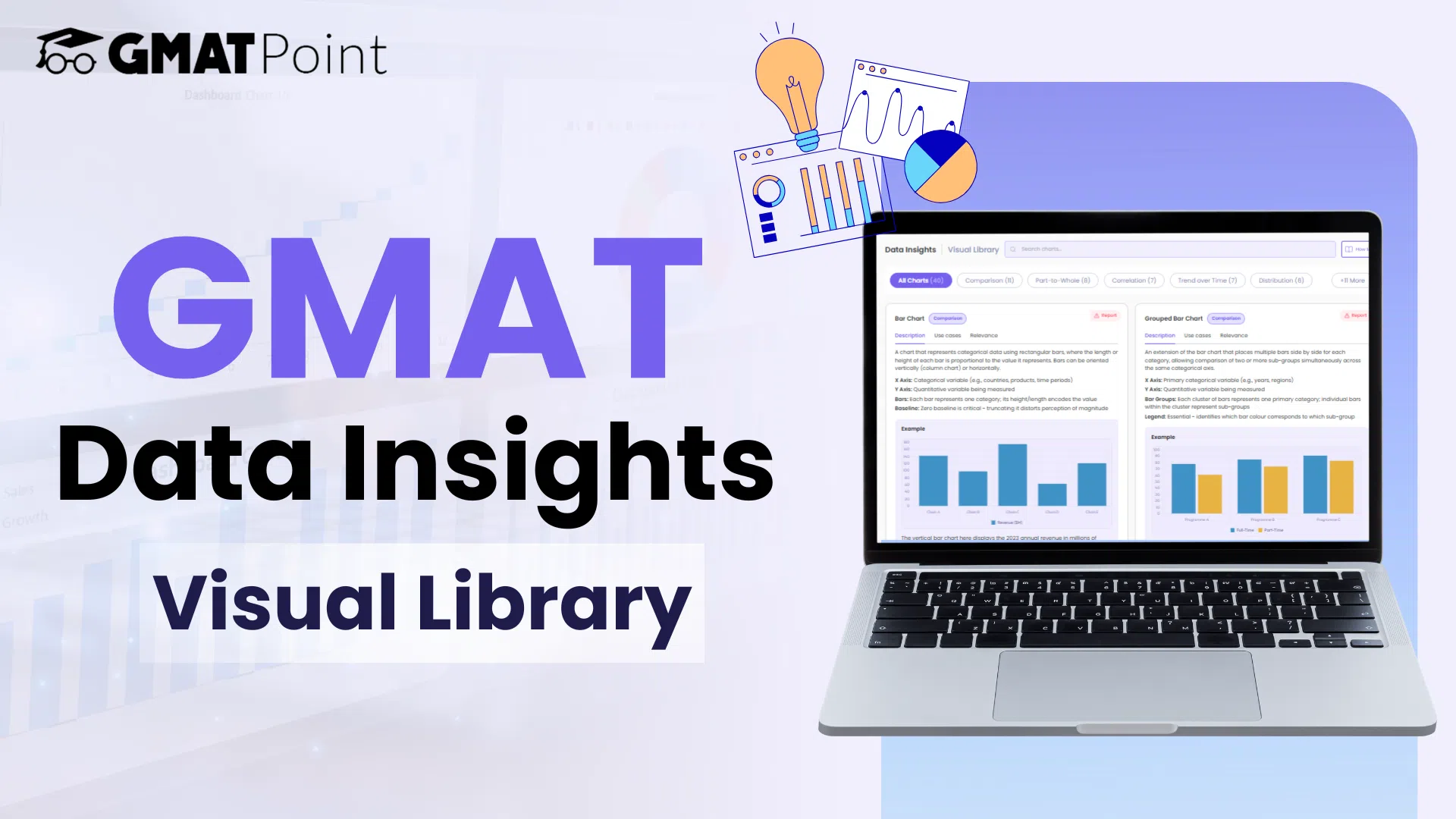
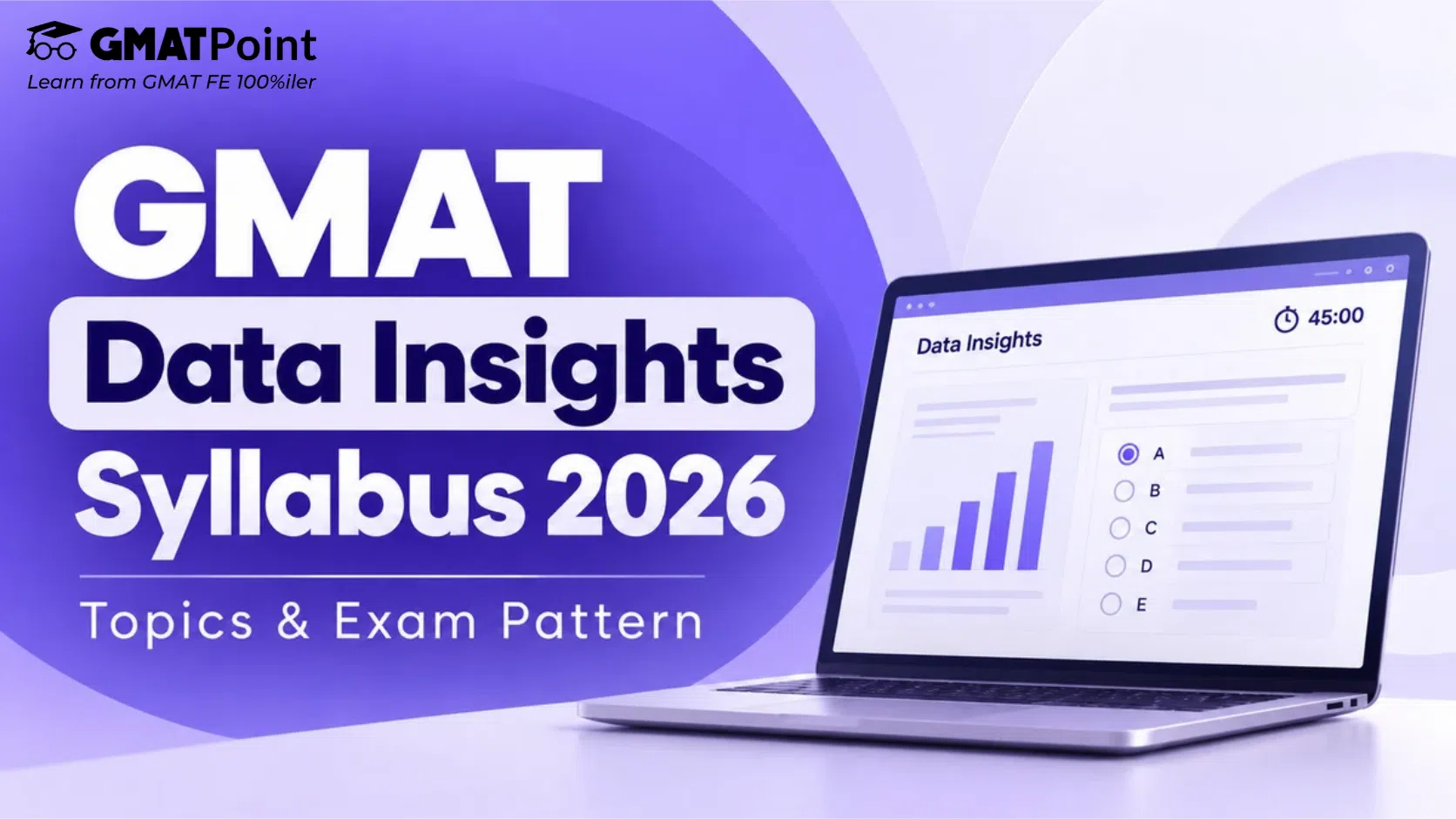

GMAT Data Insights is one of the three sections of the GMAT, alongside Quantitative Reasoning and Verbal Reasoning. It tests your ability to understand, analyse and interpret information presented through numbers, graphs, tables and written passages. The section contains 20 questions to be answered in 45 minutes, covering five different question types.
Unlike a traditional mathematics section, Data Insights focuses on how effectively you can use information to solve problems and make decisions. An on-screen calculator is also available during this section. Understanding the GMAT Data Insights syllabus 2026 is important before starting your preparation. This guide covers the complete syllabus, question types, exam pattern, difficulty level and practical preparation strategies.
GMAT Data Insights Syllabus 2026
The GMAT Data Insights syllabus covers data interpretation, quantitative reasoning, logical analysis and decision-making based on the information provided. Questions can include numerical data, written statements, graphs, tables or a combination of these formats.
The section evaluates how well you can identify relevant information, establish relationships between different pieces of data and reach logical conclusions. Rather than simply testing mathematical knowledge, it focuses on applying analytical skills to solve problems.
According to the Graduate Management Admission Council (GMAC), Data Insights consists of five official question types.
Question Type | Skills Tested | What You Need to Do |
Data Sufficiency | Quantitative reasoning and logical analysis | Determine if and when the information provided is sufficient to answer a question |
Multi-Source Reasoning | Information analysis and critical reasoning | Combine information from multiple sources to evaluate statements and draw conclusions |
Table Analysis | Data interpretation and comparison | Sort and analyse tabular data to determine whether given conditions are satisfied |
Graphics Interpretation | Visual data interpretation | Interpret graphs and charts to identify trends, relationships and values |
Two-Part Analysis | Analytical reasoning and problem-solving | Answer two related parts of a problem involving quantitative, verbal or combined reasoning |
These five formats make up the official Data Insights question types. However, GMAC does not publish a fixed number of questions for each type. Therefore, candidates should prepare for all five rather than expecting a particular distribution.
Watch this video here by GMAT Expert Mentor to better understand the GMAT Syllabus:
GMAT Data Insights Topics and Question Types
The GMAT Data Insights section contains five question formats, each requiring a different approach to understanding and using information. Some questions focus on numerical reasoning, while others test your ability to interpret written information, compare datasets or evaluate multiple conditions.
Understanding how these question types work will help you choose the right solving approach and avoid spending unnecessary time on calculations.
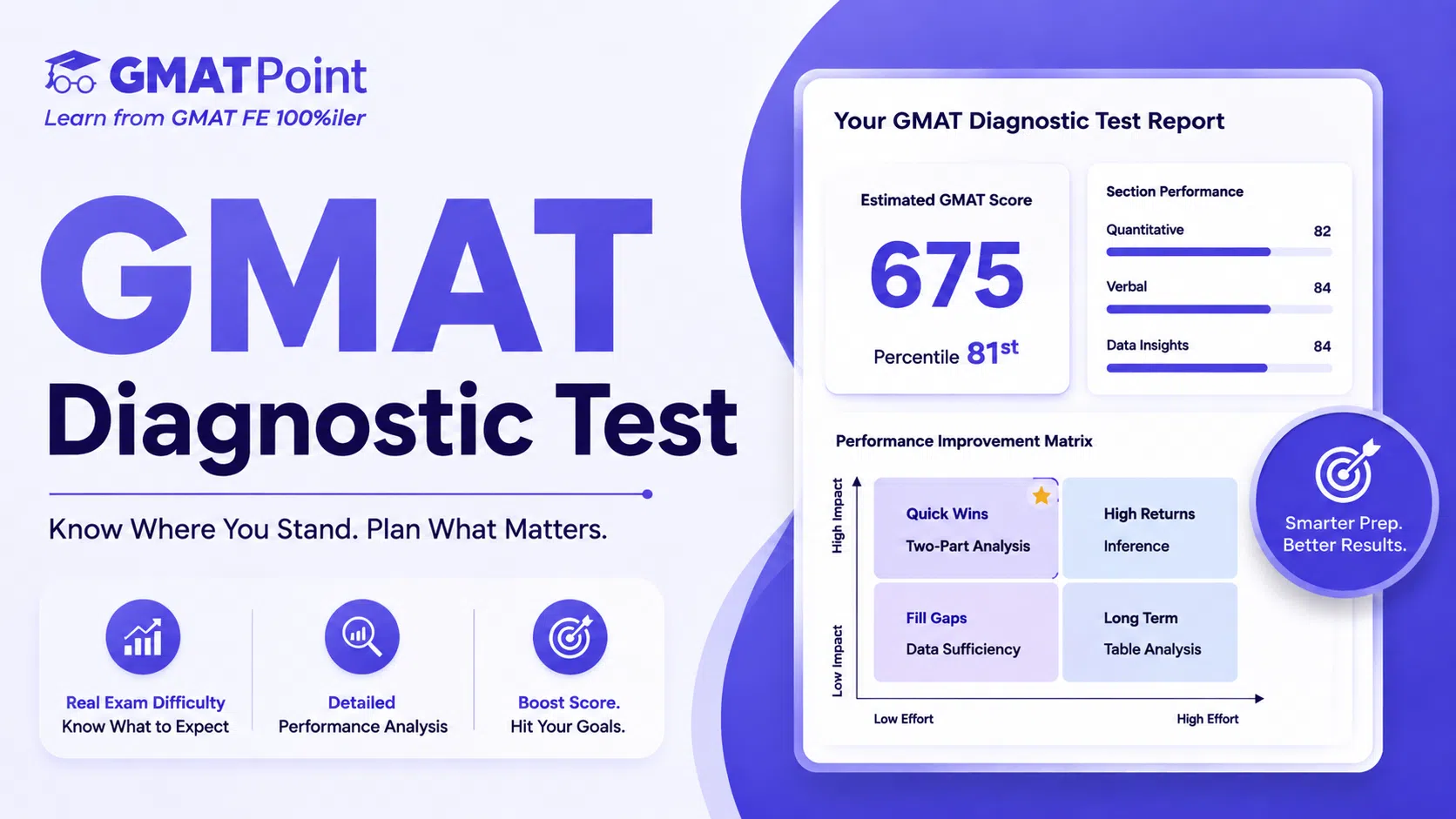
One of the best ways to familiarise yourself with the GMAT Exam Format is to take the Free GMAT Mock Test by 785 Scorer. The test closely simulates the real GMAT experience by using the same question formats and also helps you compare your current score level to the class scores from top business schools around the world.
Data Sufficiency
Data Sufficiency questions present a problem followed by two statements containing additional information. Your task is to decide whether the statements provide enough information to answer the problem.
The focus is on determining whether the information is sufficient, rather than necessarily calculating the final answer.
These questions may involve arithmetic, algebra, number properties, ratios, percentages and word problems. You must evaluate each statement independently and then consider them together if required.
For example, suppose a question asks for the value of a number. One statement tells you that the number is greater than 10, while another tells you that it is less than 15. Even when both statements are combined, several values may be possible. The information would therefore be insufficient to determine a unique value.
The key preparation skill is learning to recognise when enough information is available without performing unnecessary calculations.
Multi-Source Reasoning
Multi-Source Reasoning questions present information across multiple tabs. These tabs may contain written passages, tables, graphs or a combination of formats.
You must examine the relevant sources, compare details and use the information to answer questions. Some problems require identifying inconsistencies, while others involve drawing conclusions or evaluating statements.
For example, one tab might contain a company's sales figures, another might show operating costs, and a third might explain changes in market conditions. You may need to combine information from these sources to assess whether a particular conclusion is supported.
A useful approach is to understand what each tab contains before analysing the details. This makes it easier to locate the required information without repeatedly reading every source.
Table Analysis
Table Analysis questions present data in a sortable table, similar to a spreadsheet. The information may include numerical values, percentages, categories or other variables.
You must examine the table and determine whether particular statements are true or false, or whether specified conditions are satisfied.
For example, a table showing revenue, expenses and employee numbers across several companies might require you to identify which companies have revenue above a particular threshold while maintaining expenses below a specified amount.
Preparation should focus on comparing values, interpreting ratios and percentages, and using the sorting functionality effectively.
You do not need to memorise the entire table. Instead, identify the relevant columns and use them to evaluate each statement.
Graphics Interpretation
Graphics Interpretation questions test your ability to understand information presented through graphs and charts. These may include bar charts, line graphs, scatter plots, pie charts and statistical distributions.
You may need to identify trends, compare values, calculate proportions or determine relationships between variables.
For example, a line graph might display a company's revenue over several years. A question could ask you to identify the year with the greatest percentage increase rather than the highest revenue.
This distinction matters because interpreting a graph involves more than reading individual values.
Pay close attention to axis labels, scales, units and any accompanying information. Candidates should also become comfortable interpreting graphical information alongside written conditions.
Two-Part Analysis
Two-Part Analysis questions require you to answer two parts of a problem. The response is generally presented in a table with two answer columns.
These questions may involve quantitative problems, verbal reasoning, simultaneous equations, logical conditions or evaluating trade-offs.
For example, a problem might describe two products with different selling prices and production costs. You may be asked to determine the number of units of each product that satisfy particular revenue and cost conditions.
Some questions contain two closely connected tasks, while others allow the two parts to be solved independently.
The important point is that both answers must be correct for the question to receive credit. Candidates should carefully evaluate all answer options and check that their selections satisfy the conditions.
Candidates looking for focussed practice for the Data Insights section are strongly advised to try doing so through Data Insights Sectional Tests by 785 Scorer. These tests allow candidates to practice DI in depth with all question formats, along with the added benefit of being a quick, 45 minute test. This way, candidates looking for focussed DI practice don’t have to give a full-length mock every time they want to practice DI under time pressure.
GMAT Data Insights Exam Pattern 2026
The GMAT Data Insights exam pattern consists of 20 questions to be completed within 45 minutes. It is one of three equally weighted sections in the GMAT, meaning your Data Insights performance contributes directly to your overall score.
The section includes five question types, but their individual distribution is not fixed. Questions can also have different response formats depending on the type.
The table below provides the important exam details.
Particular | GMAT Data Insights Exam Details |
Section | Data Insights |
Number of Questions | 20 |
Duration | 45 minutes |
Question Types | 5 |
Section Score Range | 60-90 |
Average Time per Question | 2 minutes 15 seconds |
On-Screen Calculator | Available |
Question Formats | Multiple-choice and multi-part response formats |
Negative Marking | No fixed negative-marking scheme; incorrect and unanswered questions affect the score under the adaptive exam nature |
Contribution to Overall Score | Equally weighted with Quantitative and Verbal Reasoning |
Overall GMAT Score Range | 205-805 |
Question Review & Edit | Review questions and change up to 3 answers per section if time remains after answering all questions |
The current GMAT has a total of 64 questions across its three sections and a testing duration of 2 hours and 15 minutes, excluding the optional break. Unlike the Integrated Reasoning section of the older GMAT, Data Insights contributes to the current GMAT total score.
Candidates looking to improve their GMAT score across any of the sections are advised to utilise study materials prepared by experts and top scorers. GMAT Courses by 785 Scorer are extremely well-aligned to the real GMAT Exam and are hence a great resource for your exam preparation.
Time Management and Calculator Use
With 45 minutes for 20 questions, you have an average of approximately 2 minutes and 15 seconds per question. This is a pacing benchmark, not a strict time limit for individual questions.
Some questions, particularly those involving multiple sources or complex conditions, may take longer than others.
An on-screen calculator is available throughout Data Insights. However, using it for every calculation may not be efficient. Practise estimating values, simplifying calculations and recognising relationships before reaching for the calculator.
You should also avoid spending excessive time on a single difficult question, especially when several questions remain unanswered.
Scoring, Section Order and Question Review
Data Insights is scored on a scale of 60-90, with the same overall weighting as Quantitative and Verbal Reasoning. The total GMAT score ranges from 205 to 805.
Candidates can choose the order in which they attempt the three sections according to their strengths and test-taking preferences.
The GMAT also provides a Question Review & Edit feature. You can bookmark questions while answering a section. Once you have answered all questions in that section, you can access the review screen, provided time remains.
You can review as many questions as you want and change up to three answers per section. However, there is no separate review period. If the section timer expires, you cannot return to review or edit your responses.
Therefore, completing all questions within the allotted time should remain a priority.
Is GMAT Data Insights Difficult?
GMAT Data Insights can be challenging because it requires you to interpret information, evaluate conditions and make decisions within a limited time. However, the difficulty varies depending on your comfort with quantitative reasoning, critical thinking and data interpretation.
Multi-Source Reasoning questions can take time because you must examine information across different tabs. Table Analysis and Graphics Interpretation require attention to labels, scales, numerical relationships and specific conditions.
Data Sufficiency presents a different challenge. Even when the calculations are simple, identifying whether the information is sufficient requires careful logical reasoning.
Two-Part Analysis questions can also be tricky because both responses must be correct.
There is no official difficulty ranking for the five question types. A candidate comfortable with mathematics may find Data Sufficiency manageable but struggle with lengthy Multi-Source Reasoning questions, while another candidate may experience the opposite.
The best approach is to practise all five formats, identify recurring errors and become comfortable solving questions under timed conditions.
To improve your exam approach, it is strongly advised to discuss with with someone who already holds a high GMAT score, since they can provide you with insights that are not only useful but also exceptional to find.
Check out: GMAT Expert Mentorship
How to Prepare for GMAT Data Insights 2026?
Preparing for GMAT Data Insights requires a combination of conceptual clarity, familiarity with question formats and consistent practice. Rather than jumping directly into full-length tests, build your understanding of each question type and gradually improve your speed and accuracy.
Here are five practical ways to prepare.
Understand All Five Question Types
Start by learning the response format and solving approach for Data Sufficiency, Multi-Source Reasoning, Table Analysis, Graphics Interpretation and Two-Part Analysis.
Understand what each question asks you to determine before attempting more difficult problems. Familiarity with the formats will help you spend less time figuring out the instructions during the exam.
Strengthen Your Foundational Skills
Revise essential concepts such as percentages, ratios, averages, arithmetic, algebra and logical reasoning.
These skills are useful when interpreting datasets, comparing quantities and evaluating whether the given information is sufficient.
Focus on applying concepts rather than memorising formulas alone.
Practise One Question Type at a Time
Begin with topic-wise practice before moving to mixed Data Insights sets.
For example, practise Data Sufficiency questions until you become comfortable evaluating statements independently. Similarly, work on interpreting tables and graphs before attempting more complex questions involving multiple information sources.
After every practice session, review incorrect answers to understand whether the mistake came from a calculation, misinterpretation or reasoning error.
Improve Speed Without Compromising Accuracy
Time management is especially important in Data Insights because different question formats require different amounts of reading and analysis.
Practise timed sets and track how long you spend on each type. Learn to recognise when a calculation is unnecessary, when information can be ignored and when you should move on from a difficult question.
The objective is not to solve every question at the same speed but to manage the entire 45-minute section effectively.
Take Mock Tests and Analyse Your Performance
Once you are comfortable with individual question types, attempt sectional practice tests and full-length GMAT mocks.
Free GMAT Mock Tests by 785 Scorer are a great way to start your journey with GMAT Mocks, since they simulate the real GMAT experience, and have been curated by experts and top scorers in GMAT.
Conclusion
The GMAT Data Insights Syllabus 2026 covers five question types that test your ability to interpret data, evaluate information and solve problems using logical and quantitative reasoning. Understanding these formats and the exam pattern is the first step towards effective preparation.
To perform well in GMAT Data Insights, focus on building strong fundamentals, practising each question type and improving your accuracy under timed conditions. Regular mock tests and careful analysis of your mistakes will help you identify weak areas and approach the section with greater confidence.