
Is GMAT difficult? The GMAT can be challenging, but there is no single difficulty level that applies to every test taker. How hard it feels depends on your Quant fundamentals, reading and reasoning ability, comfort with data, target score, and preparation time.
The GMAT is not difficult because it requires an unusually vast syllabus or highly advanced mathematics. The challenge lies in applying concepts accurately, reasoning through unfamiliar questions, and making good decisions under time pressure. A competitive target such as 645+ also demands greater consistency across the exam.
If you are starting your preparation and want to understand your current level compared to the scores required for your target schools, taking a Free GMAT Mock Test can give you a useful baseline before you build a study plan. Compare
Is the GMAT Really Difficult?
The GMAT is challenging, but it is learnable with systematic preparation. Its difficulty comes less from obscure theory and more from applying concepts efficiently in a reasoning-heavy test environment.
The exam rewards logical reasoning, problem solving, reading comprehension, data interpretation, accuracy, and time management. A candidate with strong fundamentals may still struggle with pacing or avoidable mistakes, while someone with weaker fundamentals may need more time before moving to timed practice.
Your target score also changes the level of difficulty. Preparing for a moderate score and preparing for a highly competitive one are not the same task. As the target rises, softer weaknesses in accuracy, pacing, or specific question types become more important.
So, is GMAT difficult for an average student? It can be, especially at the beginning, but the exam is not reserved for candidates with exceptional mathematics or English skills. Focused preparation can make the challenge much more manageable.
Expert guidance can be a huge advantage when it comes to building study plans that are suited to your individual strengths and capabilities, since experts have real-exam experience, and know the whats and hows of improvement. Check out: GMATPoint Mentorship
Why Does the GMAT Feel Difficult?
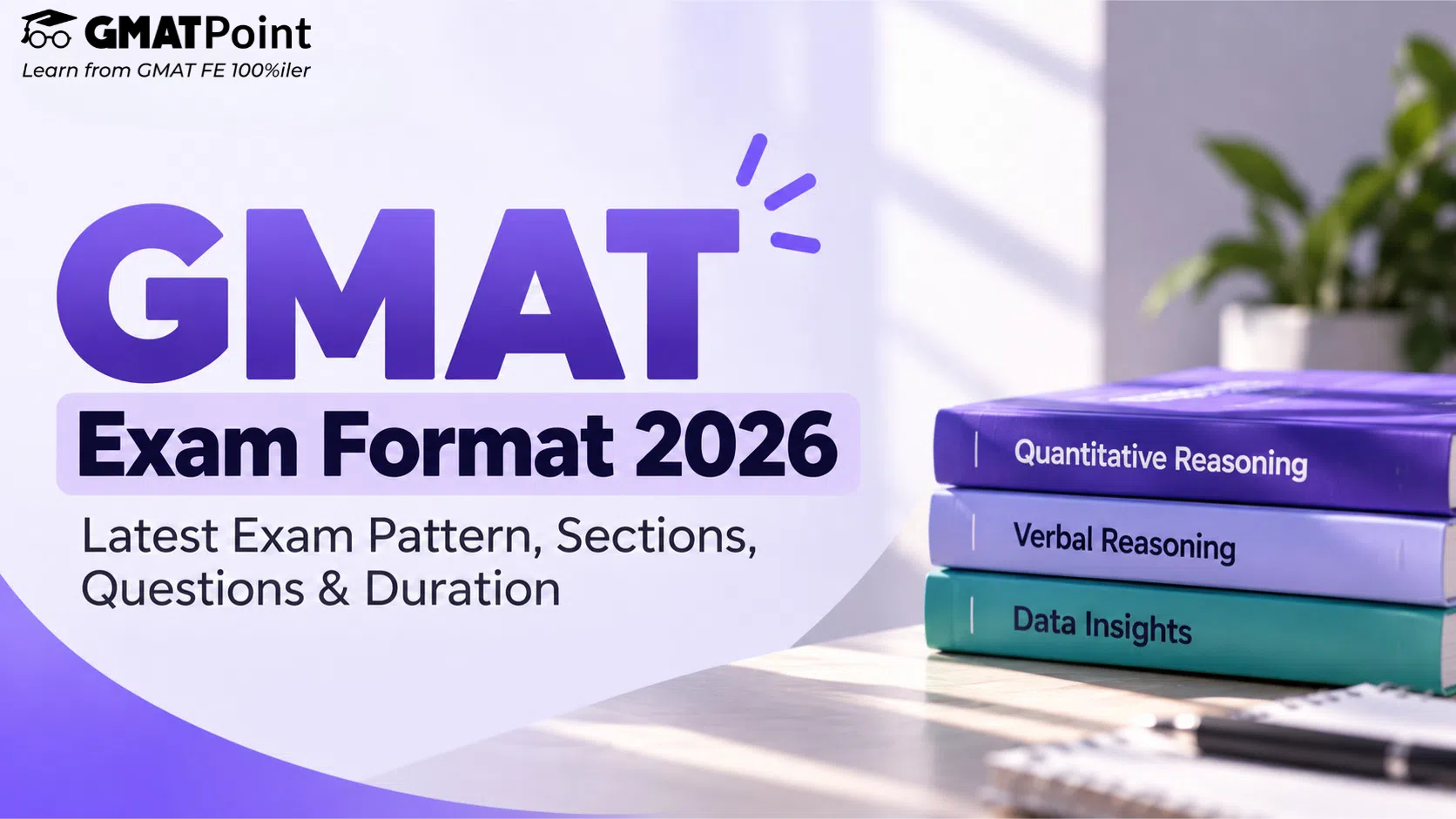
The GMAT combines reasoning, accuracy, and time management instead of rewarding memorisation alone. The current exam has 64 questions across Quantitative Reasoning, Verbal Reasoning, and Data Insights, with 45 minutes allotted to each section.
Several factors contribute to the GMAT difficulty level:
- Time pressure: Knowing how to solve a question is different from solving it accurately within the available time.
- Reasoning-based questions: Memorising rules or formulas is not enough. Questions often require interpretation, efficient problem solving, and careful evaluation of answer choices.
- Computer-adaptive testing: The GMAT adjusts question difficulty based on your performance as you move through a section. A correct answer may be followed by a harder question, while an incorrect answer may lead to an easier one. Your score reflects the overall pattern of responses.
- Pacing decisions: You cannot freely skip around the section while answering questions, so spending too long on one question can affect later questions. After completing a section, candidates with time remaining can review questions and edit up to three answers.
- Mixed skills in Data Insights: Data Insights can require numerical reasoning, reading comprehension, and data analysis within the same section.
- Consistency: Quantitative Reasoning, Verbal Reasoning, and Data Insights are equally weighted in the total score.
If you’re looking for GMAT preparation material, designed by top scorers and experts, check out: GMAT Courses.
Which GMAT Section Is the Hardest?
There is no single hardest GMAT section for every candidate. The answer depends on your strengths because each section tests a different combination of reasoning and application.
Section | Why Students May Find It Difficult | Who May Find It Easier |
Quantitative Reasoning | Problem solving, mathematical reasoning, and pacing | Students with strong mathematical fundamentals |
Verbal Reasoning | Reading and critical reasoning under time pressure | Strong readers and logical thinkers |
Data Insights | Multiple data formats and mixed reasoning | Candidates comfortable analysing tables, graphs, and data |
Quantitative Reasoning
Quantitative Reasoning is not simply a test of formulas. You need to understand mathematical principles, translate word problems into mathematical relationships, and choose efficient solution methods. Lengthy calculations can create time-management problems even when the concepts are familiar.
Verbal Reasoning
Verbal Reasoning tests Reading Comprehension and Critical Reasoning. The challenge lies in understanding passages precisely, recognising argument structure, evaluating evidence, and eliminating options that sound reasonable but do not fully answer the question.
Data Insights
Data Insights involves Data Sufficiency, tables, graphs, multiple sources of information, and questions requiring quantitative and verbal analysis. Candidates comfortable with only one type of reasoning may need additional practice to become consistent.
How Difficult Is It to Score 645+ on the GMAT?
A score of 645+ is a strong target on the current GMAT. The latest edition uses a 205-805 total score scale, compared with the 200-800 scale used by the previous edition. GMAC describes 645 on the current exam as equivalent to 700 on the previous edition, so the two scales should not be compared number for number.
Reaching 645+ generally requires strong fundamentals, good pacing, high accuracy, and consistent performance across Quantitative Reasoning, Verbal Reasoning, and Data Insights. Simply completing a large volume of questions is not enough.
Practice tests are most useful when followed by detailed analysis. Instead of only counting incorrect answers, identify why each mistake happened:
- Concept gap: The underlying concept was not understood.
- Calculation error: The approach was correct, but the execution was inaccurate.
- Misreading: A condition or important detail was overlooked.
- Time pressure: You understood the question but could not solve it efficiently.
Once your concepts are reasonably strong, full-length GMAT Mock Tests can help identify whether timing, accuracy, or specific question types are keeping you below your target score.
Is the GMAT Harder Than CAT or GRE?
There is no universal answer to whether the GMAT is harder than CAT or GRE because the exams have different formats, purposes, and skill demands.
Factor | GMAT | CAT | GRE |
Primary Admission Use | Graduate business and management programmes | IIM and other participating management programmes in India | Graduate, business, and law programmes |
Quant Style | Reasoning-focused problem solving | Broader and often more mathematically intensive | Quantitative reasoning across standard mathematical topics |
Verbal Style | Reading Comprehension + Critical Reasoning | Reading Comprehension + Verbal Ability | Vocabulary + reading and reasoning |
Data Interpretation | Dedicated Data Insights section | Data Interpretation + Logical Reasoning | Less central to the test |
Indian students who have prepared for CAT may find some GMAT Quant concepts familiar. However, the question style, pacing, and adaptive format still require adjustment. GMAT Verbal also differs from CAT VARC because Critical Reasoning plays a major role.
Data Insights may require separate preparation because it combines data interpretation with quantitative and verbal reasoning. CAT preparation can therefore provide useful foundations, but it does not automatically make the GMAT easy.
The same principle applies to the GRE. The GRE gives greater prominence to vocabulary and allows more navigation within sections, while the GMAT is designed around skills relevant to graduate management education. Rather than asking which test is universally harder, consider which exam better matches your strengths and target programmes.
How Much Preparation Do You Need for the GMAT?
There is no single preparation timeline that works for everyone. The time you need depends on the gap between your current ability and your target score.
Consider the following factors:
- Diagnostic score: Your starting score shows how far you are from your target.
- Target score: A candidate targeting 545 and one targeting 645+ may need different levels of preparation.
- Quant fundamentals: Strong basics can reduce the amount of concept revision required.
- Verbal ability: Reading comprehension and reasoning ability affect how much work is needed in Verbal.
- Data Insights familiarity: Experience interpreting tables, charts, and data can shorten the learning curve.
- Weekly study time: Consistent weekly preparation affects how quickly you move from concepts to timed practice.
- Previous GMAT preparation: Returning candidates may spend more time fixing weaknesses than relearning the full syllabus.
A practical sequence is:
Diagnostic test → Identify gaps → Learn concepts → Topic-wise practice → Timed practice → Full mocks → Analyse mistakes → Revise → Repeat
Conclusion
Students who need structured concept learning can use a GMATPoint Course to work systematically across all three sections. If you are unsure how to convert your diagnostic score into a realistic study plan, GMATPoint Mentorship can help you prioritise areas based on your current level, target score, timeline, and target schools.
The GMAT is challenging, but its difficulty is manageable with the right preparation. Understanding your baseline, strengthening weak areas, practising under timed conditions, and analysing recurring mistakes can make the path to your target score much clearer.





![GMAT Geometry Formulas | Geometry Cheat Sheet [PDF]](https://gmatpoint.com/media/71.webp "GMAT Geometry Formulas | Geometry Cheat Sheet [PDF]")
![GMAT Ratio & Proportion Formulas | Ratio & Proportion Cheat Sheet [PDF]](https://gmatpoint.com/media/73.webp "GMAT Ratio & Proportion Formulas | Ratio & Proportion Cheat Sheet [PDF]")









![ISB Programmes Full Breakdown 2026: Compare PGP, PGP YL, Fees & Placements [Free PDF]](https://gmatpoint.com/media/ISB_PDF_Banner.webp "ISB Programmes Full Breakdown 2026: Compare PGP, PGP YL, Fees & Placements [Free PDF]")




















![GMAT Accepting Colleges in India 2026: MBA Programmes List [Free PDF]](https://gmatpoint.com/media/Colleges_accepting_GMAT_PDF_Banner.webp "GMAT Accepting Colleges in India 2026: MBA Programmes List [Free PDF]")