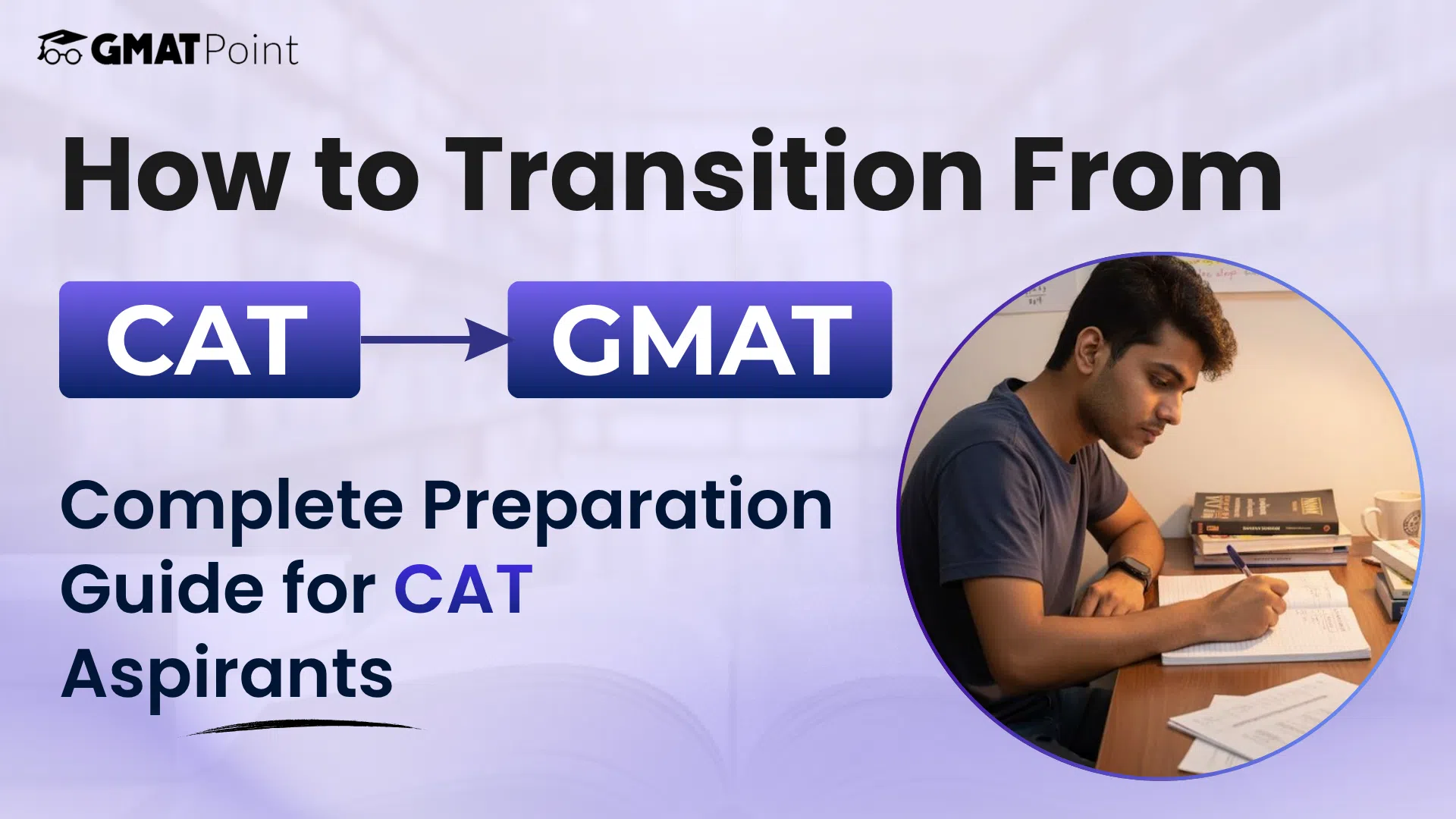


Every year, many CAT aspirants who have spent months building their Quant, VARC, and DILR skills consider taking the GMAT as another pathway to top global and Indian business schools.
One of the biggest questions they have is: “Does CAT preparation help in GMAT, or do I need to start preparing from scratch?”
The answer is that CAT preparation gives you a significant advantage for GMAT preparation. Having been through a strong CAT preparation journey means you already have a stronger foundation than most global candidates. You have already built many of the skills that GMAT tests: mathematical ability, reading comprehension, logical reasoning, data analysis, and decision-making under time pressure. In fact, for some of these skills, CAT is actually harsher than GMAT, so you’re already above and beyond what is expected of a strong performance.
However, GMAT is still a different exam. It has a different structure, different question formats, different priorities and hence requires a different approach. The transition is hence less about learning everything again, but rather more about adapting the existing capabilities to a new framework. For candidates with CAT experience, it is about refinement, not building from scratch.
Candidates who already have a strong CAT foundation can focus on structured GMAT-specific preparation to understand the exam pattern, question types, and strategies required to maximise their score.
In this article, we’ll go over how CAT preparation helps in GMAT, to what extent, and how to leverage your existing experience to maximise your odds of success in the GMAT exam.
How Much Does CAT Quant Preparation Help in GMAT Quant?
Quant is the section where CAT preparation provides one of the biggest advantages when transitioning to GMAT.
The conceptual overlap is extremely high. In fact, GMAT’s Quant syllabus is a subset of CAT’s quant syllabus. So if you have seriously prepared for CAT, you have studied nearly all of the topics you will come across in the GMAT exam. The biggest difference is that GMAT Quant does not involve Geometry, which means that there is in fact one less topic to worry about when preparing for GMAT quant as compared to CAT quant.
The actual strategic difference comes from the format of questions.
CAT Quant is known for its challenging problems. So the difficulty arises from the time it takes to find the right approach and recognising hidden patterns while avoiding traps at the same time. GMAT Quant questions, on the other hand, are generally less focussed on complex calculations and detailed questions and more focussed on logical application of concepts. So the foundation of the problem stays the same, but the level of difficulty arising from minute details decreases. The toughest questions might still have an occasional trap, but they still would rank on the moderate level in CAT conversations.
So someone with experience in CAT Quant doesn’t need to spend months building a different Quant skillset. They just need to maintain their current level at their existing skillset.
Using concise GMAT-specific formula sheets and revision material can help CAT aspirants quickly refresh concepts and focus more time on solving GMAT-style questions.
Does CAT VARC Preparation Help in GMAT Verbal?
CAT VARC preparation also has an advantage for GMAT Verbal Reasoning, especially for Reading Comprehension.
Both CAT and GMAT require you to read complex passages, understand arguments, identify the author’s viewpoint, and answer questions based solely on the information presented.
So they both test comprehension. However, the ways in which they test comprehension are slightly different from one another.
CAT RC vs GMAT RC: What Is the Difference?
The first difference is passage length. CAT Reading Comprehension passages are generally longer, often around 400-600 words, while GMAT Reading Comprehension passages are usually shorter, around 200-400 words. So reading speed is not as heavily tested as it is in CAT. But since the reading discipline (focus and understanding of the flow) stays the same, CAT VARC experience is still a massive benefit when preparing for GMAT Verbal Reasoning, because someone who has prepared for CAT has already spent months reading difficult passages across multiple complex topics.
Does CAT VARC Help in GMAT Critical Reasoning?
While CAT VARC preparation does help in GMAT CR, the overlap is slightly smaller and less direct as compared to Reading Comprehension.
CAT preparation helps you build the foundation for GMAT CR:
- Reading dense information
- Understanding arguments
- Identifying important information
- Connecting ideas
However, GMAT CR has a deeper approach to reasoning. GMAT CR questions typically require you to:
- Find logical fallacies
- Spot gaps between evidence and conclusions
- Evaluate causal relationships
- Identify the quality of evidence
So CAT reasoning-based questions are centred around information that is directly available in the passage. However, GMAT CR frequently tests whether you can independently identify what’s missing from an argument.
For example, a GMAT CR question might have a passage where a character has certain evidence and draws a conclusion from it. However, they might have made a critical assumption that allowed them to neglect other possible conclusions, leaving the one they made as the only possible conclusion.
So a gap exists. But that is acceptable, because it is very manageable. A few hours every week practicing GMAT Critical Reasoning questions to understand the flow of logic that the exam expects is all that someone with good CAT experience needs to perform.
Does CAT DILR Preparation Help in GMAT Data Insights?
CAT DILR preparation transfers extremely well to GMAT DI. In fact, while CAT has logical reasoning puzzles, GMAT doesn’t. This reflects in the names of the sections as well. CAT has Data Interpretation and Logical Reasoning, whereas GMAT has Data Insights.
The core skills tested in both exams have a significant overlap:
- Reading data from tables
- Interpreting charts and graphs
- Finding patterns in data
- Connecting multiple pieces of information from multiple sources
So a CAT aspirant who has solved several difficult DILR sets already has experience working with large, often incomplete data sets under time pressure.
Multi-Source Reasoning in GMAT DI requires you to analyse different types of data from different sources, which is similar to CAT DILR where multiple constraints have to be combined to get to the solution.
Similarly, Table Analysis and Graphical Interpretation in GMAT DI require the same data interpretation skills that one would have developed during their CAT preparation journey.
The only major difference is Data Sufficiency, where you’re not directly asked to solve for an answer. Instead, you are supposed to determine whether the given information is sufficient or not. But even that is something a CAT aspirant has practiced before, especially in DILR sets that have multiple solutions.
CAT vs GMAT Preparation: Key Differences
Area | CAT | GMAT |
Quant | More calculation-heavy and tricky | More reasoning-based |
Geometry | Tested | Not tested |
RC | Longer passages | Shorter passages |
Verbal Focus | Understanding the idea | Evaluating arguments |
Reasoning | Passage-based reasoning | Structured argument analysis |
DI | DILR sets | Data Insights Formats |
Exam Pattern | Fixed scoring | Computer adaptive |
So it really is just the format that one needs to prepare specifically for. Apart from that, the core skillset is near congruent.
How Long Does It Take to Prepare for GMAT After CAT?
The preparation timeline depends on your CAT preparation level, target score, and familiarity with GMAT. However, CAT aspirants generally have a head start because they already possess the required foundational skills.
A practical transition plan might look like this:
First 1-2 Weeks: Understand the GMAT Format
Focus on:
- GMAT question types
- Exam structure
- Adaptive testing strategy
- Official question patterns
Next 4-6 Weeks: Build GMAT-Specific Skills
Focus on:
- Critical Reasoning
- Data Sufficiency
- GMAT Reading Comprehension
- Official GMAT practice questions
Final 2-4 Weeks: Test Practice and Refinement
Focus on:
- Full-length mocks
- Time management
- Error analysis
- Improving consistency
The exact timeline varies, but CAT preparation significantly reduces the learning curve.
Conclusion: Is GMAT Easier After CAT?
CAT preparation gives you a strong foundation for GMAT preparation. Your Quant concepts are already covered. Your VARC preparation builds the reading and comprehension skills needed for GMAT Verbal. Your DILR experience provides a strong base for Data Insights.
The transition from CAT to GMAT is not about starting from zero. It is about adapting your existing skills to a different testing style.
With focused preparation on GMAT-specific question types and strategies, CAT aspirants can make the transition smoothly and efficiently.
For someone who has already invested months preparing for CAT, GMAT preparation is not a completely new journey. It is a natural extension of the skills you have already built.





















![GMAT Accepting Colleges in India 2026: MBA Programmes List [Free PDF]](https://gmatpoint.com/media/Colleges_accepting_GMAT_PDF_Banner.webp "GMAT Accepting Colleges in India 2026: MBA Programmes List [Free PDF]")