
Most GMAT score plateaus are not caused by lack of practice, but by repeated mistakes that go untracked.
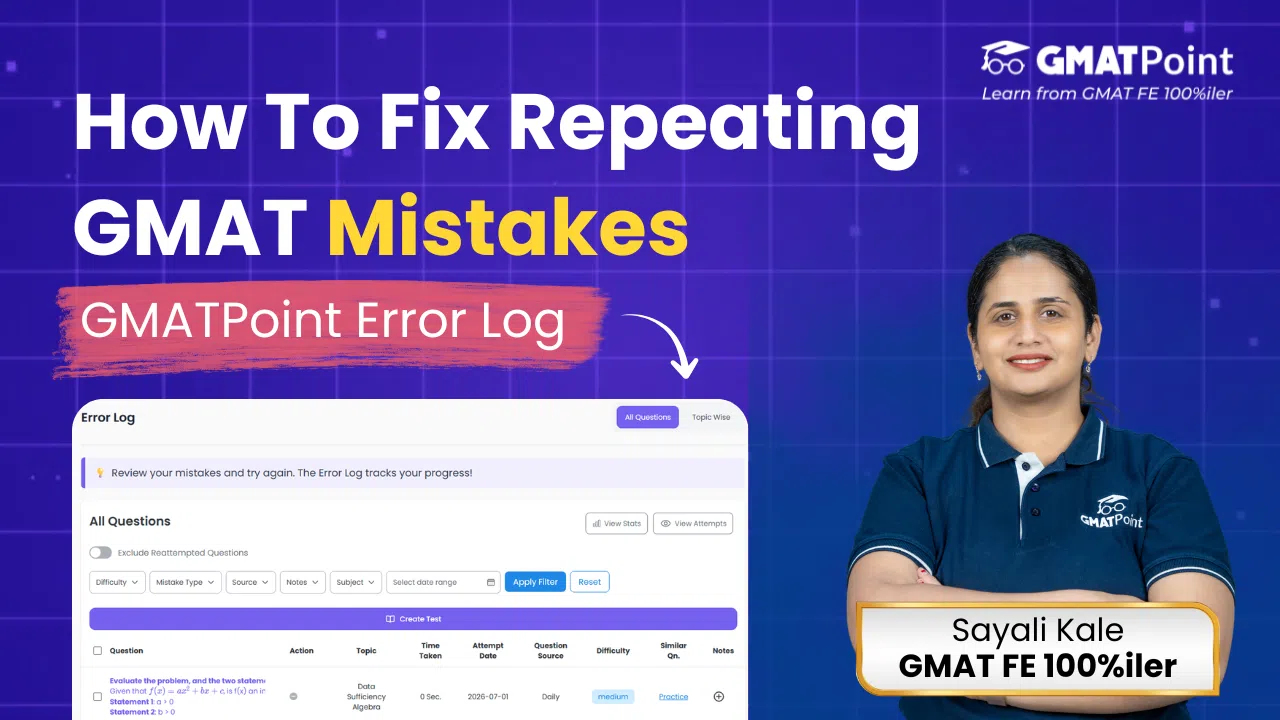
The GMATPoint Error Log is a structured system used during GMAT preparation to identify, categorize, and analyze recurring errors across GMAT Practice andMock Tests. Instead of treating mistakes as isolated events, the Error Log turns them into pattern data. This helps improve accuracy, timing, and decision-making in the GMAT Focus Edition, leading to faster score progression.
Why Most GMAT Preparation Fails
A common issue in GMAT Preparation is repetition without reflection.
Students often:
- Solve large volumes of questions
- Review answers briefly
- Move on without tracking patterns
- Repeat similar mistakes in future tests
This creates a cycle where effort increases, but improvement slows down. The main issue is not practice volume. It is a lack of structured feedback. Without a system to track mistakes, preparation becomes reactive rather than proactive.
What Is the GMATPoint Error Log
The GMATPoint Error Log is a centralized system that records and organizes every meaningful mistake that you’ve made during your preparation. Unlike traditional review methods that focus only on wrong answers, this system captures the full context behind each mistake.
This creates a structured history of performance that evolves over time which completely transforms your preparation from isolated practice into continuous performance tracking.
Key Features of the GMATPoint Error Log
The GMATPoint Error Log is designed as a structured analysis system rather than a simple mistake list.
Complete Mistake Tracking from Day One
Every mistake is stored and retained across your entire preparation journey. This creates a full performance history instead of fragmented review data.
Advanced Filtering System
Students can filter mistakes by:
- Difficulty Level
- Mistake Type (Conceptual, Formula, Time Management, Interpretation, etc.)
- Section (Quant, Verbal, Data Insights)
- Source (Mock, Practice Test, Studyroom)
- Date range
- Personal Notes
This makes it easy to isolate specific weak patterns instead of reviewing everything at once.
Personal Note System
Each mistake includes a dedicated space for notes explaining what caused the error. This helps you focus on a specific pattern every session. These patterns include:
- Misunderstood Question
- Faulty Assumption
- Knowledge Gap
- Did not use elimination
- Forgot Formula
- Mismanaged Time
- Trap Answer Chosen
- Computation Error
- Mental Block
Over time, these notes become more valuable than the questions themselves. For example, if you want a list of the formulas you tend to forget, you can simply filter out using these notes and have the list on your fingertips in seconds.
Now, you don’t have to visit all your notes from day one to find where you lack. The Error Log gives you 14 different patterns you can choose from and fix one at a time.
The improvement pattern looks like this:
Analyse Every Mistake $$\longrightarrow\ $$ Add Notes $$\longrightarrow\ $$ Filter $$\longrightarrow\ $$ Fix
Personalised Test
We have seen how the error log analyses your mistakes. We have also seen how it allows you to make notes. The next step is to filter. The error log has a feature for this too!
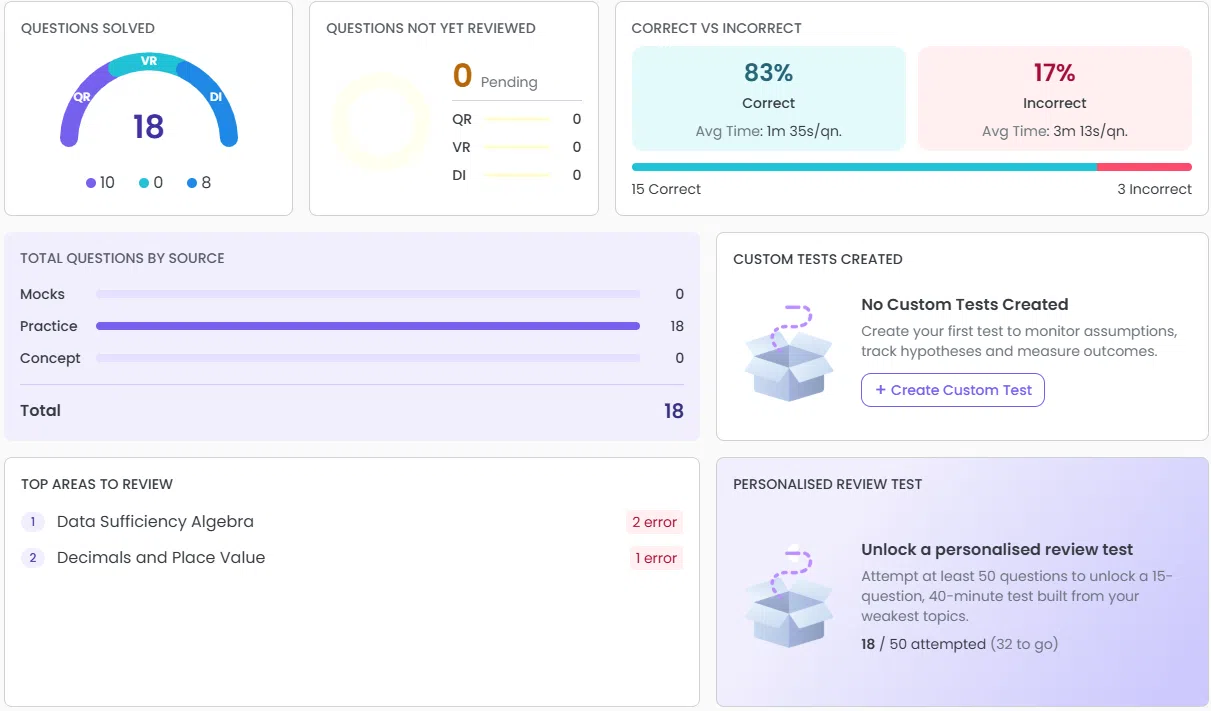
Perhaps the best feature in the Error Log is the Personalised Test. This combines all the mistakes you have made, and curates a personalised test for you that covers all of these topics.
And it still gets better! We have a summarised version for you to refer to. So you not only get the raw data from your preparation history, you get the signal separated from the noise right away!
Conclusion
The GMATPoint Error Log transforms your preparation into a structured, data-driven improvement system. By tracking every mistake along with its causes and recognising patterns thereof, it ensures that errors are not repeated but systematically eliminated.
In the GMAT Focus Edition, where consistency matters more than volume, this system provides a clear path from repeating mistakes to measurable score improvement.