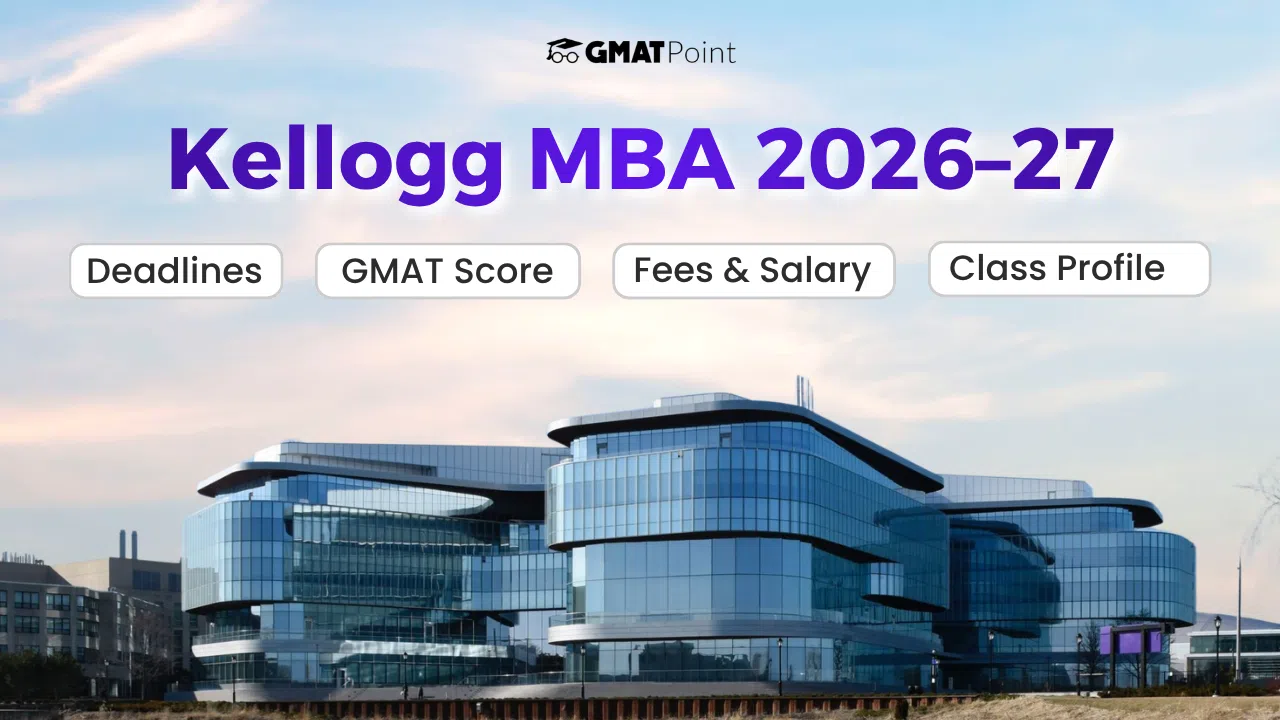

The Kellogg School of Management, Northwestern University, is among the top MBA programs in the world and is part of the prestigious M7 group of business schools. With students joining from diverse academic, professional, and international backgrounds, Kellogg attracts applicants looking for strong career opportunities, a collaborative learning environment, and global exposure.
The Kellogg MBA application cycle for the 2026-27 intake has three application rounds. When evaluating the program, applicants typically consider factors such as GMAT/GRE requirements, class profile, tuition fees, scholarships, and post-MBA career outcomes.
This guide covers all the important details about the Kellogg MBA, including application deadlines, accepted test scores, admission requirements, class profile, fees, scholarships, and salary outcomes.
Kellogg School of Management PDF
Kellogg MBA Application Deadlines 2026-27
The Full-Time MBA Class of 2027 at Kellogg has three application rounds. Applicants can choose the round that best suits their preparation timeline, although applying earlier can be beneficial, especially for international candidates and scholarship applicants.
Application Round | Application Deadline | Decision Release |
Round 1 | September 9, 2026 | December 9, 2026 |
Round 2 | January 6, 2027 | March 24, 2027 |
Round 3 | March 31, 2027 | May 12, 2027 |
Which Kellogg MBA Round Should You Choose?
- Round 1: A suitable option for applicants whose applications are ready early. International students get additional time for visa processing, and applying earlier may help applicants access more available opportunities during the admissions cycle.
- Round 2: A popular choice for candidates who need more time to improve their GMAT/GRE scores, refine essays, or strengthen their overall profile. International applicants should still consider applying by this round to allow sufficient time for visa procedures.
- Round 3: The final application opportunity for the 2026-27 cycle. Applicants should apply in this round only if they have a strong and complete application, as fewer seats may remain later in the cycle.
Another major factor that decides which round you should apply in is your GMAT preparation and score in hand. The sooner you can get a strong GMAT score, the sooner you can apply, giving you all the benefits of being an early bird! To see how your scores compare to those required for Kellogg and other top business schools across the globe, try taking a Free GMAT Mock Test.
What GMAT or GRE Score Do You Need for Kellogg MBA?
Kellogg accepts both GMAT and GRE scores for MBA admissions and does not have a minimum score requirement. However, understanding the academic profile of recent admitted classes can help applicants evaluate their competitiveness.
Metric | Kellogg Class of 2027 |
Average GMAT Focus Edition Score | 687 |
Average Classic GMAT (10th Edition) Score | 733 |
Average GRE Verbal Score | 162 |
Average GRE Quantitative Score | 162 |
Average Undergraduate GPA | 3.68 |
Average Work Experience | 5.1 years |
*Average GPA includes students from universities using a 4.0 GPA system.
These figures represent class averages and are not minimum admission requirements. Kellogg follows a holistic admissions process, meaning applicants with scores below the average may still be considered if they demonstrate strengths in other areas of their profile. Similarly, a high GMAT or GRE score alone does not guarantee admission.
Does Kellogg Accept GMAT Superscores?
GMAC automatically calculates a GMAT Superscore for candidates who take the GMAT multiple times by combining their highest section-level scores across valid attempts. However, Kellogg has explicitly stated that it does not consider GMAT superscores during the MBA admissions process. The school evaluates only GMAT scores achieved in a single test sitting.
Therefore, applicants submitting GMAT scores to Kellogg should ensure that their strongest overall score comes from one individual attempt rather than relying on a superscore.
The best way to improve your score is by practicing using study material prepared by experts and top-scorers. Check out: GMAT Courses by 785 Scorer
Kellogg MBA Admission Requirements
Kellogg evaluates applicants based on their academic background, test scores, professional experience, leadership potential, and overall application. The key requirements for the 2026-27 application cycle include:
Requirement | Details |
Undergraduate degree | Required |
GMAT/GRE | Required |
Minimum GMAT/GRE score | No minimum score |
Work experience | At least 2 years strongly recommended at matriculation |
Typical work experience | 3-7 years |
Recommendations | 2 |
Written essay | 1 essay (550 words maximum) |
Video essays | 5 questions |
Application fee | $250 |
Interview | Virtual |
Kellogg MBA Essays and Video Interview
For the 2026-27 application cycle, Kellogg requires applicants to submit one written essay and five video essay responses.
The written essay has a maximum word limit of 550 words. After submitting the application, candidates receive five video essay questions and must record responses of up to 60 seconds each.
The video essay provides Kellogg with additional insight into an applicant’s communication skills, personality, motivations, and fit with the school beyond academic achievements and professional experience.
Kellogg MBA Requirements for International Students
Kellogg accepts applicants from a wide range of international academic systems. Candidates with three-year undergraduate degrees, including degrees from countries such as India and the United Kingdom, may be eligible to apply if their academic background meets Kellogg’s requirements.
International applicants may also need to demonstrate English proficiency unless they qualify for an exemption. Kellogg accepts:
- TOEFL
- IELTS
- Duolingo English Test
All Kellogg Full-Time MBA programs are STEM-designated. This is particularly valuable for international students because eligible F-1 graduates may qualify for the additional STEM OPT extension, allowing extended work authorization in the United States after graduation.
To get expert guidance on your applications essays, from experts, check out: GMAT Mentorship
Kellogg MBA Class Profile 2027
The Kellogg MBA Class of 2027 includes students from diverse academic, professional, and international backgrounds.
Kellogg does not officially publish application volume, acceptance rate, or yield figures for the Class of 2027. Therefore, third-party acceptance rate estimates should be treated cautiously, as they are not official Kellogg data.
Metric | Class of 2027 |
Class Size | 534 students |
Average GMAT Focus Score | 687 |
Average GPA | 3.68 |
Average Work Experience | 5.1 years |
International Students | 37% |
Veterans | 9% |
Kellogg Student Background
Kellogg’s MBA class includes students from different academic disciplines, including business, STEM fields, and humanities.
Undergraduate Background | Percentage |
Economics & Business | 49% |
STEM | 41% |
Humanities | 21% |
Note: These percentages add up to more than 100% because students with multiple majors may be counted across more than one academic category.
Kellogg MBA Fees and Scholarships 2026-27
The cost of a Kellogg MBA extends beyond tuition. Students also need to account for housing, food, health insurance, course materials, travel, personal expenses, and other university-related costs. For the 2026-27 academic year, Kellogg estimates the following first-year expenses for the Two-Year MBA:
Expense | Estimated Cost |
Tuition | $88,536 |
Food & Housing | $22,941 |
Books & Supplies | $1,743 |
Course Material Fee | $310 |
Travel | $1,551 |
Personal Expenses | $2,835 |
Health Insurance | $5,996 |
Computer Equipment | $1,200 |
University Health Services Fee | $894 |
Student Activity & Experience Fee | $1,400 |
Student Association Fee | $450 |
First-Year Fee | $2,000 |
Loan Fees | $216 |
Estimated First-Year Cost | $130,072 |
The estimated first-year cost of attendance is $130,072, including tuition and other expenses. These costs are estimates for 2026-27 and may change in future academic years.
Kellogg MBA Scholarships
Kellogg offers both merit-based and need-based scholarships. Merit-based scholarships recognize academic, professional, or other achievements, while need-based scholarships consider an applicant's financial circumstances and eligibility.
Some notable Kellogg scholarships and fellowships include:
Scholarship | Details |
Finance Fellows Scholarship | Full-tuition scholarship for selected MBA students interested in pursuing careers in finance |
F.C. Austin Scholarship | One of Kellogg's major scholarships for incoming students |
Donald P. Jacobs International Scholarships | Scholarships designed to support outstanding international students |
McGowan Fellows Program | Provides full second-year tuition support to selected students |
Admitted students are automatically considered for a number of Kellogg scholarships, although some specific scholarships may have additional eligibility requirements or application components.
Kellogg MBA Salary and Career Outcomes
Kellogg's employment outcomes show the career opportunities available to graduates across consulting, financial services, technology, healthcare, consumer goods, and other industries.
For the Two-Year MBA Class of 2025, 90% of graduates had accepted a job offer within six months of graduation. The median base salary was $175,000, while median total compensation, which includes base salary and signing bonus, was $205,000. The class also recorded 20 graduates launching new businesses.
Career Metric | Outcome |
Accepted a job offer within 6 months | 90% |
Median Base Salary | $175,000 |
Median Total Compensation | $205,000 |
Graduates Launching New Businesses | 20 |
Kellogg MBA Salary by Industry
Consulting was the largest employment destination, with 38% of accepted job offers and a median base salary of $190,000. Financial services accounted for 21% of accepted job offers, with a median base salary of $175,000, while technology accounted for 19%, with a median base salary of $151,500.
Industry | Share of Accepted Jobs | Median Base Salary |
Consulting | 38% | $190,000 |
Financial Services | 21% | $175,000 |
Technology | 19% | $151,500 |
Consumer Packaged Goods | 9% | $128,000 |
Healthcare | 6% | $142,500 |
Manufacturing | 3% | $159,500 |
Media/Entertainment | 2% | $150,861 |
Kellogg notes that these figures cover industries with significant percentages of accepted offers, not all offers. Hence, the percentages don’t add up to 100%
Where Do Kellogg MBAs Work?
Among accepted jobs for Kellogg's Two-Year MBA Class of 2025, 94% were located in the United States, while 6% were international.
Of these 94%, the U.S. regional breakdown was:
U.S. Region | Percentage of All Accepted Jobs |
Midwest | 39% |
West | 24% |
Northeast | 18% |
Mid-Atlantic | 5% |
South | 4% |
Southwest | 4% |
Chicago Metro accounted for 34% of all accepted jobs, while New York City Metro accounted for 16% and San Francisco Metro accounted for 11%.
Kellogg MBA 2026-27: Is It Worth Applying?
The Kellogg MBA 2026-27 cycle offers applicants three opportunities to apply, with Round 1 closing on September 9, 2026. With an average GMAT Focus score of 687, a diverse Class of 2027, and strong career outcomes, Kellogg remains a compelling option for candidates targeting a leading global MBA program. The program's STEM designation, scholarship opportunities, and international student support also make it relevant for applicants planning to build careers in the United States.
Before applying, candidates should evaluate their GMAT or GRE performance, academic and professional profile, financial readiness, and preferred application round. Reviewing the Kellogg MBA fees, admission requirements, class profile, scholarships, and salary outcomes can help applicants make a more informed decision and prepare a stronger application for the 2026-27 admissions cycle.