
The M7 business schools—Harvard, Stanford, Wharton, Booth, Kellogg, Columbia, and MIT Sloan—have built global reputations through selective admissions, influential faculty, strong industry connections, career opportunities, and extensive alumni networks.
Their graduates have founded companies, led global corporations, managed major investment firms, and shaped industries ranging from technology and finance to consumer products. Here is one especially notable MBA alumnus from each M7 school and what makes their career stand out.
To get admission at M7 schools, one of the most common routes is through the GMAT exam, and a good GMAT score can significantly improve your chances of getting in..
So, to increase your chances of studying at these schools, check out: GMAT Courses by 100 percentiler.
What Are the M7 Business Schools?
M7 is often referred to as the Magnificent 7, a commonly used name for seven prominent US business schools:
- Harvard Business School
- Stanford Graduate School of Business
- Wharton School
- Chicago Booth School of Business
- Northwestern Kellogg School of Management
- Columbia Business School
- MIT Sloan School of Management
Business School | Reported Alumni Network |
Harvard Business School | 93,600 |
Stanford GSB | 34,213 living alumni |
Wharton | 100,000+ |
Chicago Booth | 61,000+ |
Kellogg | 70,000+ |
Columbia Business School | 52,000+ |
MIT Sloan | 31,000+ |
These figures are not directly comparable because schools may count alumni across different programs. Still, they show the scale of the professional communities surrounding the M7.
A good GMAT score is an essential part of applying to these schools. To know your current GMAT score, check out: Free GMAT Mock Test
Most Notable M7 MBA Alumni at a Glance
For this list, we selected one notable MBA graduate from each school based on business influence, leadership impact, company-building, and global recognition.
School | Featured MBA Alumnus | Class | Best Known For |
Harvard Business School | Michael Bloomberg | 1966 | Bloomberg LP |
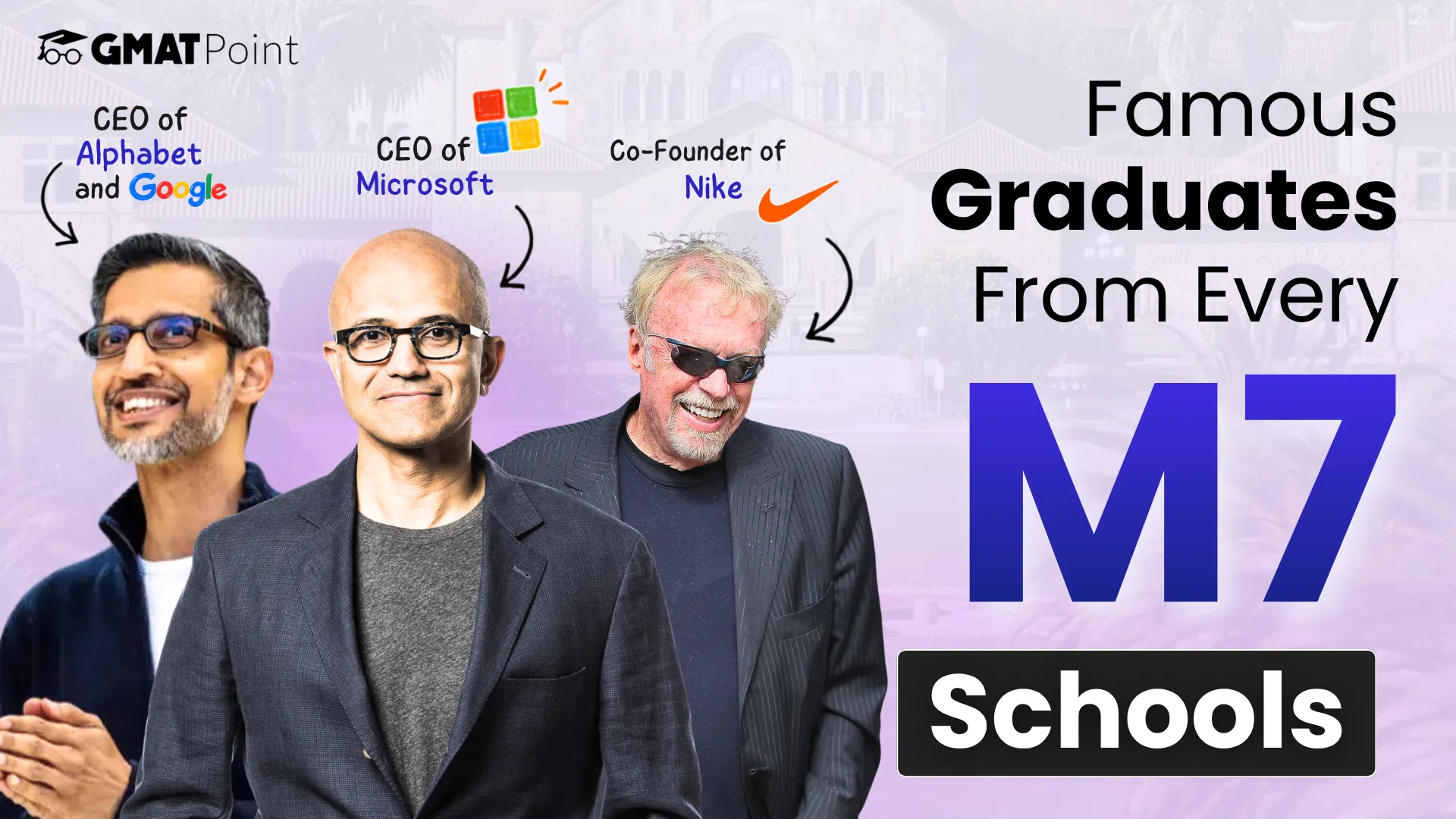
Stanford GSB | Phil Knight | 1962 | Co-founder of Nike |
Wharton | Sundar Pichai | 2002 | CEO at Alphabet and Google |
Chicago Booth | Satya Nadella | 1997 | CEO at Microsoft |
Kellogg | Roshni Nadar Malhotra | 2008 | Chairperson at HCLTech |
Columbia Business School | Henry Kravis | 1969 | Co-founder of KKR (Kohlberg Kravis Roberts & Co.) |
MIT Sloan | Brian Halligan | 2005 | Co-founder of HubSpot |
Famous Alumni From Each M7 Business School
Harvard Business School - Michael Bloomberg
Michael Bloomberg earned his Harvard Business School MBA in 1966. He worked at Salomon Brothers until he was let go after the firm was acquired in 1981.
Instead of returning to another Wall Street role, Bloomberg started a financial-information business that eventually became Bloomberg LP. He later entered politics and served three terms as mayor of New York City.
His career followed a distinctive progression:
HBS → Wall Street → job loss → entrepreneurship → Bloomberg
Stanford GSB - Phil Knight
Phil Knight completed his Stanford MBA in 1962. His connection with Nike began during business school, where he explored the idea of importing Japanese running shoes in a Stanford GSB class.
He later began selling shoes directly from his car. The business initially operated as Blue Ribbon Sports before becoming Nike. Knight's story is notable because the idea that eventually contributed to one of the world's best-known sportswear companies can be traced back to his Stanford years.
Wharton - Sundar Pichai
Sundar Pichai earned his Wharton MBA in 2002 as both a Palmer Scholar and a Siebel Scholar. He joined Google in 2004 and later took leadership responsibility for products including Chrome and Android.
Google appointed Pichai CEO in 2015, and he became CEO of Alphabet in 2019.
A Wharton Magazine analysis found that 237 Wharton alumni joined Google or Alphabet companies between April 2015 and March 2020. Among the alumni included in that historical analysis, 18% held C-suite or vice-president-level positions.
Chicago Booth - Satya Nadella
Satya Nadella earned his Chicago Booth MBA in 1997 through the school's Weekend MBA program while continuing his professional career.
Microsoft appointed him CEO in February 2014, making him only the company's third chief executive at the time. His background combines engineering, computer science, technology leadership, and management education, making his MBA path particularly relevant for professionals who want to study without completely stepping away from their careers.
Kellogg - Roshni Nadar Malhotra
Roshni Nadar Malhotra completed her Kellogg MBA in 2008. She later became chairperson of HCLTech and, in 2020, became the first woman to lead a listed IT company in India.
Her career also extends into education, philanthropy, and conservation. Her profile shows a different kind of M7 leadership path—one combining management education with leadership of a major publicly listed technology company, family enterprise, and social initiatives.
Columbia Business School - Henry Kravis
Henry Kravis earned his Columbia MBA in 1969 and co-founded Kohlberg Kravis Roberts, or KKR, in 1976.
KKR began with three partners and $120,000 of startup capital. By the end of Q1 2026, the firm reported $758 billion in assets under management.
$120,000 startup capital → $758 billion AUM
Kravis' career is one of the clearest examples of the scale an investment business can reach over several decades.
MIT Sloan - Brian Halligan
Brian Halligan completed his MIT Sloan MBA in 2005 and co-founded HubSpot while studying at Sloan.
Halligan became closely associated with popularising inbound marketing, while HubSpot grew into a publicly traded software company. MIT Sloan's faculty profile states that HubSpot serves more than 200,000 customers.
Halligan later returned to MIT Sloan as a lecturer focused on entrepreneurial scaling, creating a direct link between his MBA experience, company-building, and teaching.
M7 MBA Alumni Who Became Global Business Leaders
The seven alumni represent very different career paths.
Leadership Route | Alumni Example | School |
Entrepreneurship | Michael Bloomberg | HBS |
Consumer Brand Building | Phil Knight | Stanford |
Technology Leadership | Sundar Pichai | Wharton |
Technology Transformation | Satya Nadella | Booth |
Technology & Family Enterprise | Roshni Nadar Malhotra | Kellogg |
Private Equity | Henry Kravis | Columbia |
SaaS Entrepreneurship | Brian Halligan | MIT Sloan |
Four of the featured alumni—Bloomberg, Knight, Kravis, and Halligan—built or co-built major businesses. Pichai, Nadella, and Nadar Malhotra reached senior leadership roles within large corporations.
These seven individuals do not represent the full career composition of M7 alumni, but they demonstrate the range of paths found across these business-school communities.
Which M7 School Has the Strongest Alumni Network?
There is no objective answer because network value depends on size, geography, industry, alumni engagement, and individual career goals.
Based on published figures, Wharton reports more than 100,000 alumni and Harvard Business School reports 90,662. Kellogg reports 70,000+, Booth 61,000+, Columbia Business School 52,000+, Stanford GSB 34,213 living alumni, and MIT Sloan 31,000+.
These totals should not be treated as a direct ranking because schools count alumni differently. A larger network also does not automatically mean a stronger network for every applicant. Stanford, for example, has a smaller reported alumni population but a particularly visible presence in technology and entrepreneurship.
For prospective MBA students, industry relevance, geography, alumni accessibility, and career goals may matter more than absolute network size.
Conclusion
The M7 label is associated with some of the world's best-known business schools, but their alumni careers vary widely.
Bloomberg, Knight, Kravis, and Halligan followed entrepreneurial paths, while Pichai, Nadella, and Nadar Malhotra became prominent corporate leaders. Their careers span finance, consumer products, technology, private equity, and SaaS.
An M7 MBA does not automatically produce such outcomes. However, these schools combine rigorous education, career opportunities, and extensive alumni communities that can support graduates across industries and geographies.