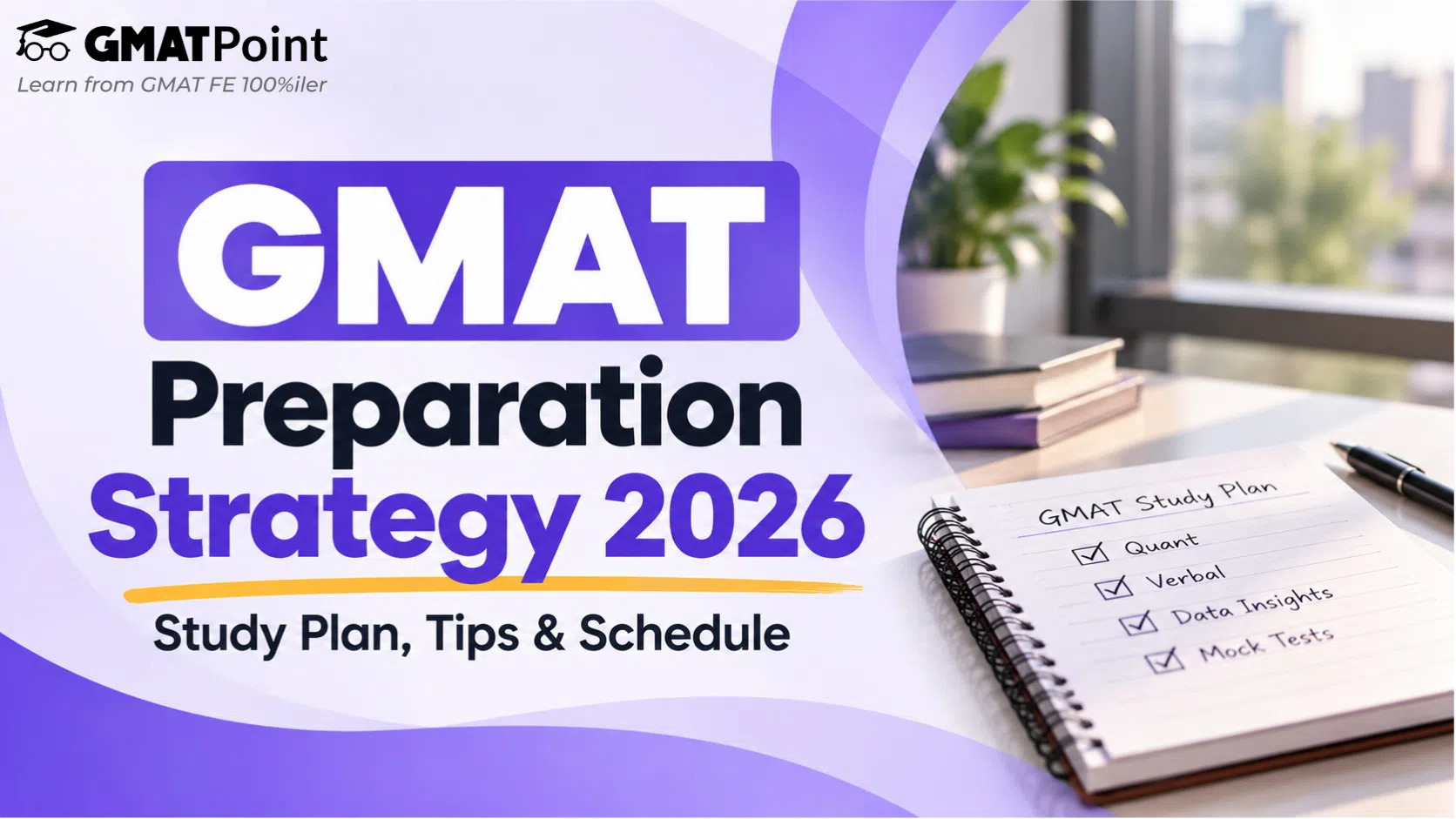

A good GMAT Preparation Strategy 2026 starts with understanding your current level instead of trying to study everything at once. Begin with a diagnostic test, identify your strong and weak areas, set a realistic target score, and then create a study schedule based on what you need to improve.
Your preparation should cover all three sections of the GMAT: Quantitative Reasoning, Verbal Reasoning, and Data Insights. A practical approach is to move from concept building to topic-wise practice, timed sets, mock tests, and detailed analysis. This guide provides a 3-month GMAT study plan along with section-wise strategies, recommended study hours, mock-test tips, and advice for working professionals.
How to Start Your GMAT Preparation in 2026
The first step in GMAT preparation is to understand where you currently stand. Instead of completing the entire syllabus before taking a mock test, take a diagnostic mock early in your preparation. This will help you identify your strengths, weak areas, and the question types that need the most attention.
Once you know your starting level, decide on your target GMAT score and tentative exam date. You can then create a weekly schedule that gives more time to weaker areas while ensuring that your stronger areas remain in practice.
Preparation Step | What to Do |
Step 1 | Understand the GMAT format and question types |
Step 2 | Take a diagnostic mock test |
Step 3 | Analyse performance across Quant, Verbal, and Data Insights |
Step 4 | Identify weak concepts and question types |
Step 5 | Set your target GMAT score |
Step 6 | Decide your tentative exam date and preparation timeline |
Step 7 | Build a weekly study schedule |
Step 8 | Study concepts and practise questions, progressing from untimed to timed practice |
Step 9 | Take full-length mocks regularly and analyse your mistakes |
Use your diagnostic results to decide how much time to spend on each section. Prioritise your weaker areas, but continue practising your strengths so that your performance remains consistent.
Important: Do not wait until you have completed the entire syllabus to take your first mock. An early diagnostic test can show you where your preparation time will be most useful.
Starting with the Free GMAT Mock Test can allow candidates to better understand where they currently stand, and how their scores compare to the class scores from the top business schools around the world. It can also help them familiarise themselves with the question and timing format that GMAT follows.
GMAT Preparation Strategy for Quant, Verbal & Data Insights
Each GMAT section tests a different set of skills, so your preparation should not be exactly the same for all three. Quantitative Reasoning requires strong mathematical fundamentals and problem-solving skills, Verbal Reasoning tests your ability to understand and evaluate written information, while Data Insights tests how effectively you can analyse and use data.
GMAT Quant Preparation
Build conceptual clarity in arithmetic and algebra before focusing heavily on speed. Once your fundamentals are clear, practise different Problem Solving questions and gradually move from untimed topic-wise practice to timed mixed sets.
Maintain an error log and classify your mistakes into four broad categories:
- Concept errors: Gaps in your understanding of the underlying concept.
- Calculation errors: Mistakes while performing arithmetic or calculations.
- Misreading errors: Missing or incorrectly interpreting important information in the question.
- Time-management errors: Spending too long on a question or rushing because of time pressure.
Review this log regularly to identify patterns and improve both accuracy and efficiency.
GMAT Verbal Preparation
Focus your Verbal preparation on Reading Comprehension (RC) and Critical Reasoning (CR).
For Reading Comprehension, practise identifying the main idea, author's purpose, passage structure, and important inferences. For Critical Reasoning, first understand the argument, its premises and conclusion before evaluating the answer choices.
After every practice set, do not simply check whether your answer was correct. Review why the correct option works and why the other options are incorrect.
GMAT Data Insights Preparation
Data Insights preparation should cover all five major question types: Data Sufficiency, Multi-Source Reasoning, Table Analysis, Graphics Interpretation, and Two-Part Analysis.
Start by practising individual question types so that you understand what each one requires. Then move to mixed timed sets. Focus on interpreting tables, graphs, and information from multiple sources while also improving your data sufficiency and reasoning skills.
Accuracy is important, but you should also learn to process information efficiently under time pressure.
GMAT Section | Main Preparation Focus | Practice Approach |
Quantitative Reasoning | Concepts, problem solving, and accuracy | Concepts → topic practice → timed mixed sets |
Verbal Reasoning | Reading Comprehension and Critical Reasoning | Passage/argument analysis → timed practice |
Data Insights | Data interpretation, sufficiency, and multi-source reasoning | Question-type practice → mixed timed sets |
GMAT Courses by 100 Percentiler offer high-quality practice questions, structured study plans, along with guidance from experts and top scorers, which can help significantly improve one’s performance across all GMAT sections.
3-Month GMAT Study Plan: Week-by-Week Strategy
A 3-month GMAT study plan can help you organise your preparation across Quantitative Reasoning, Verbal Reasoning, and Data Insights. However, this timeline should be treated as a framework rather than a guarantee of a particular GMAT score.
Your actual preparation time will depend on your starting level, target score, available study hours, and the gap between your current and desired performance.
Weeks | Main Focus | What to Do |
Weeks 1-2 | Diagnostic + Fundamentals | Take a diagnostic mock, identify weak areas, and begin core Quant, Verbal, and DI concepts |
Weeks 3-4 | Concept Building | Continue concepts and start topic-wise practice across all three sections. Start taking weekly full-length mocks. |
Weeks 5-6 | Practice | Increase question practice and begin timed sectional sets |
Weeks 7-8 | Mixed Practice | Solve mixed-difficulty sets, improve pacing, and revise weak areas |
Weeks 9-10 | Mock Phase | Increase full-length mocks, analyse mistakes, and revise recurring weak areas |
Week 11 | Exam Simulation | Practise under test-like conditions and refine your section and time-management strategy |
Week 12 | Final Revision | Review error logs, revise key concepts, and avoid unnecessary new material |
How to Make the 12-Week Plan Effective
1. Analyse every mock thoroughly
Taking a mock is only the first step. Review why you got questions wrong, which questions took too much time, where you misread information, and whether poor pacing affected your performance.
2. Give more attention to weak areas
If a particular Quant concept, Critical Reasoning question type, or Data Insights question type repeatedly causes difficulty, allocate more preparation time to it. Do not spend most of your study time repeatedly practising topics you already handle comfortably.
3. Maintain an error log
Record important mistakes throughout the 12 weeks. Note what went wrong, why it happened, and what you should do differently when you encounter a similar question.
4. Use the final week mainly for revision
Review your error log, revisit important concepts, and practise representative GMAT questions or questions you previously struggled with. Avoid trying to learn large amounts of completely new material just before the exam.
GMAT Expert Mentorship is a great resource for candidates to get personalised, structured and timely feedback from a top scorer with extensive experience in mentoring students.
How Many Hours Should You Study for the GMAT?
There is no fixed number of study hours that guarantees a particular GMAT score. The time you need depends on your current skills, target score, preparation timeline, and performance in each section.
The following can be used as a practical starting point rather than a fixed requirement:
Candidate Type | Suggested Study Time |
College Student | Around 2-3 hours per day |
Working Professional | Around 1.5-2 hours on weekdays + longer weekend sessions |
Candidate With Strong Fundamentals | Around 2-3 focused hours per day |
Candidate With Significant Concept Gaps | Around 3-4 hours per day, depending on the preparation timeline |
How to Divide Your GMAT Study Time
Rather than spending every study session solving questions, divide your preparation time across four activities:
- Concept learning: Understand the fundamentals and strategies required for different question types.
- Question practice: Apply what you have learned through topic-wise questions and timed sets.
- Error analysis: Review incorrect answers, identify recurring mistakes, and understand how to approach similar questions more effectively.
- Revision: Revisit difficult concepts and previously incorrect questions to reinforce what you have learned.
Consistency matters more than simply counting study hours. Adjust your schedule based on your diagnostic performance, target score, timeline, and progress across Quant, Verbal, and Data Insights.
If you’re looking to get guidance on how to effectively utilise your time and structure your prep, GMAT Expert Mentorship can provide you with the necessary feedback from top scorers and guide you towards efficient GMAT preparation!
When Should You Start Taking GMAT Mock Tests?
Take your first diagnostic mock early in your GMAT preparation rather than waiting until you have completed the syllabus. The purpose of this test is to establish your starting point and identify the areas that need the most work.
Beginning: Establish Your Baseline
Take a diagnostic test before beginning intensive preparation. Analyse your performance across Quantitative Reasoning, Verbal Reasoning, and Data Insights and identify your stronger and weaker areas.
You do not need to achieve your target score in your first diagnostic mock. Instead, use the result to decide what to prioritise in your GMAT study plan.
Middle: Track Your Progress
As you continue learning concepts and practising individual question types, introduce sectional tests and full-length mocks periodically.
Use these tests to check whether improvements during practice are translating into better test performance. Your results can also help you decide which concepts or question types need further revision.
Final Phase: Simulate the Actual Exam
As you get closer to your exam date, increase your focus on full-length mocks and realistic exam simulations.
The current GMAT has three 45-minute sections: Quantitative Reasoning, Verbal Reasoning, and Data Insights. Candidates can choose their section order and have one optional 10-minute break, which can be taken after the first or second section.
Your final mock tests should therefore help you practise pacing, section order, break strategy, and concentration under realistic test conditions.
Taking GMAT Mock Tests curated by experts and top scorers can enable candidates to better prepare themselves for the GMAT Exam by simulating the real GMAT environment and exam format.
What Should You Analyse After Every GMAT Mock?
Taking a mock is useful only when you review the results carefully. After every test, analyse:
- Incorrect answers: Was the mistake caused by a conceptual gap, calculation error, misreading, or faulty reasoning?
- Correct answers that took too long: Identify questions that consumed excessive time even though you answered them correctly.
- Guessing patterns: Check whether you guessed because of a knowledge gap, confusion, or time pressure.
- Recurring weak topics: Identify concepts and question types that repeatedly cause difficulty.
- Timing problems: Check where you spent too much time or rushed unnecessarily.
- Questions left unanswered: Determine whether poor pacing prevented you from completing the section.
- Accuracy by question type: Compare your performance across different question types to identify where additional practice is required.
Do not judge your GMAT preparation based on one unusually good or bad mock. Look at your performance across multiple tests to identify consistent trends.
GMAT Preparation Strategy for Working Professionals
Preparing for the GMAT while working full time requires a realistic and consistent schedule. Instead of setting study targets that are difficult to maintain during busy weekdays, use shorter weekday sessions for focused preparation and reserve longer weekend blocks for practice, mocks, and analysis.
Here are a few ways to manage GMAT preparation alongside a full-time job:
- Use weekdays for focused sessions: Dedicate shorter sessions to concept learning and question practice. Rotate between Quantitative Reasoning, Verbal Reasoning, and Data Insights instead of trying to cover all three every day.
- Set fixed study slots: Choose times that fit your routine, such as early mornings or evenings. A consistent schedule is usually easier to maintain over several weeks.
- Use weekends strategically: Reserve longer blocks for mixed practice, sectional tests, full-length mocks, and detailed analysis.
- Maintain an error log: Record recurring mistakes and revisit them during revision. This allows you to spend limited study time on areas that genuinely need improvement.
- Adjust your workload when necessary: If work becomes particularly demanding, prioritise essential practice and revision rather than trying to compensate with unrealistic study hours later.
Sample Weekly GMAT Study Schedule for Working Professionals
The following is only a sample schedule. Adjust it according to your working hours, diagnostic results, available study time, and weaker areas. If you cannot take a full-length mock every Sunday, schedule it on a day when you have enough uninterrupted time for both the test and its analysis.
Day | Suggested Focus |
Monday | Quant concepts + practice |
Tuesday | Verbal practice |
Wednesday | Data Insights practice |
Thursday | Quant/Verbal weak areas |
Friday | Revision + error log |
Saturday | Longer mixed practice / sectional tests |
Sunday | Full mock + detailed analysis |
If you are finding it difficult to decide what to prioritise each week or balance preparation with your work schedule, GMAT Expert Mentorship can help you build a more personalised preparation approach.
Conclusion
An effective GMAT Preparation Strategy 2026 should start with a diagnostic test, a realistic target score, and a preparation timeline that fits your current level. Build strong concepts in Quantitative Reasoning, Verbal Reasoning, and Data Insights before gradually moving towards timed practice and full-length mock tests.
Most importantly, analyse your mistakes instead of focusing only on solving more questions. Use your mock performance and error log to decide what needs additional attention, and adjust your GMAT study schedule as you progress. A consistent plan that focuses on your actual weaknesses will be more useful than following the same fixed routine throughout your preparation.