


Before you start preparing for an exam, you need to prepare for the preparation itself. The real exam isn’t when you go to the test centre, it is during the preparation phase.
Doing so without knowing where you currently stand, where you need to be and how to get there is like navigating through a sea without a map.
Students spend weeks studying topics that they already understand, while neglecting topics that would actually improve their score. The result is inefficient preparation, unnecessary frustration and slower progress, if any at all. Improving on a topic where you get 8 out of every 10 questions correct can bring you a maximum of 2 extra points. The topic where you get only 5 out of every 10 questions correct is where the real gold mine is.
At GMATPoint, we have built our Free GMAT Diagnostic Test to solve exactly this problem.
It answers the three most important questions:
- Where do I currently stand?
- How far away am I from my dream schools?
- What is the shortest route to the scores I want?
The best part? In 60 minutes, you can get a detailed study plan backed by real data on your attempt.
Estimate Your GMAT Score
The diagnostic test consists of 27 questions that we have selected with painstaking precision to serve the sole purpose of diagnosis.
Unlike a full-length mock, the goal isn’t to simulate exam day. The objective is to gather enough information to accurately estimate your current ability, and we find an hour of your time sufficient to achieve our goal.
At the end of the test, you’ll receive:
- Estimated GMAT score
- Topic-Wise Breakdown
- Percentile Estimates
- Mean Performance Comparison
This is the most realistic benchmark of where you currently stand.
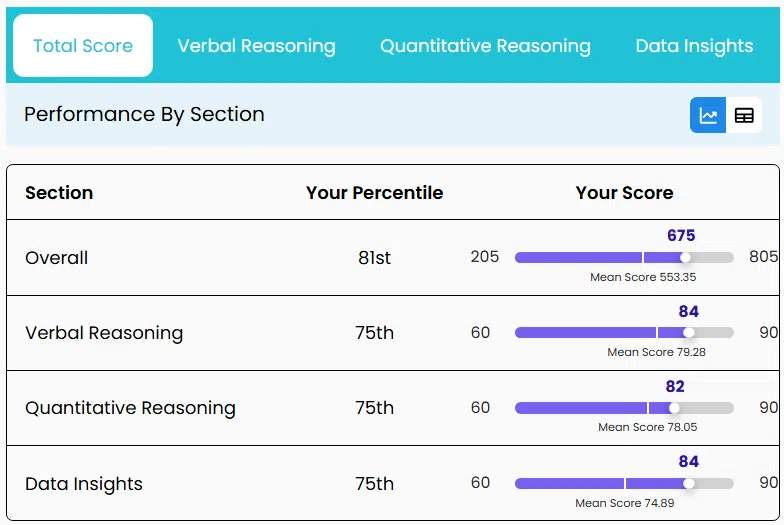
Performance Improvement Matrix
This is where the Diagnostic Test stands out from a traditional full-length mock.
Sure, knowing which topic you’re weak in is helpful.
What helps even more is knowing which topic will improve your score the fastest. And the diagnostic test creates one for every student:
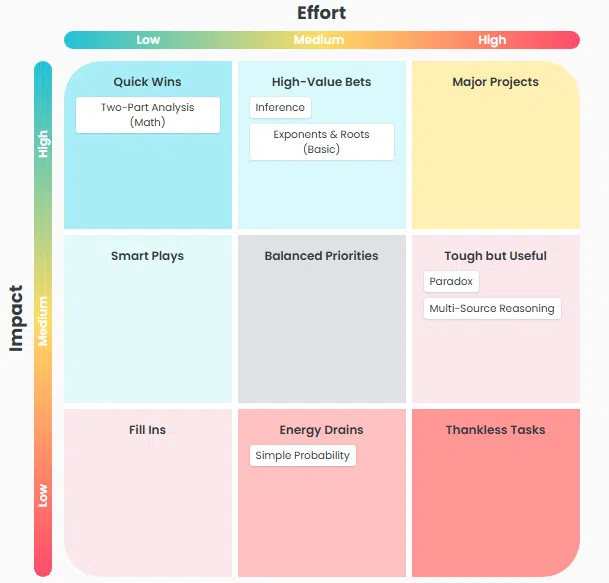
Instead of treating every topic equally, the matrix classifies every weakness based on two factors:
- Estimated effort required to improve
- Expected Impact on your GMAT score
This immediately tells you where to aim.
For example, the sample report above shows that Two-Part Analysis questions lie in the Quick Wins region. This means that for this test-taker:
- The topic is relatively easy to improve and won’t take much time or effort
- The topic has a significant impact on the test taker’s GMAT score
In other words, the score gain per unit effort spent is the highest for this question format.
So, the test-taker should prioritize two-part analysis questions rather than working on every topic simultaneously. This alone could realistically take their DI score from 84 to 86 or maybe even 87.
Instead of wondering ‘What should I study today’, you start with the answer in hand.
Compare Your Score To The Score You Need
What GMAT score you want to target depends on the school you are targeting.
Before you start the diagnostic test, it asks you to list three schools. These could be Harvard Business School, Stanford GSB, Kellogg, ISB, INSEAD, HEC, or any other institute in the database. Once the diagnostic is complete, your estimated score is compared against the average scores from the profiles that actually got into the school.
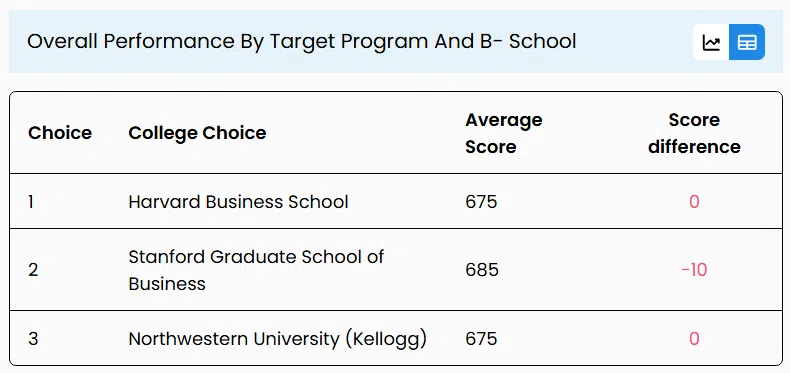
This immediately answers the biggest question that most aspirants have in mind: How far away am I from the score I need to get into my dream school? How competitive is my current score?
Smart Study Strategy
Now comes the most important question: How do I utilise all this information?
Suppose the snippets above are from your diagnostic test. Your estimated score is 675, but your dream school averages around 685. Now without this data, most students would simply think: I need to study harder. I should study an extra hour everyday.
But like most things, smart work out-results hard work. The Performance Improvement Matrix shows you how to study smart.
In the example above, Two-Part Analysis is a quick win. Low effort, multiple scoring opportunities.
Inference questions offer high returns. Slightly harder to improve as compared to Two-Part Analysis, but it offers high gains.
So, the smart strategy would be to work on Two-Part Analysis first. This alone should be enough to push the example report to a 685+. Now, build your breathing room using Inference Questions. This should take your estimated scores to 705+.
Only now do you attempt full-length mocks, work on your performance under pressure and start observing yourself scoring more than you need on most occasions.
Your Goal Isn’t Necessarily 805
Every applicant wants an 805. But in reality, there are constraints that might not always allow you the time to score one. It’s not to say that you can’t score it, it is simply to say that there might sometimes be situations where accepting a lower score might be the pragmatic way to go about your application.
If the diagnostic test suggests that you can reach your desired score relatively quickly, your time might be better spent on working on essays and SoPs after scoring what you need.
The goal isn’t to ace GMAT. The goal is to maximize the admissions outcome.