

Your GMAT score is more than just a number. It plays an important role in determining your chances of admission to leading business schools worldwide. So using online GMAT Study Materials designed by experts and high-scorers to achieve high scores is something that is immediately obvious. However, many candidates are unsure about how the GMAT scoring system works, what the different scores mean and how admissions committees interpret them.
The current GMAT uses a different score scale from the previous GMAT Exam (10th Edition). Therefore, candidates must understand the updated scoring system before comparing scores or setting their target.
GMAT Scoring System Explained
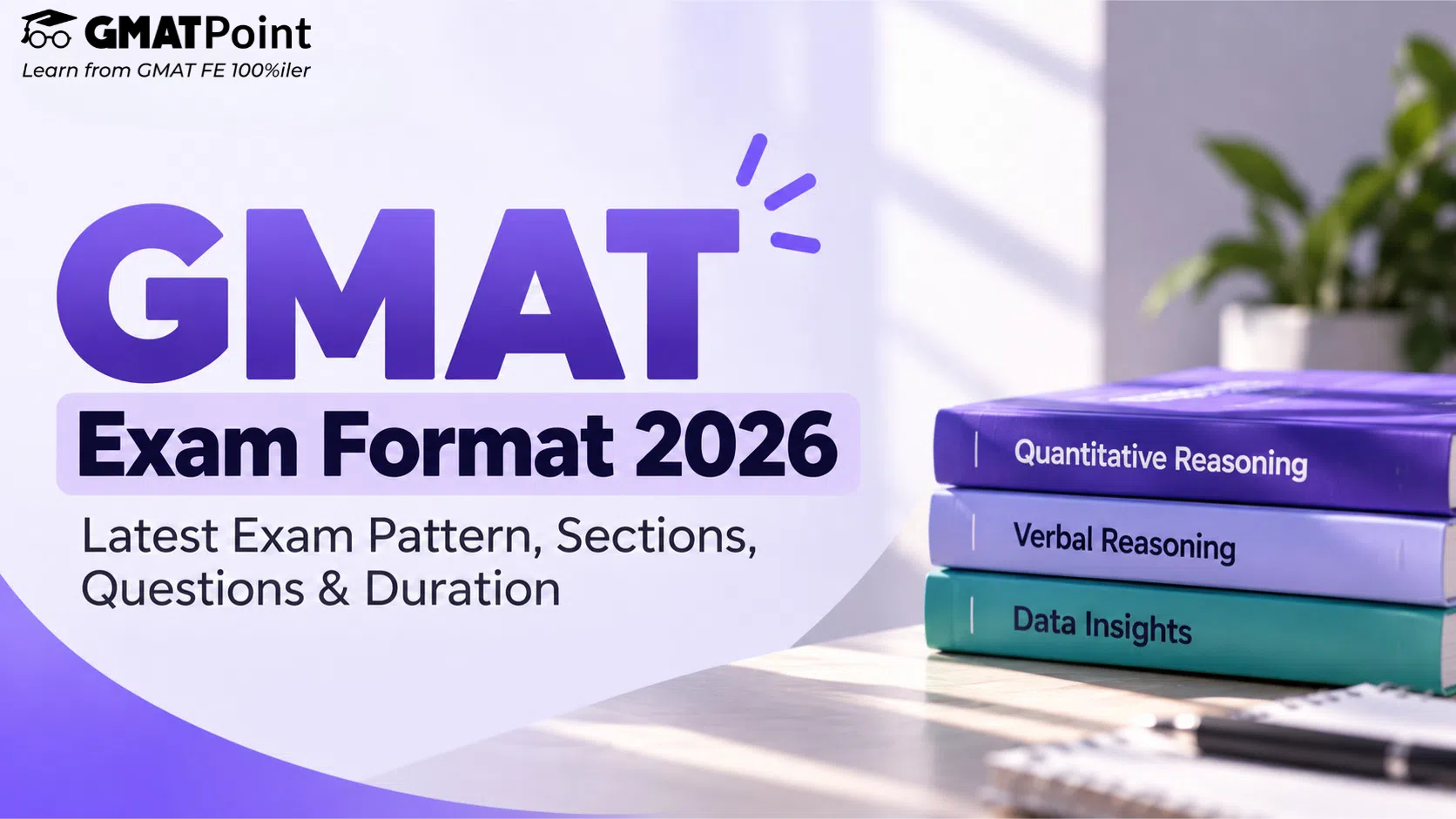
The GMAT is a computer-adaptive examination that evaluates a candidate’s quantitative, verbal and data-analysis skills. It consists of three equally weighted sections:
- Quantitative Reasoning
- Verbal Reasoning
- Data Insights
Each section is scored on a scale of 60 to 90 in one-point increments. These three section scores contribute equally to the Total Score, which ranges from 205 to 805 in 10-point increments.
A GMAT score report includes the candidate’s Total Score, individual section scores and percentile rankings. Business schools may consider both the Total Score and section-level performance while reviewing an application. However, the importance given to each score varies across institutions and programmes.
How Is the GMAT Score Calculated?
The GMAT uses a computer-adaptive scoring system. As candidates answer questions, the test uses their performance to determine the questions presented later in the section. A correct answer may lead to a more difficult question, while an incorrect answer may result in a comparatively easier one.
However, the process is not based only on the number of correct answers. A section score is influenced by:
- The number of questions answered
- Whether the answers are correct or incorrect
- The difficulty and other characteristics of the questions answered
- The number of unanswered questions
Candidates should therefore try to complete every section because leaving questions unanswered may negatively affect the score.
The GMAT Total Score is not calculated by simply adding or averaging the three section scores. GMAC uses a proprietary scoring algorithm, with Quantitative Reasoning, Verbal Reasoning and Data Insights contributing equally to the Total Score.
Some unofficial estimates suggest that a three-point increase in the combined section scores may result in an increase of approximately 20 points in the Total Score. However, this is only a general estimate and not GMAC’s official scoring formula.
Current GMAT vs Previous GMAT Score Conversion
The current GMAT uses a different scoring scale from the previous GMAT Exam (10th Edition). As a result, candidates should not compare the same numerical score across the two editions.
For example, a score of 700 on the previous GMAT does not represent the same performance level as a score of 700 on the current GMAT. The two examinations have different structures, score ranges and score distributions.
The most reliable way to compare scores from the two editions is to use percentile rankings and GMAC’s official score concordance information. Percentile rankings help identify comparable performance levels even when the numerical scores are different.
GMAT Score Concordance: Current vs Previous GMAT
The GMAT score concordance table helps candidates and business schools compare scores from the current GMAT with scores from the previous GMAT Exam (10th Edition). The table does not provide a simple mathematical conversion. Instead, it compares scores according to similar percentile rankings and performance levels.
For example, a score of approximately 645 on the current GMAT is broadly comparable to a score of 700 on the previous edition. However, candidates should always refer to the latest official concordance information because percentile distributions may be updated over time.
The concordance table is particularly useful for:
- Setting a target score
- Comparing current scores with historical business-school averages
- Understanding older admission statistics
- Evaluating scores from different GMAT editions
Candidates should avoid relying on unofficial score converters that do not use GMAC’s published concordance data.
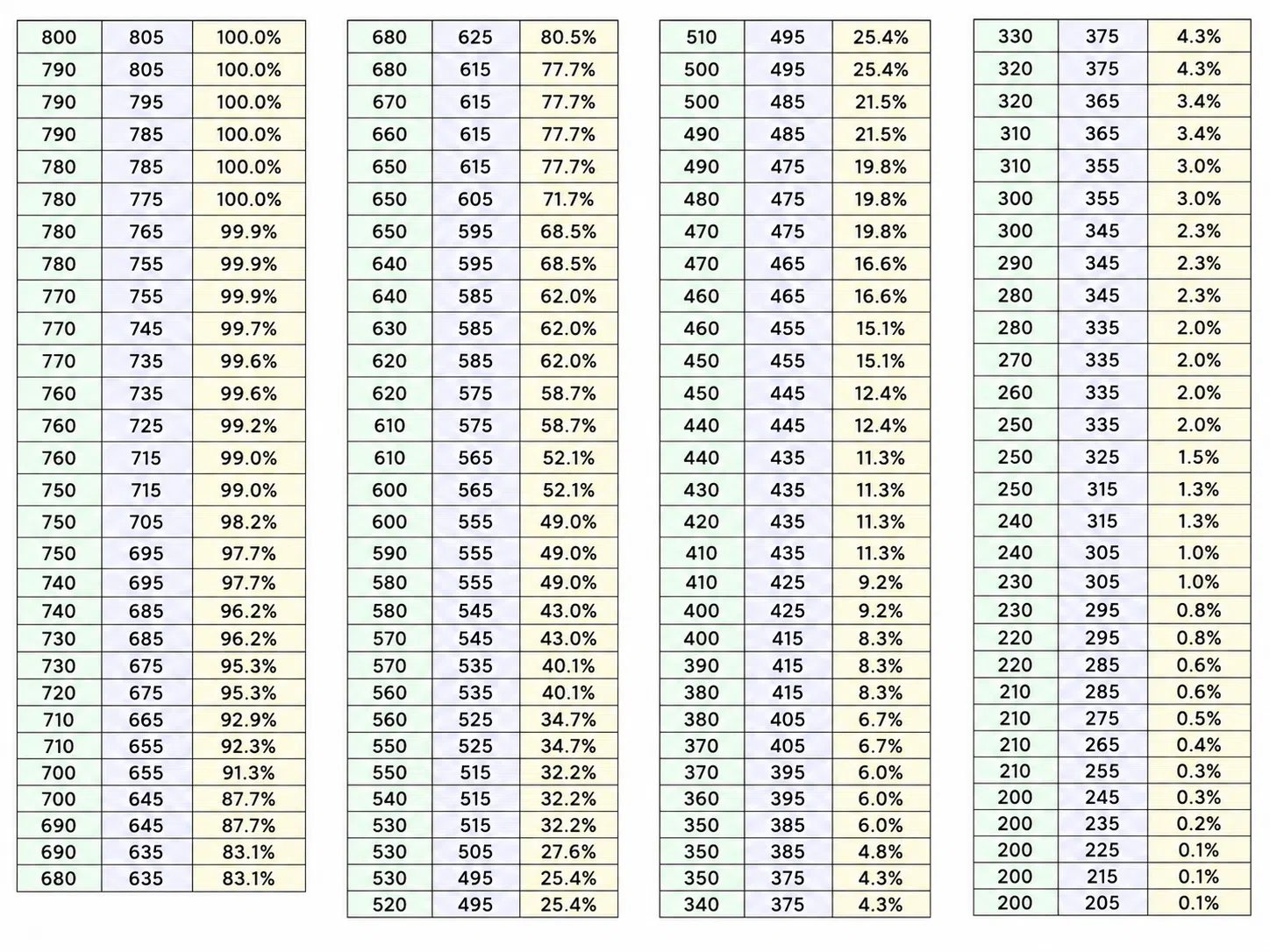
* GMAC Official Concordance Table
GMAT Score vs Percentile: Understanding Your Ranking
A GMAT score represents a candidate’s performance on the examination, while the percentile ranking compares that performance with that of other GMAT test-takers. For example, a score at the 90th percentile means that the candidate performed better than approximately 90% of the test-taking population used for the comparison.
Percentile rankings are useful because they provide context for a numerical score. Two scores from different GMAT editions may look similar but represent different performance levels. Similarly, two different numerical scores may represent comparable percentile rankings. GMAC periodically updates percentile rankings using recent test-taking data. Therefore, the percentile associated with a particular score may change slightly over time, even though the score itself remains unchanged.
When comparing the current GMAT with the previous edition, candidates should focus on percentile rankings rather than directly comparing numerical scores.
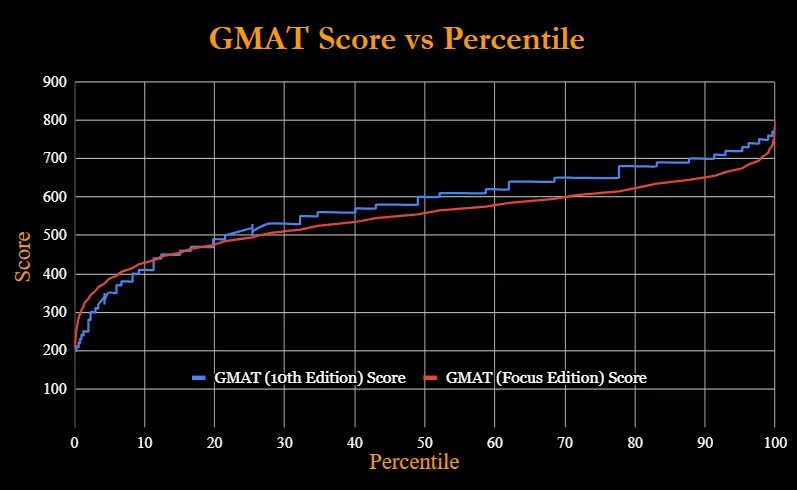
* The graph shows that the scores are scaled differently in both the exams. The difference in scaling varies for different percentile ranges
What Is a Good GMAT Score for MBA Programmes?
There is no single GMAT score that can be considered good for every candidate or business school. A competitive score depends on the programme, the applicant pool and the overall strength of the candidate’s profile.
Several factors influence what may be considered a good GMAT score.
Target business school
Highly selective MBA programmes generally report stronger average or median GMAT scores than less selective or regional programmes. Candidates should check the latest class profile published by their target institution.
Average class profile
A candidate should compare their score with the average or median score of the programme’s incoming class. Scoring near or above the reported average strengthens the application, although it does not guarantee admission.
Overall applicant profile
Business schools do not assess candidates solely on the basis of their GMAT scores. Academic performance, work experience, career progression, essays, recommendations, interviews and extracurricular achievements may also influence the admission decision.
Section-level performance
Some programmes may pay particular attention to section scores. For example, programmes with a strong analytical or quantitative focus may examine performance in Quantitative Reasoning and Data Insights more closely.
Scholarship goals
A strong GMAT score may improve a candidate’s chances of receiving a merit-based scholarship at some institutions. However, scholarship policies and selection criteria differ across business schools.
A score of 700 or above on the previous GMAT was widely regarded as a strong score. According to the official score concordance, a score of approximately 645 on the current GMAT is broadly comparable to 700 on the previous edition.
However, candidates should avoid treating any score as a guaranteed admission threshold. GMAC recommends that business schools use the GMAT as one part of a holistic admissions process rather than relying on a fixed cutoff alone.
How to Improve Your GMAT Score
Improving a GMAT score requires more than simply attempting a large number of questions. Candidates need a structured preparation plan that helps them strengthen concepts, improve accuracy and manage time effectively.
Identify weak sections through mock tests
Begin your preparation with a full-length mock test. Analyse your performance across Quantitative Reasoning, Verbal Reasoning and Data Insights to identify weak topics and recurring mistakes.
Continue taking full-length mock tests at regular intervals to measure progress.
Focus on accuracy before increasing speed
Develop a clear understanding of GMAT concepts before attempting to solve questions faster. Once your accuracy improves, use timed practice sessions to gradually increase your speed.
Accuracy and time management should be developed together because candidates must complete each section within the available time.
Analyse incorrect answers and leverage expert advice
Do not stop after checking whether an answer is right or wrong. Identify the reason behind each mistake.
Common causes include:
- Weak conceptual understanding
- Calculation errors
- Misreading the question
- Selecting an answer without sufficient evidence
- Poor time management
- Falling for a misleading answer choice
Understanding the cause of an error makes it easier to avoid repeating it. A GMAT Mentor can guide you through this process. Mentors are experts at diagnosing and finding quick fixes, so leveraging their advice gets you as close to targeted practice as can be.
Maintain an error log
Record important mistakes in an error log. For each incorrect question, note:
- The topic being tested
- Why the selected answer was incorrect
- The correct method or reasoning
- The lesson learned from the mistake
- How to avoid a similar error in the future
Review the error log regularly to identify patterns and strengthen weak areas.