

GMAT Superscore
The Graduate Management Admission Council (GMAC) has announced the introduction of the GMAT Superscore, a significant update to how GMAT exam results will be reported to business schools.
While the GMAT Superscore does not replace your existing GMAT exam scores, it introduces an additional score data point that represents your best aggregate performance across multiple valid attempts of the latest GMAT edition. In this article, we’ll break down the official information for you to digest.
What Is the GMAT Superscore?
To quote GMAC:
"A GMAT Superscore is an additional score data point that is representative of a test taker's best aggregate performance across all valid GMAT exam attempts of the latest edition."
GMAC basically takes the best sectional scores from all your attempts and combines them to create your superscore. Rather than evaluating only one test sitting, the GMAT Superscore allows schools to view a candidate's strongest section performances across multiple attempts.
When Will the GMAT Superscore Launch?
GMAC has announced their plans to launch the GMAT Superscore in August this year. Once implemented, the superscore will be shared with all schools that any subsequent score reports are shared with. There will be no independent application and no additional charges for the superscore.
How Is the GMAT Superscore Calculated?
The calculation process for the GMAT Superscore is fairly straightforward. Across your attempts, GMAC will identify:
- Your highest Quantitative Reasoning score
- Your highest Data Insights score
- Your highest Verbal reasoning score
These scores will then be combined to generate your GMAT Superscore.
If you're unsure which section is currently limiting your GMAT score, taking a full-length GMAT diagnostic test can help identify your biggest opportunities for improvement.
Important Points
- The GMAT score scale remains unchanged. This means that the overall superscore you receive from the best sectional scores will undergo the same scaling as an individual attempt would.
- No separate percentile ranking will be generated for the Superscore.
- If multiple attempts contain the same highest section score, the most recent score will be used.
- Only valid scores are eligible for Superscore calculation.
Below is an example table of how this might work:
Section | Attempt 1 | Attempt 2 | Attempt 3 | Superscore |
Quant | 82 | 77 | 79 | 82 |
DI | 80 | 83 | 82 | 83 |
Verbal | 77 | 81 | 83 | 83 |
Overall | 595 | 615 | 645 | 665 |
*Illustrative data, not representative of real GMAC scaling
GMAC has also released an example superscore report:
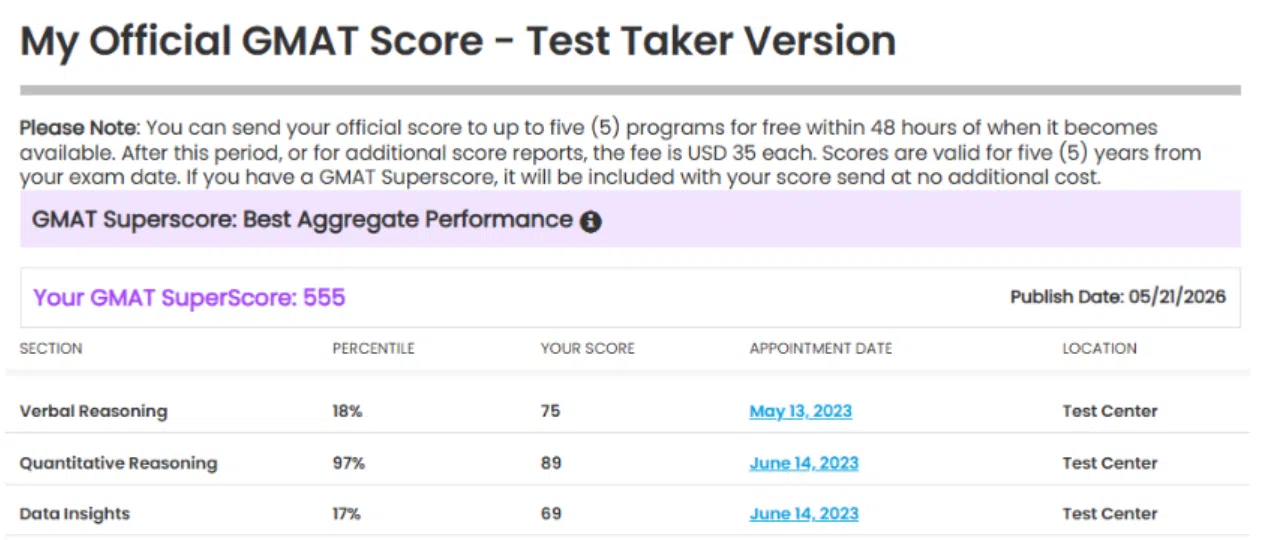
*Screenshot adapted from GMAC's sample score report interface. The example scores shown are illustrative and may not represent an actual candidate's complete testing history.
The score report identifies:
- The overall GMAT Superscore
- The section scores used in the calculation
- The exam date associated with each section score
- The testing location or delivery method
If you're wondering what your own GMAT Superscore might look like, the first step is understanding your current section-level performance. A GMAT mock test will provide you with detailed breakdowns across Quantitative Reasoning, Verbal Reasoning, and Data Insights.
How Much Can a GMAT Superscore Increase Your Score?
This is one of the most important questions from candidates. Most candidates are interested in knowing whether this affects their application or not, and if it does, by how much?
GMAC has suggested that candidates could commonly see increases in the range of approximately 20-50 points, though actual results will vary considerably based on score consistency and performance across attempts. So, your sectional score profile can significantly guide you towards an efficient study plan for any future attempts, since it provides you with the data to choose which section's GMAT Question Banks to focus on.
Business Schools Already Understand Superscoring
Before we dive into whether this actually helps your application, we need to understand what this change means from the perspective of your desired school.
Business schools already understand the superscore. Superscoring has been used extensively in standardized testing for years. Examples include SAT Superscores, ACT superscores and TOEFL superscores. The adoption of the concept by GMAC does not require schools to reconsider their existing shortlisting frameworks.
What Will Business Schools See?
Will schools only see the superscore? What is the information they will receive? These are also some questions raging in aspirant’s minds. First of all, you are only required to share one score report with any school. Any additional information will be included in the report itself. The schools will see:
- Your shared score. Any scores you have shared with the school in the last 5 years will still be visible to the school.
- GMAT Superscore. The school will receive your GMAT superscore as mentioned above. This will include the overall score, the sectional breakdown and the attempt from which the sectional scores have been chosen.
- Whether the exam was taken online or at a test centre.
In brief, the GMAT Superscore is simply another additional data point that the school receives about the candidate. They continue to receive all the information they did before the introduction of the superscore, with the superscore acting as a cherry on top.
Can You Opt Out of the GMAT Superscore?
No.
Candidates cannot choose to suppress a valid GMAT Superscore.
If a Superscore exists, it will be included in the score report sent to schools.
If a candidate has only one valid attempt, or if the highest individual score already represents the best combination of section scores, GMAC will still provide the appropriate reporting information to schools.
What Happens If You Retake the GMAT Exam?
If you have previously sent scores to schools and later take another GMAT exam, the reporting process remains simple.
When you send a future score report:
- The latest GMAT Superscore will be automatically included if one exists.
- There is no need to request separate Superscore reporting.
- Schools will continue receiving the relevant score history and associated information.