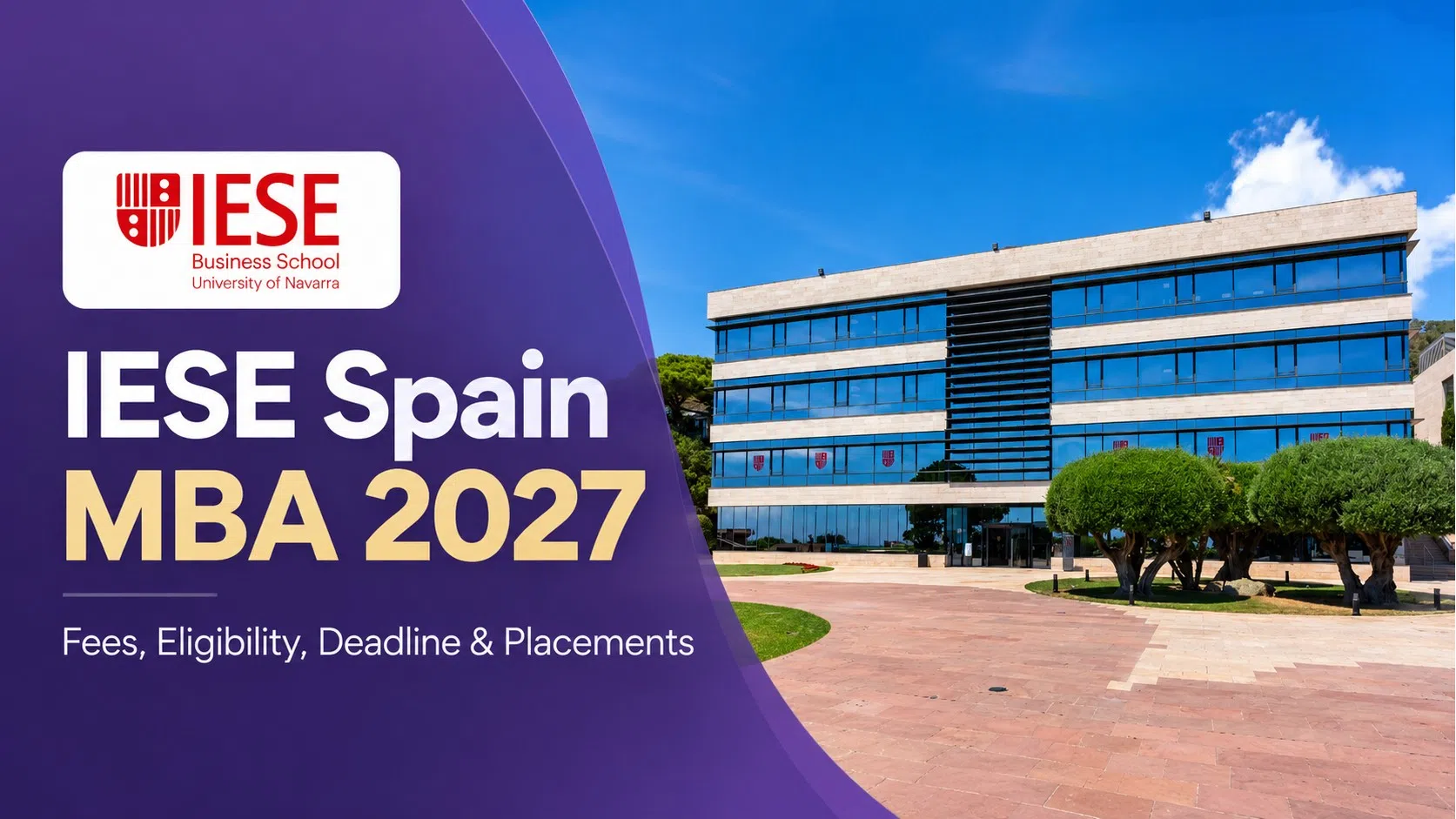

The IESE Business School Full-Time MBA is a globally oriented program offered in Barcelona, Spain. For the September 2027 intake, students can complete the MBA in either 15 or 19 months, with the program taught entirely in English.
IESE reports that 80% of its Class of 2025 graduates accepted employment within three months of graduation. This article covers the key information prospective applicants should know about the IESE MBA, including the GMAT score range, class profile, admission requirements, application deadlines, fees, scholarships, career outcomes, and admissions competitiveness.
Download IESE Spain MBA FREE PDF
IESE MBA Class Profile
The IESE Full-Time MBA has a highly international student body, bringing together candidates from diverse professional, geographic, and cultural backgrounds. The current class profile includes more than 370 students, of whom 89% are international students and 38% are women.
IESE MBA Class Profile | Details |
Class Size | 370+ students |
Average Age | 29 years |
Average Work Experience | 5.4 years |
International Students | 89% |
Women | 38% |
GMAT Score Range | 545-715 |
Take the Free GMAT Mock test by 785 Scorer to understand your current GMAT level and how it compares against the scores from IESE’s class profile, along with the class profiles from other top business schools.
Work Experience Distribution
IESE MBA students typically enter the program with several years of professional experience. The largest group, accounting for 60% of the class, has 3-6 years of work experience, while another 30% has 6-10 years.
Work Experience | Share of Class |
2-3 years | 5% |
3-6 years | 60% |
6-10 years | 30% |
10+ years | 5% |
Pre-MBA Professional Background
IESE MBA students also come from a range of professional backgrounds. The largest share comes from the corporate sector, followed by financial services and consulting.
Previous Experience | Share |
Corporate Sector | 45% |
Financial Sector | 30% |
Consulting | 25% |
Student Geographic Origin
The international character of the IESE MBA is also reflected in the geographic distribution of its students. Latin America and Europe each account for 26% of the class, followed closely by Asia-Pacific at 24%.
Geographic Origin | Share of Class |
Asia-Pacific | 24% |
North America | 19% |
Latin America | 26% |
Europe | 26% |
Middle East & Africa | 5% |
IESE MBA GMAT Score and Admission Requirements
The current GMAT acceptance score range for the IESE MBA is 545-715, according to IESE's official class profile. IESE also accepts the GRE as an alternative to the GMAT.
IESE does not publish a specific minimum GMAT score, so a score of 545 should not be interpreted as the minimum required for admission. Instead, the school evaluates applicants holistically, with standardized test performance forming only one part of the overall application.
While there is no minimum score requirement published by IESE, a stronger score almost always helps make an application stronger. The best way to improve your score is to use study materials curated by experts and top scorers.
Check out: GMAT Courses by 785 Scorer
IESE MBA Admission Requirements
Candidates must complete IESE's online application and submit the required supporting documents. The application is designed to help the admissions team evaluate a candidate's academic ability, professional experience, goals, and overall suitability for the MBA.
Key IESE MBA admission requirements include:
- Completed online application form
- Kira video essays
- Official academic transcripts
- Updated CV
- GMAT or GRE score
- English-language test score, where applicable
- One letter of recommendation
- Mandatory essays
- Application fee
- Other required supporting documents
For applicants who need to demonstrate English proficiency, IESE currently recommends the following scores:
English Test | Recommended Score |
TOEFL | 100 |
IELTS | 7.5 |
PTE Academic | 68 (C1) |
Cambridge Certificate of Proficiency in English | Minimum Level B |
GMAT performance is only one component of IESE's holistic admissions process. Applicants should also demonstrate strong academic credentials, relevant professional experience, leadership potential, clear career goals, and the ability to contribute to the MBA community.
It is often useful to get in touch with experienced professionals that can help evaluate your profile and guide through other steps of your application process, to increase your chances of getting admitted to IESE and other top business schools.
Check out: GMAT Expert Mentorship
IESE MBA Acceptance Rate and Admissions Process
IESE Business School does not publicly disclose an official acceptance rate for its Full-Time MBA. Applicants should therefore assess the competitiveness of the program using IESE's published class profile, GMAT acceptance range, admission requirements, and selection process rather than relying on unofficial acceptance-rate estimates.
Admissions at IESE are holistic. GMAT or GRE performance is an important component, but the school also considers factors such as academic background, professional experience, motivation, leadership potential, communication skills, career goals, and overall fit with the program.
IESE MBA Admissions Process
The IESE MBA admissions process consists of several stages, beginning with the application and ending with the final admission decision.
- Online Application: Candidates submit the application form along with the required documents, test scores, essays, recommendation, and application fee.
- Admissions Pre-Committee: IESE reviews the submitted application to determine whether the candidate should progress to the next stage.
- Personal Interview: Shortlisted candidates participate in an interview conducted in English.
- Assessment Day: Candidates may be invited to an Assessment Day, where they interact with potential classmates and demonstrate different aspects of their candidature. IESE notes that Assessment Day is not mandatory for every applicant, although participation is highly recommended when invited.
- Admissions Committee: Following the selection process, the candidate's application is presented to the Admissions Committee.
- Admission: Candidates receive the Admissions Committee's final decision.
While planning their applications, candidates should simultaneously prepare for GMAT, so that there is no obvious weak point. To get guidance on creating stronger applications for IESE and other top global business schools, GMAT Expert Mentorship can help.
IESE MBA Application Deadlines 2027
For candidates applying for the September 2027 intake, IESE MBA Class of 2029, IESE has listed four expected application rounds. The school also provides expected dates by which candidates should receive their interview and final admission decisions.
Application Round | Application Deadline | Interview Decision By | Final Decision By |
Round 1 | September 23, 2026 | October 9, 2026 | November 23, 2026 |
Round 2 | January 7, 2027 | January 22, 2027 | March 15, 2027 |
Round 3 | March 9, 2027 | March 19, 2027 | April 30, 2027 |
Round 4 | May 6, 2027 | May 14, 2027 | June 11, 2027 |
These are IESE's expected dates for the September 2027 intake. Applicants should check the latest schedule before applying and leave sufficient time to prepare their GMAT or GRE scores, essays, recommendation, and other required application documents.
Applicants should have some idea of the round that they’re looking to apply to. To gauge this, one metric can be to follow the stage at which your GMAT score reaches your initial target score. To understand your current level and how it compares to class profiles from various top global schools, take a Free GMAT Mock Test by 785 Scorer.
Once you have taken the free mock, GMAT Courses by 785 Scorer can help improve your upcoming scores.
IESE MBA Fees, Scholarships and Cost of Attendance
For the September 2027 intake, the total IESE MBA program fee is €117,000. The fee is paid through a commitment payment followed by payments across the two academic years.
Fee Component | Amount |
Application Fee | €200 |
Commitment Fee | €10,000 |
MBA Year 1 Payment | €48,500 |
MBA Year 2 Payment | €58,500 |
Total MBA Program Fee | €117,000 |
The €10,000 commitment fee is deductible from the €117,000 total program fee. Therefore, it should not be added separately to calculate a €127,000 program cost. The €200 application fee, however, is separate from the program fee.
Students should also account for living expenses in Barcelona, including accommodation, food, transportation, insurance, travel, and other personal expenses.
IESE MBA Scholarships
IESE offers several scholarship opportunities to help students finance their MBA. Merit-based scholarships are available, and factors such as academic performance, professional achievements, leadership potential, and GMAT or GRE performance may influence scholarship decisions.
IESE states that individual scholarships typically range from 10% to 50% of tuition fees. However, the exact amount depends on the scholarship, and certain awards may provide greater financial support. Need-based financial assistance is also available, including opportunities aimed at candidates from emerging markets.
Applicants should check the eligibility and coverage of each scholarship individually rather than assuming that every IESE scholarship follows the same funding range. Students should also budget separately for living expenses, as scholarship coverage varies and should not automatically be assumed to include living costs.
For merit-based scholarships, your GMAT score may play a vital role in determining whether or not you secure a scholarship for your MBA at IESE. To improve your GMAT score and potentially increase your chances of securing such scholarships, check out: GMAT Courses by 785 Scorer
IESE MBA Placements and Career Outcomes
IESE MBA graduates have access to an extensive international recruitment network. For the Class of 2025, 80% of graduates accepted employment within three months of graduation, while IESE works with more than 300 recruiting companies.
These outcomes, along with the geographic and sectoral distribution of employment, can help prospective students evaluate the career opportunities available after completing an IESE MBA.
Consulting was the largest employment sector for the IESE MBA Class of 2025, accounting for 41% of placements. Diversified industries accounted for 33%, followed by finance at 16% and technology at 9%.
Sector | Share of Placements |
Consulting | 41% |
Diversified Industries | 33% |
Finance | 16% |
Technology | 9% |
IESE's diversified industries category covers areas such as healthcare, energy and manufacturing, consumer goods and retail, highlighting career opportunities beyond consulting, finance, and technology.
IESE MBA Employment by Region
The geographic distribution of employment further reflects the international nature of the IESE MBA. Latin America accounted for the largest share at 27%, followed by Spain at 21% and the rest of Europe at 20%.
Region | Share of Employment |
Latin America | 27% |
Spain | 21% |
Europe excluding Spain | 20% |
Asia-Pacific | 15% |
Middle East | 11% |
North America | 3% |
Africa | 3% |
For international students, this geographic spread demonstrates that IESE MBA graduates pursue careers across multiple global markets rather than being concentrated solely in Spain.
Top IESE MBA Recruiters
Companies recruiting IESE MBA graduates include Accenture, Almirall, Amazon, Bain & Company, Boston Consulting Group (BCG), Fever, Google, Kearney, McKinsey & Company, and Strategy&.
With more than 300 recruiting companies engaging with IESE, graduates can explore opportunities across consulting, technology, finance, healthcare, consumer businesses, and other industries.
Is the IESE MBA Worth It?
Whether the IESE MBA is worth the investment ultimately depends on a candidate's career objectives, preferred geography, financial situation, and post-MBA plans. At €117,000 for the September 2027 intake, the program represents a significant financial commitment, particularly once living expenses in Barcelona are considered.
At the same time, IESE offers a highly international MBA experience. International students account for 89% of the class, while students enter with an average of 5.4 years of professional experience. Its Barcelona location can also appeal to applicants looking to study and build professional connections in Spain and the broader European market.
Career outcomes are another important consideration. For the Class of 2025, 80% of graduates accepted employment within three months, and IESE works with more than 300 recruiting companies. Consulting was the largest employment sector, accounting for 41% of placements.
IESE graduates find opportunities across Latin America, Spain, the rest of Europe, Asia-Pacific, the Middle East, North America, and Africa. The school's global alumni network can provide an additional networking resource for graduates pursuing international careers.
Scholarships can also reduce the financial burden for eligible candidates, although applicants should evaluate the specific coverage of each award and budget separately for living expenses.
Overall, IESE may be particularly relevant for professionals seeking an international MBA experience, consulting opportunities, career mobility, exposure to European and global job markets, or a significant career transition.
Conclusion: Is the IESE MBA Right for You?
The IESE Full-Time MBA offers a flexible 15- or 19-month format in Barcelona, Spain, with a total program fee of €117,000 for the September 2027 intake. Its cohort is highly international, with 89% international students and an average of 5.4 years of professional experience.
Career outcomes are another important factor to consider. For the Class of 2025, 80% of graduates accepted employment within three months of graduation, with consulting emerging as the largest employment sector. IESE also works with more than 300 recruiting companies and has a large international alumni network.
For prospective applicants, the decision should ultimately go beyond rankings alone. Career goals, target geography, financing capacity, preferred MBA experience, and long-term post-MBA plans should all be considered when deciding whether the IESE MBA is the right fit.






![GMAT Geometry Formulas | Geometry Cheat Sheet [PDF]](https://gmatpoint.com/media/71.webp "GMAT Geometry Formulas | Geometry Cheat Sheet [PDF]")
![GMAT Ratio & Proportion Formulas | Ratio & Proportion Cheat Sheet [PDF]](https://gmatpoint.com/media/73.webp "GMAT Ratio & Proportion Formulas | Ratio & Proportion Cheat Sheet [PDF]")














![ISB Programmes Full Breakdown 2026: Compare PGP, PGP YL, Fees & Placements [Free PDF]](https://gmatpoint.com/media/ISB_PDF_Banner.webp "ISB Programmes Full Breakdown 2026: Compare PGP, PGP YL, Fees & Placements [Free PDF]")
![GMAT Accepting Colleges in India 2026: MBA Programmes List [Free PDF]](https://gmatpoint.com/media/Colleges_accepting_GMAT_PDF_Banner.webp "GMAT Accepting Colleges in India 2026: MBA Programmes List [Free PDF]")