
How Long Do I Need to Prepare for GMAT?
One of the most important questions to ask oneself before attempting the GMAT exam is ‘How long do I need to prepare for it?’ While there is nobody in the world that can guarantee a number for you, there are patterns that exist amongst top scorers, even though some of them took longer than others.
The right preparation timeline depends on multiple factors. Your current level, target score, and the amount of time you can dedicate to focussed study per week. After all, in order for you to know how long it will take you to reach a place, you need to first know how far you are currently and how fast you can realistically cover distance. And both of these change constantly.
How to Gauge Your Current Level
As we discussed, the first thing we need is to find out where we are. The best and realistically the only way to do so is to take a ‘GMAT Mock Test'.
This helps you assess where you currently stand with respect to your destination. It gives a raw picture of the conceptual gaps you have and what strategy will best compliment your skillset.
For example if you are close to your desired score, your preparation might only need a month or two. But, if you’re further away, you should plan for a longer preparation period.
How to Identify Weak Points
Now that we know where we are and how far we are, we need to know what the route is. This means figuring out the path that takes you from your benchmark score to your desired score.
The best way to do this is to attack weak points. Weak points are what we call low-hanging-fruits. Consider this: there are two topics A and B. You get 8/10 questions correct on topic A, but only 3/10 in topic B. Now, improving your skills in topic A only brings you a maximum of 2 extra questions, but improving them in topic B can potentially bring you 7. And like most things, preparation follows the 80-20 principle: 80 percent of the results in topic B will come from the initial 20% of your efforts. Hence why the term: low-hanging fruits.
But the biggest question is still: How to identify them?
Once you have your benchmark score, that is data on your capability! (Identifying your weak points is a Data Insights problem in itself lol). Use your attempt to identify:
- Quantitative topics where you either spent too much time or had a low accuracy.
- Question types that consistently cause you problems. This could be Multi-Source Reasoning, Critical Reasoning, Reading Comprehension, etc.
- Thought process in Verbal section. Underlying biases and tendencies.
- Your weakest section. The largest portion of your preparation should be focussed on this. Update this as your relative sectional strength changes with time.
But this is not the only data your attempt carries. Categorisation comes next. You need to separate strategic weak points from conceptual ones.
- Which questions would you have gotten correct if it wasn’t for time pressure? This helps you identify genuine conceptual weaknesses.
- Which questions did you spend too much time on? These questions might have led you to the situation where you got other questions wrong or failed to complete the section.
Identifying these weak points shows you where the low-hanging fruits are. Your efforts can now be targeted at getting to those particular fruits first. These days, GMAT online coaching offers a vast range of features to facilitate this. There are question analyses, frequent mistakes, time pressure index, etc. This is 100% objective data on your attempt because it separates the signal from the noise.
How to Work On The Weak Points
Now that we have the route to our destination, we need to actually move. But what vehicle should we use? If we want to improve our strength in our weakest points, what should we do to achieve that?
This depends on the nature of the weak point. For the weak points in the section above,
- Review fundamental concepts for weak quant topics. Which ones to prioritise depends on the topic. For example, combinatorics is a skill that requires extensive practice. Algebra not so much. Focus on probability for the long term, while wrapping up algebra and moving on to the next one. It doesn’t have to be one topic at a time, unless it is an entirely new topic for you.
- Practice LOTS of questions on whichever format you’re struggling with. If you struggle in Multi-Source Reasoning, practice them. If it is Critical Reasoning, practice that.
- If your struggle stems from one particular section, practice using GMAT sectional mock tests Focus your effort on that particular section instead of undergoing un-fruitful fatigue with full-length tests every time.
And the growth compounds when you use the data generated from this practice, feed it back into the loop and sharpen down your target area further by prioritising the trends observed.
How to Push the Score Beyond Conceptual Capability?
Once your conceptual weak points are eradicated or are at least at a point where they are not the bottleneck anymore, move on to the strategic methods. This is where you stop studying FOR the exam, and start studying THE exam.
The factors that guide you to push your score are
- Time management. Most people think of this as the average time per question but forget to think about the entire section. You don’t need to do every question in 2 minutes as long as you finish the section in 40.
- Shortcut methods or advanced problem-solving techniques. Certain questions can be solved from first principles, but have methods that get you to the solution much faster. Alligation for mixture problems and standard results for combinatorics are just two examples.
- Decision-Making under pressure, especially when deciding when to let go of a question. You can’t skip questions in GMAT, which means almost everyone gets some wrong. Knowing when a question is no longer worth its time investment is a skill that brings massive jumps.
- Mental endurance. A 100m sprinter runs for miles in his training. You’re training for a 135 minute exam. Train for a focussed 150 minutes.
This is where regular mock tests become even more important. Experimenting with new sectional orders, new strategies and new methods brings you even cleaner data. Just be mindful to not attach yourself to mock scores. These are to bring you data, not to gauge your capability.
Conclusion
How long do I need to prepare for the GMAT exam? The answer depends on the gap between your current level and your desired score.
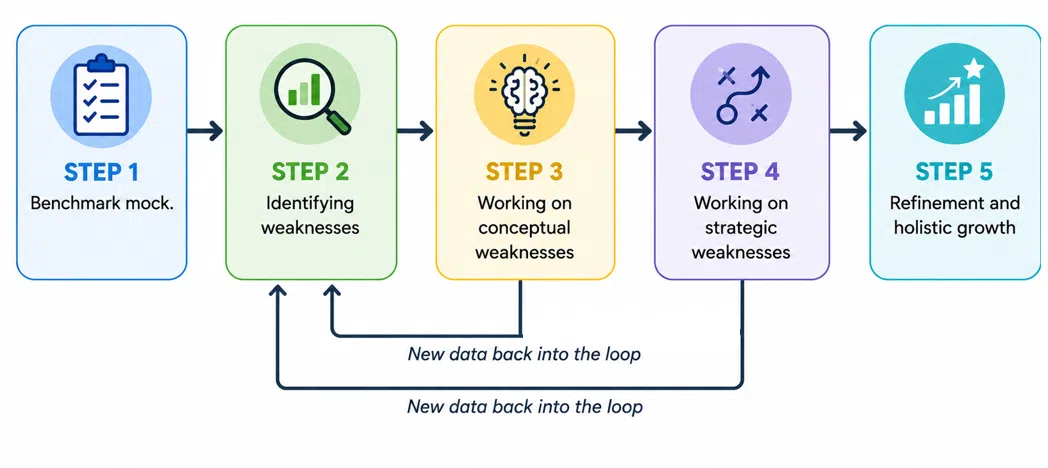
Start with a Benchmark mock test, identify your weak points, work systematically to improve them, and then focus on advanced strategies that maximize performance. Most students benefit from structured learning through GMAT Online Coaching, which provides the guidance and accountability needed to accelerate progress.
Ultimately, you should prepare for the GMAT for the amount of time that it takes you to get your desired scores in mocks consistently. If you want a 700+ score, prepare until you consistently start seeing 700+ scores in your mock tests.