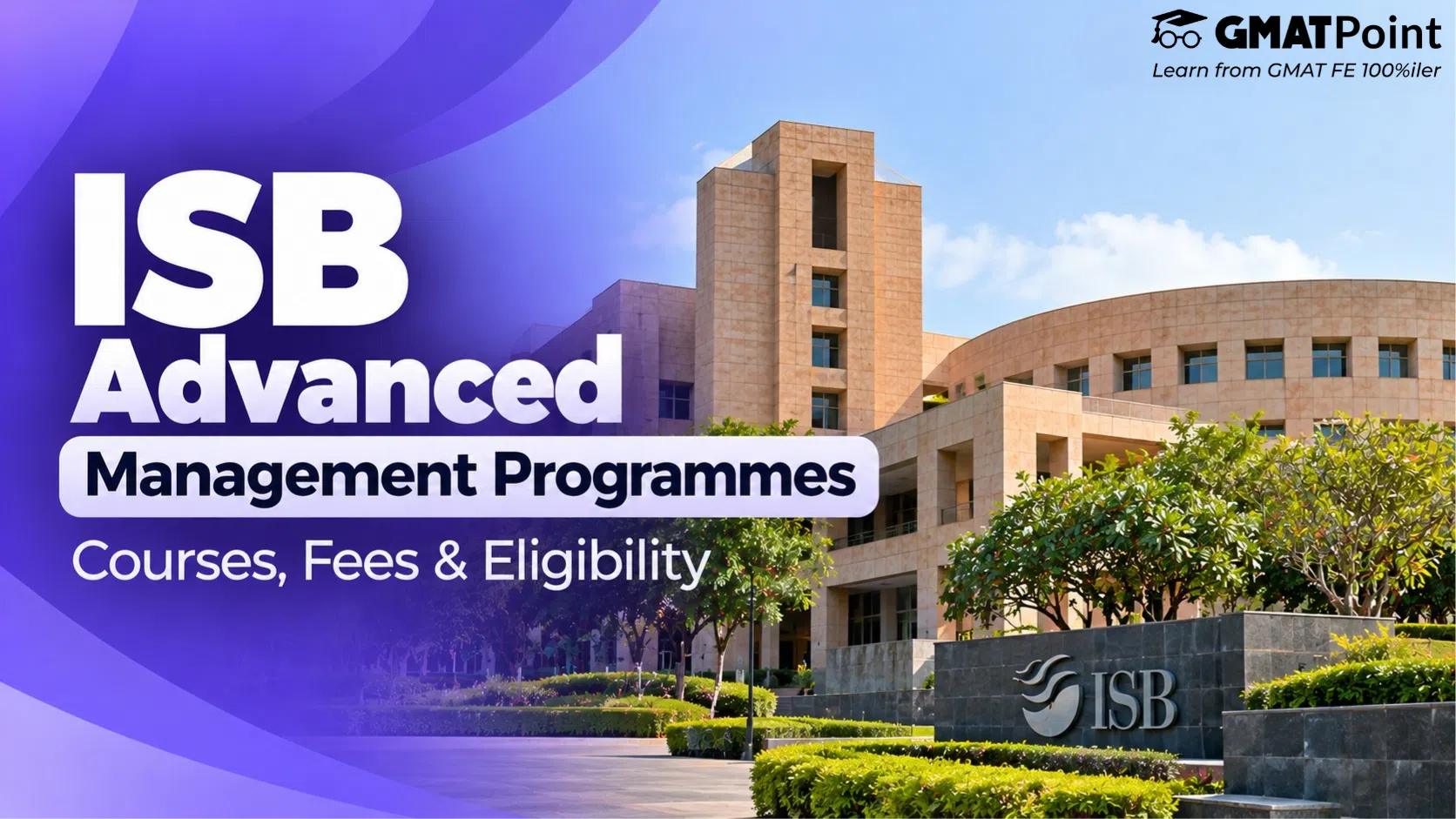

ISB offers Advanced Management Programmes (AMPs) for working professionals who want to build specialised management expertise in a specific domain. Rather than being a single course, the ISB AMP portfolio includes five programmes covering Business Analytics, Operations and Supply Chain, Healthcare, Infrastructure, and Public Policy.
Each programme is designed for a different professional profile and varies in curriculum, work experience requirements, duration, and admission criteria. This guide explains the different ISB Advanced Management Programmes, their fees, eligibility, learning format, and who each programme is best suited for.
Download the Free ISB Programmes PDF to compare eligibility, work experience, fees, entrance tests, deadlines, placements and other important details in one place!
What Are ISB Advanced Management Programmes?
ISB Advanced Management Programmes (AMPs) are domain-specific management programmes designed for working professionals who want to deepen their expertise in a particular field or industry. Unlike a general-management MBA, these programmes focus on specialised knowledge, leadership, and practical application within a specific domain.
ISB currently offers five Advanced Management Programmes:
- Advanced Management Programme in Business Analytics (AMPBA)
- Advanced Management Programme in Operations and Supply Chain (AMPOS)
- Advanced Management Programme for Healthcare (AMPH)
- Advanced Management Programme for Infrastructure (AMPI)
- Advanced Management Programme in Public Policy (AMPPP)
These programmes use a blended learning format that combines on-campus sessions with live virtual learning. This structure allows participants to continue working while pursuing the programme. However, candidates should also account for the time required for campus residencies, online sessions, assignments, projects, and independent study.
ISB AMPs should not be confused with ISB's Post Graduate Programme (PGP). They are specialised programmes rather than general-management MBA programmes, and the credential awarded depends on the programme. For example, AMPBA participants receive a certificate and transcript upon successfully completing the programme rather than a master's degree.
The right ISB AMP therefore depends on your professional background, work experience, desired specialisation, and long-term career goals.
One of the test scores accepted for getting into an AMP program is a GMAT score. To understand your current GMAT score level and how that compares to the scores from batches at ISB, check out: Free GMAT Mock Test by 100 Percentiler
ISB Advanced Management Programmes: Courses, Fees and Duration
The five ISB Advanced Management Programmes cater to professionals from different industries and functions. Their duration ranges from 12 to 15 months, while work experience requirements vary depending on the programme.
The following table provides a comparison of the five programmes.
Programme | Full Name | Primary Focus | Duration | Work Experience | Format | Indicative Programme Fees* |
AMPBA | Advanced Management Programme in Business Analytics | Business Analytics, Data & AI | 15 months | 2+ years | On-Campus + Live Virtual | ₹12.5-14 lakh |
AMPOS | Advanced Management Programme in Operations and Supply Chain | Operations, Manufacturing & Supply Chain | 12 months | 5+ years preferred with UG; | On-Campus + Live Virtual | ₹13.5-15 lakh |
AMPH | Advanced Management Programme for Healthcare | Healthcare Management | 12 months | 3+ years | On-Campus + Live Virtual | ₹14.5-16 lakh |
AMPI | Advanced Management Programme for Infrastructure | Infrastructure Management | 12 months | 5+ years preferred with UG; | On-Campus + Live Virtual | ₹11.5-13 lakh |
AMPPP | Advanced Management Programme in Public Policy | Public Policy | 12 months | 5+ years | On-Campus + Live Virtual | ₹16.5-17 lakh |
*Fees are indicative and may vary by intake. Applicants should check ISB's official programme pages for the latest tuition fee, applicable taxes, security deposit, and other charges.
To improve your chances of admission to ISB’s AMPBA, one of the ways is to secure a high GMAT score. To do this, aspirants are recommended to use study materials curated by experts and top scorers. GMAT Courses by 100 Percentiler can help aspirants study using GMAT-relevant material which can help improve GMAT performance.
Key Differences Between ISB's Five Advanced Management Programmes
AMPBA is the longest of the five programmes at 15 months and has the lowest work experience threshold at 2+ years. Its curriculum focuses on business analytics, data, artificial intelligence, and the application of analytical tools to business decisions.
AMPOS is a 12-month programme designed primarily for professionals working in operations, manufacturing, logistics, and supply chain. Candidates with an undergraduate degree are generally expected to have more extensive professional experience, while postgraduates, entrepreneurs, and consultants can be eligible with three or more years of experience.
AMPH is a 12-month healthcare-focused programme requiring at least three years of professional experience. It is intended for professionals who want to develop management and leadership capabilities relevant to healthcare organisations and the wider healthcare ecosystem.
AMPI is a 12-month programme for professionals working in infrastructure and related sectors. Like AMPOS, its experience criteria differ depending on the applicant's academic and professional profile.
AMPPP is a 12-month programme aimed at experienced professionals interested in public policy, policy design, implementation, and leadership.
To understand the differences between ISBs 5 AMP programs, read this detailed PDF:
Download the Free ISB Programmes PDF to compare eligibility, work experience, fees, entrance tests, deadlines, placements and other important details in one place!
Who Should Apply for ISB AMP?
An ISB Advanced Management Programme is best suited to working professionals who already have some clarity about the industry or function in which they want to develop deeper expertise. Since each programme serves a different professional audience, the right choice should be based on your current role, previous experience, and future career direction.
Programme | Best Suited For | Key Learning/Career Focus |
AMPBA | Professionals working with data, analytics, technology or business decision-making | Analytics, AI, machine learning and data-driven business decisions |
AMPOS | Professionals in manufacturing, operations, logistics and supply chain | Operations strategy, manufacturing, supply chain and operational leadership |
AMPH | Professionals in healthcare and healthcare-delivery ecosystems | Healthcare management and leadership |
AMPI | Professionals working in infrastructure, real estate and related sectors | Infrastructure management, finance, regulation, project management and leadership |
AMPPP | Mid-career and senior professionals in public/private sectors working with policy | Policy design, implementation and public-policy leadership |
AMPBA can be particularly relevant for professionals who want to strengthen their ability to use analytics and AI in business decision-making. Its curriculum covers areas such as statistics, optimisation, forecasting, machine learning, artificial intelligence, deep learning, Generative AI, and large language models.
AMPOS is more relevant to professionals in manufacturing, services, logistics, operations, and supply chain who want to strengthen their strategic, analytical, and leadership capabilities.
AMPH is designed around the management challenges of the healthcare sector, while AMPI focuses on areas such as infrastructure project management, finance, regulation, digital transformation, public-private partnerships, and strategic planning.
AMPPP is aimed at experienced professionals whose work involves public policy, government, regulation, development, or other policy-facing roles.
To get personalised guidance on your GMAT preparation, including structured study plans, daily targets and much more, check out: GMAT Expert Mentorship
ISB AMP Eligibility and Admission Process
Eligibility for ISB Advanced Management Programmes differs across programmes. Work experience is an important requirement, but candidates should also check the academic qualifications, professional background, and assessment requirements specified for their chosen programme.
The broad eligibility and test requirements are as follows:
Programme | Work Experience | Other Important Eligibility / Test Requirements |
AMPBA | 2+ years of full-time post-graduation work experience | Relevant bachelor's/master's degree with exposure to mathematics and programming; ISB Online Admissions Test (conditional exemption) |
AMPOS | 5+ years preferred with an undergraduate degree; postgraduates, entrepreneurs and consultants with 3+ years may be eligible | Eligibility depends on academic and professional profile; GMAT is not required |
AMPH | 3+ years of professional experience | Undergraduate degree in any discipline or an eligible healthcare-related diploma; healthcare experience is preferred |
AMPI | 5+ years preferred with an undergraduate degree; postgraduates, entrepreneurs and consultants with 3+ years may be eligible | Eligibility varies according to academic and professional profile |
AMPPP | 5+ years | Intended primarily for experienced professionals interested in public policy and related fields |
For AMPBA, candidates may be required to take ISB's Online Admissions Test. An exemption may be considered for applicants submitting eligible GMAT, GRE, CAT, or NMAT scores, subject to ISB's admission criteria.
If you're considering submitting a GMAT score and want to understand your current score level before preparing, taking a Free GMAT Mock Test by 100 Percentiler can help you identify your strengths and areas that need improvement.
ISB AMP Admission Process
Although the exact selection process differs by programme, applicants can generally expect the following steps:
- Check the eligibility criteria for the specific AMP, including work experience and academic requirements.
- Complete the online application with the required personal, academic, and professional information.
- Submit educational records, résumé, employment details, and other documents requested by the programme.
- Complete the applicable admissions assessment or check whether you qualify for an exemption, where relevant.
- Attend an interview if shortlisted or required by the programme.
- Check the official programme page for current application rounds, deadlines, selection updates, and enrolment instructions.
Meeting the work experience requirement alone does not necessarily guarantee eligibility. Applicants should review all programme-specific requirements before applying.
Which ISB Advanced Management Programme Is Right for You?
There is no single "best" ISB Advanced Management Programme. The right programme depends on your existing professional experience, the skills you want to build, and where you want your career to move next.
- Choose AMPBA if your work involves analytics, data, AI, technology, or data-driven business decisions and you want to strengthen both technical and business analytics capabilities.
- Choose AMPOS if you work in operations, manufacturing, logistics, or supply chain and want to develop stronger operational, strategic, and leadership capabilities.
- Choose AMPH if you work in healthcare or a related field and want management knowledge tailored to healthcare organisations and delivery systems.
- Choose AMPI if you work in infrastructure, real estate, or large-scale projects and want to strengthen your understanding of management, finance, strategy, project execution, and regulation.
- Choose AMPPP if your work involves government, public policy, regulation, development, or policy-facing roles and you want deeper expertise in policy design and implementation.
Candidates should therefore start with their career objective rather than choosing an AMP based solely on the ISB brand or programme fee.
If you’re evaluating ISB AMPs and other programmes that can be accessed through the GMAT and need guidance regarding score improvement, profile evaluation, b-school shortlisting and much more guidance from a trusted expert, check out: GMAT Expert Mentorship
Is the ISB Advanced Management Programme Worth It?
An ISB Advanced Management Programme can be worth considering for experienced professionals who want specialised management education without stepping away from their careers for a conventional full-time MBA. However, its value depends heavily on whether the chosen specialisation aligns with your existing experience and long-term career goals.
Advantages of ISB Advanced Management Programmes
- Specialised management education: Each programme focuses on a particular industry or function, allowing professionals to develop knowledge directly relevant to their field.
- Blended learning structure: The combination of campus sessions and live virtual learning makes it possible for participants to continue working while studying.
- Faculty and peer network: Participants get opportunities to learn from ISB faculty and interact with experienced professionals from relevant industries and functions.
- Applied learning: Programmes include practical components that help participants connect management concepts with real workplace challenges.
- Career-relevant skills: The specialised curriculum can be valuable for professionals who already know the domain in which they want to grow.
Trade-Offs to Consider
- Specialised rather than broad: Unlike a general-management MBA, an AMP focuses heavily on a particular domain. It may therefore not be the right option for someone seeking broad exposure across multiple business functions.
- Significant time commitment: The flexible format does not mean the programmes require little time. Participants may need to manage campus residencies, virtual classes, assignments, projects, and independent study alongside work.
- Financial commitment: With indicative programme costs ranging from around ₹11.5 lakh to ₹17 lakh, candidates should consider whether the curriculum and professional benefits justify the investment for their individual career goals.
- No conventional campus placement model: ISB AMPs should not be evaluated using the placement packages commonly associated with full-time MBA programmes. These programmes are primarily intended for working professionals and do not follow the same campus-placement model.
- Specialisation fit matters: A programme can provide limited value if its curriculum does not align with your professional background or future career direction.
Therefore, an ISB AMP is likely to make the most sense for professionals who want to deepen their expertise within a specific industry or function while continuing to work. Someone primarily seeking a broad MBA experience, a major career reset, or a placement-driven programme may need to compare the AMP route with full-time MBA options before deciding.
Conclusion
ISB's five Advanced Management Programmes cater to distinct professional profiles. AMPBA focuses on Business Analytics and AI, AMPOS on Operations and Supply Chain, AMPH on Healthcare, AMPI on Infrastructure, and AMPPP on Public Policy. The programmes also differ in their work experience requirements, curriculum, duration, and admission criteria.
Before applying, candidates should compare their professional experience, current field, desired skills, programme cost, learning commitment, and long-term career goals. Since fees, admission requirements, and application timelines can change between intakes, applicants should also verify the latest programme-specific information on ISB's official website before submitting an application.




























![ISB Programmes Full Breakdown 2026: Compare PGP, PGP YL, Fees & Placements [Free PDF]](https://gmatpoint.com/media/ISB_PDF_Banner.webp "ISB Programmes Full Breakdown 2026: Compare PGP, PGP YL, Fees & Placements [Free PDF]")