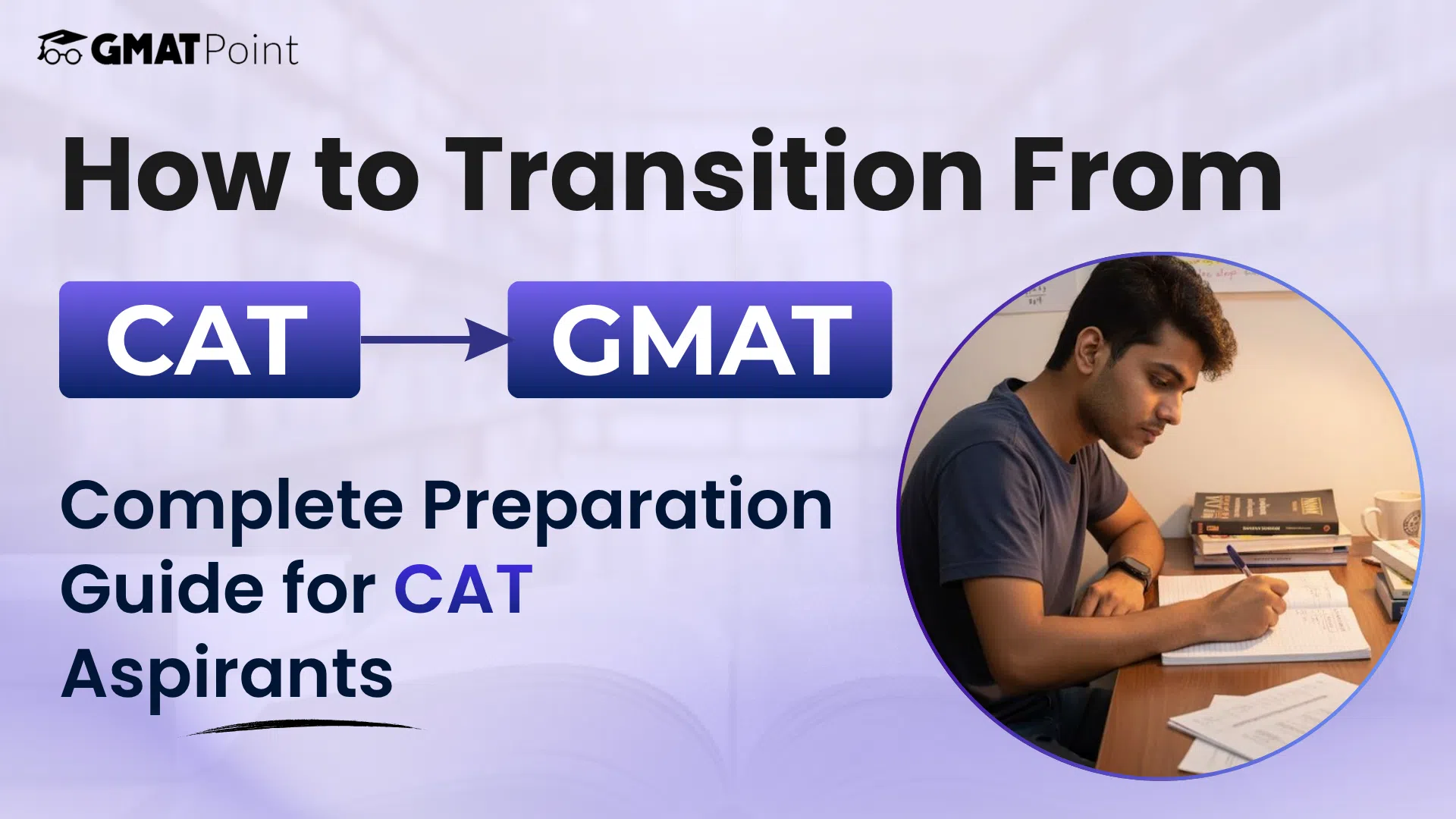


Many CAT aspirants also plan to take the GMAT, especially if they are considering MBA programmes both in India and abroad. However, preparing equally for CAT and GMAT at the same time may not be the most efficient strategy.
CAT preparation gives you a strong foundation in areas such as Quantitative Ability, Reading Comprehension, Data Interpretation and analytical reasoning. However, the GMAT has its own format, question types and test-taking requirements.
The right CAT-to-GMAT transition therefore depends heavily on one question: When are you planning to take the GMAT?
Someone targeting the GMAT in early December will need a very different strategy from someone planning to take it in February or March. Once you fix your approximate GMAT date, you can decide how much GMAT familiarity you need before CAT and how much dedicated preparation can wait until afterward.
Download GMAT 3 Month Study Plan PDF
Should You Prepare for GMAT Alongside CAT or After CAT?
For most CAT aspirants, CAT should remain the main priority until CAT day. There is significant overlap in the underlying skills tested by the two exams, so spending equal time on CAT and GMAT before CAT is usually unnecessary.
However, your planned GMAT date should determine how much exposure you have to the GMAT before CAT.
If you plan to take the GMAT in December or January, it is useful to understand the GMAT format, question types and testing experience before you finish your CAT preparation. This does not mean starting full-fledged parallel GMAT preparation. Instead, spending a couple hours per week becoming familiar with the exam can make the post-CAT transition smoother. If your GMAT attempt is in February 2027 or later, you can devote almost all your attention to CAT for now and begin dedicated GMAT preparation after CAT.
Planned GMAT Attempt | What to Do Before CAT |
December 2026 | Prioritise CAT, but build basic GMAT familiarity |
January 2027 | Prioritise CAT, with limited weekly GMAT familiarisation |
February 2027 or later | Focus almost entirely on CAT until CAT is over |
To get personalised expert guidance for your GMAT attempt, b-school applications, profile evaluation and building structured study plans, check out: GMAT Expert Mentorship.
When Should You Take the GMAT?
Before planning your GMAT preparation after CAT, first choose your target GMAT month. Then narrow it down further to an approximate 10-day window.
For example, instead of simply saying, “I will take the GMAT in December,” decide whether you are targeting December 1-10, December 11-20 or December 21-31.
This matters because CAT 2026 is scheduled for November 29, 2026. A GMAT attempt in the first week of December leaves almost no dedicated transition period after CAT, while a late-January attempt gives you close to two months.
Target GMAT Window | Approx. Time After CAT 2026 | Recommended Pre-CAT Approach |
December 1-10 | 2-11 days | Simultaneous Prep |
December 11-20 | 12-21 days | CAT priority + GMAT familiarity |
December 21-31 | 22-32 days | CAT priority + GMAT familiarity |
January 1-10 | 33-42 days | CAT priority + limited GMAT familiarity |
January 11-20 | 43-52 days | CAT priority + limited GMAT familiarity |
January 21-31 | 53-63 days | CAT priority + limited GMAT familiarity |
February onward | 64+ days | Full CAT focus is reasonable until CAT |
These are planning guidelines, not fixed preparation timelines. Two months do not automatically guarantee that you will be ready for your target GMAT score, nor does an early-December attempt automatically mean that you cannot be ready.
The amount of preparation you need will depend on your starting level, target score, GMAT familiarity, strengths, weaknesses and available study time. To check your current GMAT score level and compare it with the scores required for your dream b-schools, consider taking the Free GMAT Mock Test by 100 Percentiler.
What Should You Do Before CAT If Your GMAT Is Before February?
If you plan to take the GMAT in December or January, you do not necessarily need full-fledged GMAT preparation before CAT. Instead, use a small amount of time each week to make sure the exam does not feel completely unfamiliar once CAT is over.
Around two hours per week can be used to:
- Understand the GMAT exam structure and sections.
- Learn what the major GMAT question types look like.
- Familiarise yourself with Critical Reasoning and Data Insights.
- Understand the GMAT scoring scale and adaptive testing format.
- Learn how pacing differs from CAT.
- Understand features such as Question Review & Edit, which lets you review questions at the end of a section and change up to three answers if you have time remaining.
You can also attempt Two Free Full-Length GMAT Mocks before CAT. The objective at this stage is not to maximise your GMAT score or immediately fix every weakness. It is to experience the exam under timed conditions and identify areas that may require attention once CAT is over.
Quick GMAT Breakdown
The current GMAT has 64 questions across three 45-minute sections, with a total testing time of 2 hours and 15 minutes, plus one optional 10-minute break.
GMAT Section | Questions | Time |
Quantitative Reasoning | 21 | 45 minutes |
Verbal Reasoning | 23 | 45 minutes |
Data Insights | 20 | 45 minutes |
Total | 64 | 2 hours 15 minutes |
Quantitative Reasoning contains Problem Solving questions, while Verbal Reasoning tests Reading Comprehension and Critical Reasoning.
Data Insights includes five major question formats: Data Sufficiency, Multi-Source Reasoning, Table Analysis, Graphics Interpretation and Two-Part Analysis.
Verbal Reasoning includes Reading Comprehension and Critical Reasoning.
The GMAT Total Score ranges from 205 to 805, with Quantitative Reasoning, Verbal Reasoning and Data Insights contributing equally to the Total Score.
For a CAT aspirant, the objective before CAT is not to prepare seriously for two exams at once. It is to make sure that when CAT finishes, you are not discovering the GMAT from scratch.
The best way to transition from CAT to GMAT, for conceptual prep, is to use a dedicated course, designed for transitioning candidates.
Check out: CAT to GMAT Transition Course
What If Your GMAT Attempt Is in February or Later?
If you are targeting the GMAT in February or later, you generally do not need to divide serious preparation time between CAT and GMAT before CAT. CAT should receive the majority of your attention, particularly during the final phase of mock-taking, analysis and revision. Starting intensive GMAT-specific preparation too early may create unnecessary context-switching when CAT is the more immediate exam.
After CAT, you can take a Free GMAT Full-Length Mock to establish your starting level across Quantitative Reasoning, Verbal Reasoning and Data Insights. Your preparation plan can then be built around the results.
There is no universal number of weeks required to prepare for the GMAT. Your timeline depends on factors such as:
- Your starting GMAT level.
- Your target score.
- Your strengths and weaknesses across the three sections.
- The amount of time you can study each day.
- How familiar you already are with GMAT-specific question types.
Delaying dedicated GMAT preparation until after CAT does not mean delaying the decision about when to take the GMAT. If February or later is your target, decide on your approximate test window beforehand so that you can begin the transition immediately after CAT.
You should also have a study plan that is based on your timeline, current score, target score, and other factors. If you;re looking for a course that breaks down daily targets according to your timelines, check out: GMAT Courses by 100 Percentiler.
How Do You Transition from CAT Preparation to GMAT Preparation?
CAT preparation means you are not starting GMAT preparation from zero. Several of the skills you develop for CAT transfer well to the GMAT.
However, CAT preparation alone is not sufficient. The next step is to identify what transfers and what needs GMAT-specific preparation.
CAT Quantitative Ability gives you a useful base in arithmetic, algebra and analytical problem-solving. GMAT Quantitative Reasoning contains 21 Problem Solving questions, but the question style, pacing and reasoning required can differ from CAT. A calculator is not available in the Quantitative Reasoning section.
CAT VARC also provides useful Reading Comprehension experience. However, GMAT Verbal Reasoning additionally places significant emphasis on Critical Reasoning, where you need to analyse arguments, assumptions and evidence.
Similarly, CAT DILR develops data interpretation and logical reasoning skills, but GMAT Data Insights uses five defined formats: Data Sufficiency, Multi-Source Reasoning, Table Analysis, Graphics Interpretation and Two-Part Analysis.
CAT Preparation Area | What Transfers to GMAT | What Needs GMAT-Specific Preparation |
Quantitative Ability | Arithmetic/algebra foundations and analytical thinking | GMAT Problem Solving style, pacing and reasoning |
VARC | Reading comprehension and passage analysis | Critical Reasoning and argument analysis |
DILR | Data interpretation and analytical thinking | GMAT-specific Data Insights question formats |
Mocks | Test stamina and analysis discipline | GMAT format, adaptive testing and GMAT-specific pacing |
Your post-CAT transition should therefore focus on the areas where the two exams differ rather than unnecessarily restarting everything from the basics.
For CAT aspirants looking for a structured transition, the GMATPoint CAT to GMAT Transition Course focuses specifically on Critical Reasoning and Data Insights.
It is designed as a focused 10-day CAT-to-GMAT transition course with:
- 37 concept videos.
- 15 Data Insights videos.
- 22 Critical Reasoning videos.
- 90+ Data Insights tests.
- 70+ Critical Reasoning tests.
- 10 Data Insights sectional tests.
- 10 full-length GMAT mocks.
The idea is to build on what you have already learned for CAT while concentrating your time on the GMAT-specific gaps that still need work.
How Should You Plan Your GMAT Date, Mocks and Test Centre Slot?
Once you decide to take the GMAT after CAT, avoid leaving the test date as a vague future plan.
A simple way to create your timeline is:
- Pick your target GMAT month.
- Narrow it down to an approximate 10-day window.
- Check available GMAT appointments.
- Work backward from that window to plan your preparation and mocks.
If you are targeting a date between December and March, check appointment availability early, especially if you prefer a particular test centre, date or time. GMAT appointments are available year-round, but availability can vary by location and time of the year.
Appointments are typically available up to six months in advance, although exact availability depends on the location.
Keep a small range of acceptable dates rather than relying on one fixed appointment. This gives you flexibility if your preferred slot is unavailable or your preparation takes slightly longer than expected.
Conclusion
The CAT-to-GMAT transition does not need to involve preparing intensively for both exams at the same time. A simpler framework is:
Fix your GMAT window → decide whether pre-CAT GMAT familiarity is needed → complete CAT → begin GMAT-specific preparation → use mocks to guide the final phase.
If you are targeting the GMAT in December or January, keep CAT as your priority but build some GMAT familiarity before CAT.
If you are targeting February or later, CAT can remain almost entirely your focus until the exam is over.
Whichever window you choose, decide on it early. Knowing when you want to take the GMAT makes it much easier to determine what you should—and should not—be doing before CAT.