
GMAT Full Form
GMAT stands for Graduate Management Admission Test. It is a standardised exam taken by students who wish to apply for an MBA or other management programs. The GMAT Exam tests skills like logical reasoning, quantitative ability, verbal skills, and data analysis. Business schools around the world use GMAT scores to assess a candidate’s readiness for graduate-level study. Read the blog till the end to have all the important information related to GMAT, including eligibility criteria, syllabus, fees, and others.
GMAT Eligibility Criteria
Candidates who want to appear in the GMAT exam must be aware of the eligibility criteria to make sure they don’t fall short while applying. One needs to be at least 18 years old to apply for the GMAT, while there is no upper limit. Check the table below for all the detailed GMAT eligibility criteria:
Eligibility Component | Requirement |
Minimum Age | At least 18 years old to schedule and take the test. If you are 13-17 years old, you can take the GMAT with written parental/guardian consent. |
Maximum Age | No upper age limit - anyone older can take the exam. |
Educational Qualification | No specific academic qualification is required to take the GMAT. (However, business schools usually require a bachelor’s degree for admission.) |
Nationality | Open to all nationalities worldwide. |
Number of Attempts | You may take the GMAT up to 5 times within a rolling 12-month period with at least 16 days between attempts. |
Work Experience | Not required to take the exam, though many MBA programs prefer it. |
Identification Requirement | Must present a valid government-issued photo ID (like a passport) on test day. |
Read More: GMAT Eligibility Criteria 2026, Reservation Criteria, Age Limit
GMAT Exam Pattern
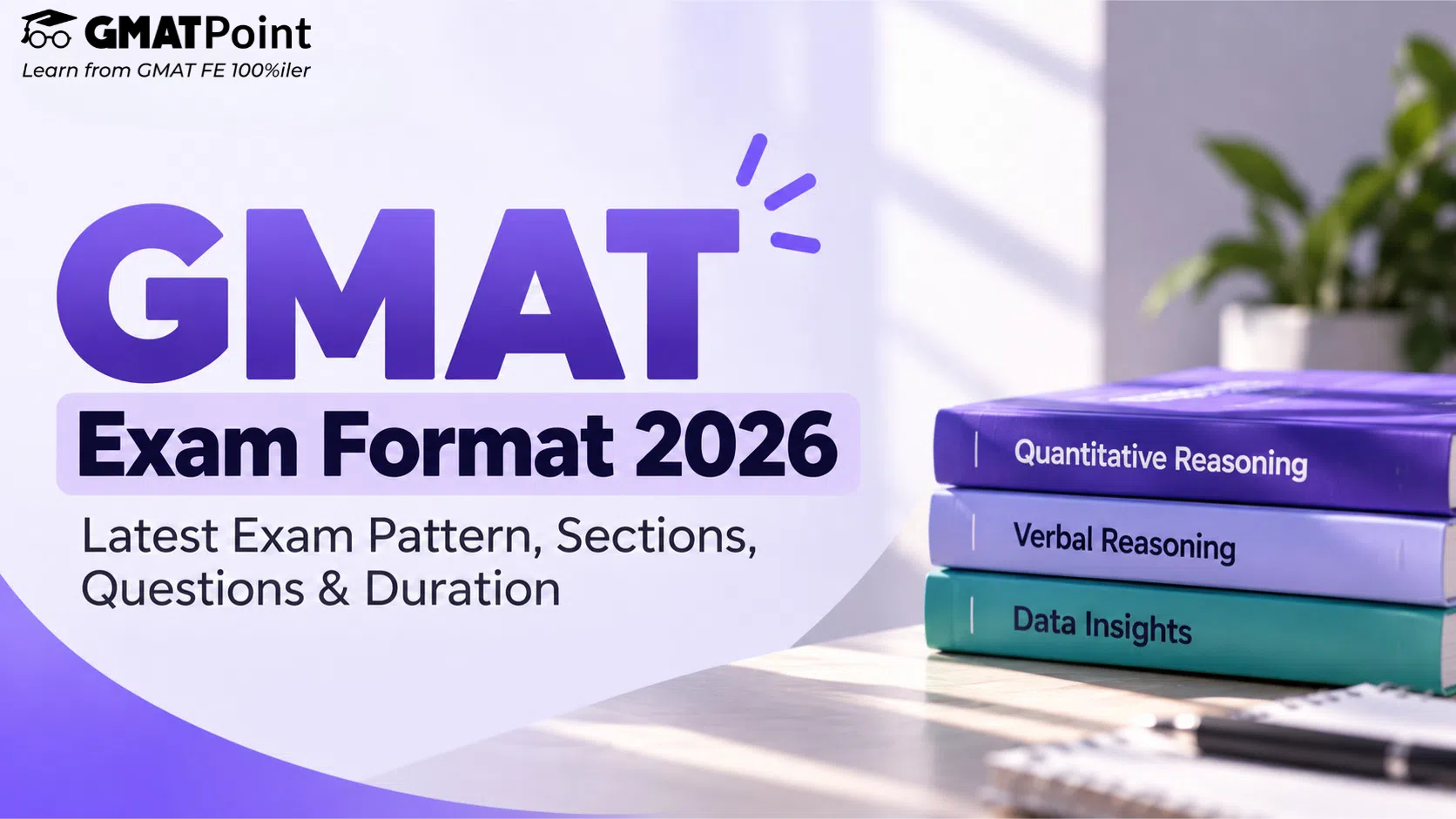
Knowing the GMAT exam pattern is very important as it will give you an understanding of the number of questions per section, the time allotted to complete the exam, and other related details. Go through the table below to have a better understanding of the GMAT exam pattern:
Section | Time Allotted | No. of Questions |
Quantitative Reasoning | 45 minutes | 21 questions |
Verbal Reasoning | 45 minutes | 23 questions |
Data Insights | 45 minutes | 20 questions |
Total Exam Time | 2 hours 15 minutes (plus one optional 10-minute break) | 64 |
Total Score Range | 205-805 | — |
Read More: GMAT Exam Structure 2026, Section-Wise Marking Scheme
GMAT Syllabus
When candidates start preparing for the GMAT exam, they need to have a proper syllabus as it helps to know what to study. Candidates can have a list of all the topics, and if possible, take a printout and mark as done once a topic is completed. It will help to track the progress. All the topics for each section is mentioned below:
Section | Main Topics Covered | Sub-Topics / Details |
Quantitative Reasoning | Arithmetic & Algebra | Properties of Integers, Fractions, Decimals, Real Numbers, Ratio & Proportion, Percentages, Powers & Roots, Descriptive Statistics, Counting Methods, Discrete Probability, Sets, Profit & Loss, Discount, Simplifying Algebraic Expressions, Equations (linear & quadratic), Exponents, Inequalities, Absolute Value, Functions |
Verbal Reasoning | Reading Comprehension & Critical Reasoning | Reading Comprehension, Critical Reasoning |
Data Insights | Data Interpretation & Reasoning | Multi-Source Reasoning, Table Analysis, Graphics Interpretation, and Two-Part Analysis |
Read More: GMAT Syllabus 2026, Exam Pattern, Section-Wise Syllabus PDF
GMAT Fees
The GMAT exam fee for the GMAT Focus Edition is USD 275 for the test taken at a test centre and USD 300 for the online GMAT exam. The fee includes sending your score to up to five business schools of your choice. Additional services such as rescheduling, cancelling, or sending extra score reports require extra payment. The GMAT Registration Fees are the same for candidates across all countries.
GMAT Score Vs Percentile
Candidates often get confused about the difference between the GMAT score and the GMAT percentile. A GMAT score is basically just the numerical score you get on your GMAT exam, and the percentile is like a comparison of your performance with that of other test-takers. So, a higher percentile would mean that you outscored a greater percentage of people who took the GMAT.
Score | Percentile Ranking |
805 | 100% |
755 | 100% |
705 | 98% |
655 | 91% |
605 | 70% |
555 | 48% |
505 | 27% |
455 | 15% |
405 | 7% |
355 | 3% |
305 | 1% |
255 | 0% |
205 | 0% |
Read More: GMAT Score Vs Percentile, Check Section-Wise Analysis
How to Register for GMAT 2026?
Before registering for GMAT 2026, candidates need to know the right and complete process to avoid mistakes. Here’s the step-by-step process for registering for GMAT 2026:
- Visit the official website: Go to www.mba.com, the official GMAT website by GMAC.
- Create an account: Sign up using your email ID and fill in basic details like name, date of birth, and nationality (must match your passport).
- Choose the exam type and location: Select GMAT Focus Edition, then choose whether you want to take the exam at a test centre or online, along with your preferred date and city.
- Confirm details and select score recipients: Review your personal details carefully and choose up to five business schools to send your GMAT scores for free.
- Pay the GMAT exam fee: Complete the registration by paying the exam fee online using a debit card, credit card, or other available payment options.
GMAT Full Form: Conclusion
The GMAT exam is very important for getting admission into MBA and management programs at top business schools around the world. Knowing the GMAT full form, eligibility, exam pattern, syllabus, and fees helps students prepare in a planned and stress-free way. The exam has clearly defined sections and flexible test rules, which allow students to show their skills in maths, verbal ability, and data analysis.
Before applying for GMAT 2026, candidates should understand how GMAT scores and percentiles work and study the exam format carefully. This helps in setting the right score goals. Completing the registration process correctly and having clear information about the exam builds confidence. With proper planning and preparation, the GMAT can help students get into top MBA colleges globally.