
GMAT 2026
The Graduate Management Admission Test (GMAT) is a standardised exam conducted by the Graduate Management Admission Council (GMAC) for admission into MBA and other management programs worldwide. GMAT 2026 follows the updated GMAT Focus Edition format, which is designed to assess analytical, quantitative, verbal, and data-interpretation skills.
This guide provides essential information about GMAT 2026 eligibility criteria, application process, registration details, syllabus, study materials, and previous year papers.
GMAT 2026 Eligibility Criteria
The GMAT 2026 has flexible and straightforward eligibility rules, making it accessible to students and working professionals from diverse backgrounds. GMAC does not impose strict academic or professional requirements, but candidates must meet certain basic conditions regarding age, identification, and the number of attempts allowed. Below are the key eligibility criteria for GMAT 2026:
- Age Requirement: The minimum age to appear for GMAT is 18 years. Candidates between 13 and 17 years old can also take the exam, but they require parental or guardian consent.
- Educational Qualification: There is no specific educational requirement to take the GMAT. However, since most MBA programs require a bachelor’s degree, students usually appear for the exam in the final year of their undergraduate studies or after completing their graduation.
- No Maximum Age Limit: There is no upper age limit for the GMAT. Anyone meeting the ID requirements can register.
- Nationality Restrictions: There are no nationality restrictions. Anyone from any country can take the exam.
- ID Requirements: A valid, government-issued ID, such as a passport or national identity card, is required on test day.
- Number of Attempts: Candidates can take the GMAT 5 times within a rolling 12-month period and a maximum of 8 times in their lifetime.
- Work Experience: GMAT itself does not require work experience, but many top business schools prefer or recommend 2-5 years of experience.
Read More: GMAT Eligibility Criteria 2026, Age Limit, Educational Qualification
GMAT 2026 Application Form
The GMAT 2026 application form is the first step for candidates planning to take the exam for admission to business schools. By creating an account on the official GMAT website and entering basic personal, educational, and identity details, candidates can complete their profile and then proceed to schedule their exam. Below are the steps involved in completing the GMAT 2026 application form:
Visit the Official Website: Candidates must first visit the GMAT official website www.mba.com and create a new account to begin the application process.
Fill Personal Information: After creating the account, candidates need to enter their personal details such as full name, date of birth, nationality, gender, email address, and phone number. All details should match the identification document to be used on exam day.
Fill Educational Background: Next, candidates must provide their educational qualifications, including the highest degree earned, the college or university name, the year of graduation, and the field of study.
Add Work Experience (Optional): Candidates may add their work experience if applicable. Although optional, this information can be helpful as business schools may access parts of the GMAT profile during the admission process.
Verify Identity Details: Candidates must verify their identity using an acceptable ID, typically a valid passport.
Review and Save Profile: After completing all the necessary sections, candidates should review all the entered details thoroughly and then save their GMAT profile.
Schedule the Exam: Once the profile setup is complete, candidates can move forward to schedule their GMAT 2026 exam by selecting their preferred date, time, and test mode (test center or online).
Read More: GMAT Exam 2026, Registration, Eligibility, Syllabus and Pattern
GMAT 2026 Registration
GMAT 2026 registration is open throughout the year, as the GMAT does not follow a fixed application or registration window. Candidates can schedule their exam at any time, depending on available dates and time slots at their preferred test center or for the online version. Below are the steps involved in completing the GMAT 2026 registration:
Log In to GMAT Account: To register, candidates must log in to their existing GMAT account or create a new one if they do not already have one.
Choose Exam Mode: After logging in, candidates must choose whether they want to take the GMAT Focus Edition at a test center or opt for the online version from home.
Select Test Center: Based on the chosen exam mode, candidates either select a test center location or confirm that their computer meets the technical requirements for the online exam.
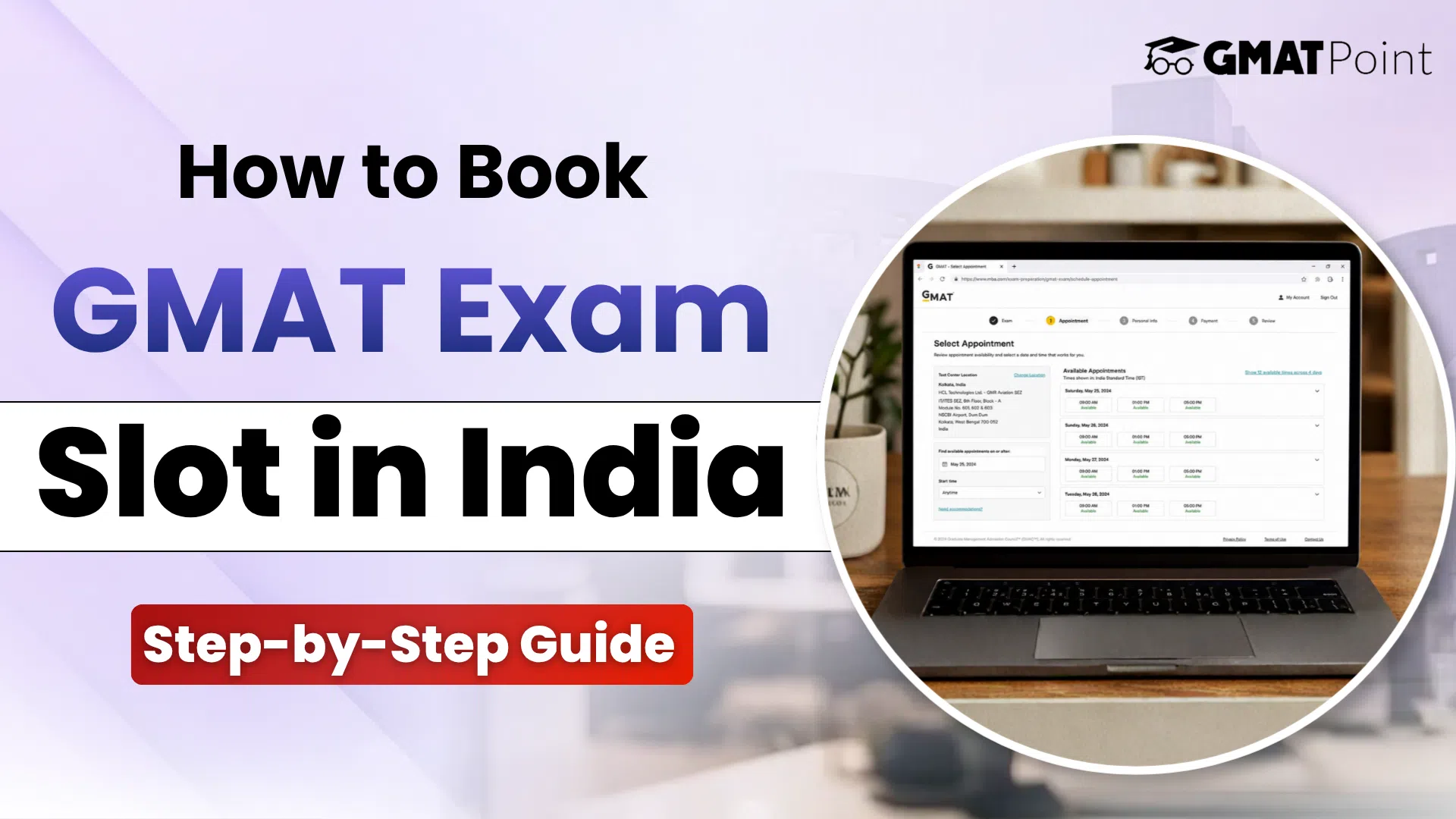
Browse and Select Exam Date & Time: Candidates can then browse the scheduling calendar to view available dates and time slots. After choosing their preferred slot, they must proceed to pay the registration fee.
Pay Registration Fee: The current GMAT Focus Edition fees are approximately:
- USD $275 for the test center exam
- USD $300 for the online exam
Note: Fees may vary slightly depending on taxes and regional pricing.
Confirmation of Exam Slot: Once the payment is successfully completed, the GMAT 2026 exam slot is officially booked.
Receive Confirmation Email: Candidates will receive a confirmation email containing important details such as the exam date, test center address (if applicable), online exam system requirements, and instructions for test-day preparation.
Read More: GMAT Registration 2026, Dates, Application Fees, How to Apply
GMAT 2026 Syllabus
The GMAT 2026 exam follows the GMAT Exam structure. It consists of three main sections: Quantitative Reasoning, Verbal Reasoning, and Data Insights. Each section is 45 minutes long, making the total testing time 2 hours and 15 minutes, with one optional 10-minute break that can be taken after either the first or second section. The exam contains a total of 64 questions across all three sections. Here is the section-wise syllabus for the GMAT 2026 exam:
- Quantitative Reasoning: The Quantitative Reasoning section includes 21 questions and evaluates the ability to solve numerical problems using arithmetic, algebra, and logical reasoning. It focuses on problem-solving rather than advanced mathematics, and includes no geometry or higher-level math. This section assesses how effectively a test-taker interprets quantitative information and derives logical solutions.
- Verbal Reasoning: The Verbal Reasoning section includes 23 questions and measures the ability to understand written text, evaluate arguments, and interpret ideas. It emphasises GMAT Reading Comprehension and GMAT Critical Reasoning. This section assesses how well passages are understood, assumptions identified, and arguments analyzed.
- Data Insights: The Data Insights section includes 20 questions and evaluates skills related to analyzing and interpreting data from tables, charts, graphs, text, and multiple data sources. It includes tasks that blend both quantitative and verbal reasoning, such as Data Sufficiency, Graphics Interpretation, Table Analysis, Two-Part Analysis, and Multi-Source Reasoning. This section focuses on comparing information, identifying trends, and solving business-related problems using the presented data.
Read More: GMAT Syllabus 2026, Exam Pattern, Section-Wise Syllabus PDF
GMAT 2026 Study Material
GMAT study material includes the latest resources designed for the updated GMAT Focus Edition format, providing accurate and relevant preparation for the exam. Students preparing for the GMAT 2026 also rely on concept-building guides from GMATPoint to strengthen fundamentals and improve problem-solving strategies.
GMAT 2026 Previous Year Papers
GMAT 2026 previous year papers help students understand how the exam looks and what types of questions are asked. They guide students about the exam pattern, difficulty level, and important topics. Practicing these papers improves speed, accuracy, and confidence. However, real GMAT previous year papersare not available because GMAC does not release actual exam questions. Instead, students can use sample papers, practice PDFs, and mock tests that follow the GMAT style.
GMATPoint provides GMAT questions and GMAT mock tests that are closest to real previous-year papers. These help students understand the real exam format. Solving these papers regularly helps students manage time better and become familiar with different types of questions. Daily practice with such papers can help achieve a good score in the GMAT 2026 exam.
GMAT 2026: Conclusion
The GMAT 2026 exam is an important step for students wanting to pursue an MBA. It's important to understand the exam's structure and requirements. By following the guidelines above, such as eligibility rules, how to apply, and the syllabus, you can make your preparation easier. Using resources like GMATPoint’s study materials, mock tests, and sample papers will help you practice and feel confident on exam day.