
Does GMAT Have Negative Marking?
The Graduate Management Admission Test (GMAT) indeed forms a very important test for aspirants looking forward to getting admitted into top schools of business all over the world. The GMAT exam was conducted by the Graduate Management Admission Council (GMAC). The GMAT exam is crucial for aspiring business school candidates around the world.
This blog provides an answer to the question “ Does GMAT Have Negative Marking?”. It also contains information about the GMAT Exam Format 2026, GMAT Syllabus 2026, and Preparation tips for the GMAT 2026
Does GMAT Have Negative Marking?. The answer in simple terms is “No”, GMAT doesn't have negative marking for wrong answers, but the wrong answers impact the difficulty level of questions. The GMAT is a computer-adaptive test, which means the GMAT changes the difficulty level of the questions based on your responses to the questions. In this way, the GMAT exam is somewhat different from other entrance exams, where you lose points for every wrong answer, but the GMAT does not take away points for every wrong answer you give.
The Impacts of Marking Wrong Answer:
Since the GMAT is a computer-adaptive test, if you mark a wrong answer, then the algorithm gives you an easier question next, which is a lower-weighted question, and this impacts the total score.
- Marking Correct answer: Then the system algorithm increases the difficulty level of the question and gives the next question as tougher, which gives you a higher score.
- Marking Wrong answer: Then the system algorithm decreases the difficulty level of the question, and the next question becomes easie,r which gives you a lower score.
The Impacts of Unanswered Questions:
Since the GMAT Exam has no negative marking for wrong answers, there is a significant penalty for unanswered questions. If you run out of time and fail to complete a section, your score will drop substantially more than if you had simply guessed incorrectly on those final few questions. So always try to answer every question, even if you are not sure about the answer. It will help to improve your score in the test.
GMAT Exam Format 2026
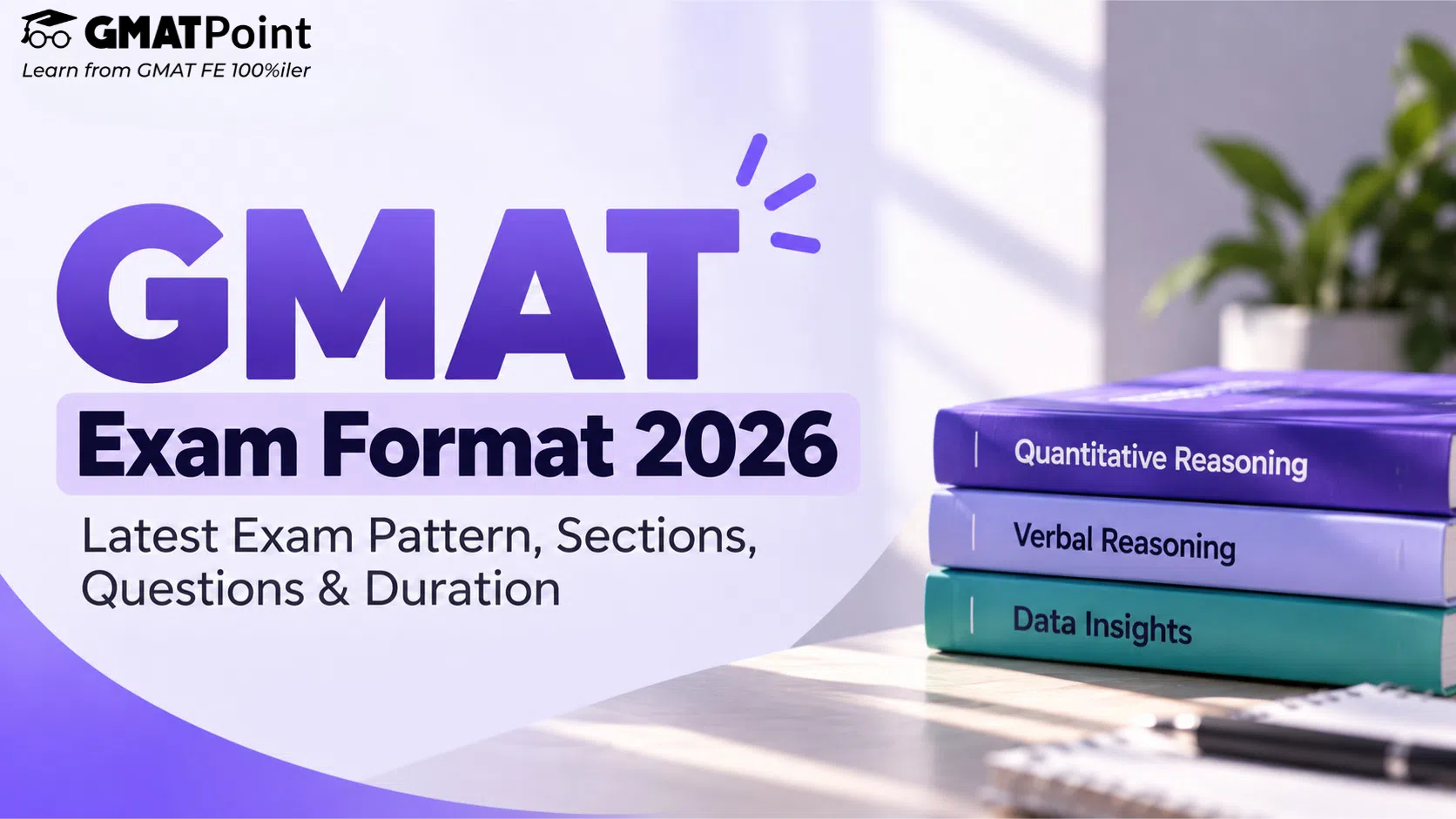
In 2023, the Graduate Management Admission Council (GMAC) replaced its old traditional GMAT exam pattern with the new GMAT Focus edition exam format, which is a shorter and modern version. In simple terms, the GMAT Focus edition is an evolved version for easier preparation and reduced syllabus load. The GMAT Focus Edition exam consists of three sections such as Verbal Reasoning, Quantitative Reasoning, and Data Insights. Below the table explaining the GMAT Focus Edition Exam format.
Section | No. Of Questions | Time Duration |
Quantitative Reasoning | 21 | 45 Minutes |
Verbal Reasoning | 23 | 45 Minutes |
Data Insights | 20 | 45 Minutes |
Total | 64 | 135 Minutes |
Read More: GMAT Exam Structure 2026, Section-Wise Marking Scheme
GMAT Syllabus 2026
The GMAT Focus Edition syllabus consists of three sections: Quantitative Reasoning (21 questions on arithmetic and algebra), Verbal Reasoning (23 questions on reading comprehension and critical reasoning), and Data Insights (20 questions focused on analyzing and interpreting data). These sections assess your mathematical, verbal, and data analysis skills.
GMAT Quantitative Reasoning Syllabus
In the GMAT Focus Edition, the Quantitative Aptitude section has 21 multiple-choice questions. These questions are from algebra and arithmetic. This section checks your calculation speed, accuracy, numerical ability, etc., and how accurately and efficiently you are able to solve tricky mathematical problems. Below are important topics from the GMAT Quant syllabus:
Arithmetic Topics | Algebra Topics |
Multiples and Factors | Monomials & Polynomials |
Number Properties | Functions |
Fractions and Decimals | Exponents & Roots |
Percentages | Quadratic Equations |
Averages | Inequalities & Basic Statistics |
Ratios and Proportions | Algebraic Expressions & Equations |
Mixtures and Allegations | Permutations and Combinations |
Pipes, Cisterns, and Work-Time | Arithmetic and Geometric Progressions |
Speed, Time, and Distance | Set Theory |
Simple & Compound Interest | Descriptive Statistics |
Probability | - |
GMAT Verbal Reasoning Syllabus
In the GMAT Focus Edition, the Verbal Ability section has 23 multiple-choice questions. This section tests your English language skills, how well you can read and understand passages, and tests your verbal ability. In this section, questions are from reading comprehension and critical reasoning. Below are important topics from the GMAT verbal syllabus :
Reading comprehension:
In this topic, questions have a 350-word passage followed by multiple-choice questions.
based on the main idea, supporting ideas, inferences, context, style, and tone.
Critical reasoning:
Critical Reasoning questions in the GMAT verbal section are based on short passages (usually under 100 words), followed by choices. These questions assess how well you can break down an argument, identify assumptions, and evaluate logic based on the information provided.
GMAT Data Insights Syllabus
The Data Insights section is the newly added part in the GMAT Syllabus. It consists of 20 questions to be answered in 45 minutes. This section measures your ability to interpret and analyse data. An on-screen calculator is available for all questions in this section. The GMAT syllabus for the Data Insights section contains the following types of questions:
Data Sufficiency: Based on two statements of data, pick the answer choice that has enough information to solve the problem.
Multi-Source Reasoning: Synthesise, compare, interpret or apply the information presented in written passages, tables, graphs, diagrams, and other types of visual representation.
Table Analysis: Determine statistics, ratios, proportions or probabilities from a given spreadsheet-like table with a drop-down menu.
Graphics Interpretation: Fill-in-the-blank questions to be answered based on given bar graphs, line graphs, scatterplots, and bubble graphs.
Two-Part Analysis: Questions comprise two problems that are connected in some way, and test your quantitative and verbal reasoning skills.
Read More: GMAT Previous Year Question Papers, Section-Wise PDFs
How is the GMAT Score Calculated?
The Total GMAT score depends on the candidate's performance in three sections, namely Quantitative Reasoning, Verbal Reasoning, and Data Insights. Each section is separately scored on a scale from 60 to 90. These individual values are input into a formula that produces a total score ranging from 205 to 805. Each section has equal weight when making up your final total. It is designed to give a more targeted assessment of the skills critical to success at business school, while reducing the overall testing time. When you get your official report, you will see your scores for each section, as well as your overall total, and your percentile rankings for each.
The GMAT score is calculated based on three important key factors:
- The number of questions you answered correctly.
- The difficulty level of the questions you answer. For example, correctly answering tougher questions gets a higher score than answering easier questions.
- Unanswered question: Leaving questions unanswered is the quickest way to reduce your score.
Read More: How to Use the GMAT Score Calculator? Check Now
How to Prepare for GMAT 2026?
The GMAT Exam 2026 preparation tips are discussed in detail below:
Go through the syllabus: The GMAT syllabus is very important. Prepare a list of all the topics on the GMAT syllabus with the breakdown of each topic in all three sections.
Set a Target Score: Set a realistic score goal based on the average GMAT scores of your target business schools.
Create a Study Plan: Allocate daily or weekly study hours and divide them among Quant, Verbal, and Data Insights sections based on your performance.
Focus on Concept Clarity: Strengthen your basics in math and reasoning before jumping into advanced-level questions.
Practice with More Mock Tests: Try to solve a maximum number of questions with the exact exam time Duration. The GMAT mock tests are a way to see how well you are prepared for the actual test. GMAT mock tests are very useful for improving your speed and accuracy on the GMAT.
Analysing the mistakes: It will help you see where you made mistakes and what you can do to get better. You need to look at the tests and figure out what you did wrong. Then you can use that information to improve your performance on the test. Reviewing mistakes is very important because it helps you to understand what you need to work on. So always make sure to review every test and think about how you can do better next time.
Get Ready for Test Conditions: It is a good idea to take practice exams in a setting that is similar to the real thing. This will help you build up your endurance and get better at managing your time. Take exams under conditions to build up your stamina and to get confidence without exam fear.
Stay Consistent and Positive: Preparation takes time, so stay motivated, track your progress, and make small improvements each week.
Does GMAT Have Negative Marking: Conclusion
The GMAT exam is important for getting into top business schools around the world. To do well, you need to understand the exam format and how the scoring works. The GMAT is a computer-based test that doesn’t take away points for wrong answers but changes the difficulty of the questions based on how you answer. This means it’s important to answer as many questions as you can and practice within time limits to do your best.
To do well in the GMAT 2026, focus on all sections: Quantitative Reasoning, Verbal Reasoning, and Data Insights. Make sure you have a strong understanding of math, algebra, and critical reasoning, and practice analysing data. Keep practising regularly, and take mock tests to find out where you need to improve.